Monday, December 6, 2010

At climate summit, they're feeling like deserted islands


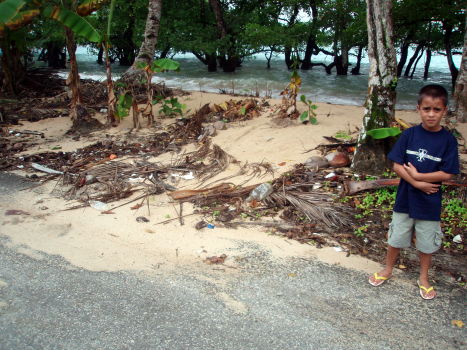
Members of the Alliance of Small Island States, already suffering the ill effects of global warming, are furious that the large nations that are the big emitters of greenhouse gases aren't doing more to ensure their survival. 

December 04, 2010
Reporting from Cancun, Mexico — In the scrum of 9,000 negotiators gathered in Cancun to wrangle over a globalclimate treaty Ronny Jumeau has no patience for diplomatic niceties.
"I won't shut up," said the pugnacious chief of the three-member delegation from Seychelles, an Indian Ocean archipelago. "Even when we're underwater, when the bubbles pop, you'll hear us  yelling.
Jumeau is a member of the Alliance of Small Island States (AOSIS), a negotiating bloc of 43 nations already suffering the ill effects of climate change: longer droughts, bigger floods, stronger hurricanes and rising seas. The countries circle the globe from the Pacific to the Caribbean to the Indian Ocean, and they are furious that the industrial nations — the big emitters of greenhouse gases — are not moving fast enough to ensure their survival. More >>>

Outside Cancún climate conference, Caribbean Sea testifies to global warming


2010 was one of the deadliest years on record for coral reefs. The Caribbean Sea just outside the Cancún climate conference offers evidence of global warming's negative effect. 

This summer’s extreme heat may seem like a distant memory as winter approaches the United States.

But the summer that broke heat records across the Northern Hemisphere is still being felt below the surface of the Caribbean Sea: 2010 will likely be one of the most deadly years on record for coral reefs.

If diplomats attending the two-week global climate change talks that opened Monday in Cancún, Mexico, want more evidence of the negative and potentially devastating affects of warming temperatures, they need look no further than the blue sea outside their hotels. Researchers say that throughout the Caribbean coral reefs are “bleaching,” a condition that occurs when they are under extreme stress due to warmer-than-normal sea temperatures. More >>>

Thursday, December 2, 2010

Modelling the Transformational Impacts and Cost of Sea Level Rise in the Caribbean


This study provides the most detailed analysis to date of the damages and costs associated with SLR for the CARICOM nations, and builds on work completed in Phase I in 2009. 
Previous economic studies as well as recent developments identified in the Economics of Climate Change Working Group (ECA) study in estimating impacts due to climate change.  The methodology incorporates top-down and bottom-up approaches (i.e., macro, meso- and micro-scales analyses) to model impacts on the economies of each CARICOM country individually.  A unique strength of this economic study is that it is based on the most detailed geographic reality of coastal geomorphology and development that determine vulnerability to SLR. 
The economic implications of the impacts of climate change and required adaptation are being increasingly quantified to better inform international negotiations regarding adaptation assistance. 
Such in-depth information is essential for the Caribbean States, SIDS and LDCs to strategically reduce vulnerability through investment, insurance, planning, and policy decisions, and inform negotiations regarding adaptation assistance under the Copenhagen Accord that was agreed at COP15 in Copenhagen.
OutputsKey Points Document - Download
Summary Document - Download

Wednesday, December 1, 2010

Future at Risk on a Hotter Planet

We are entering a new era, one of rapid and often unpredictable climate change. In fact, the new climate norm is change. The 25 warmest years on record have come since 1980. 
 
And the 10 warmest years since global recordkeeping began in 1880 have come since 1998. The effects of rising temperature are pervasive. Higher temperatures diminish crop yields, melt the mountain glaciers that feed rivers, generate more-destructive storms, increase the severity of flooding, intensify drought, cause more-frequent and destructive wildfires, and alter ecosystems everywhere. We are altering the earth's climate, setting in motion trends we do not always understand with consequences we cannot anticipate.


www.earth-policy.org/book_bytes/2010/pb4ch03_ss2


Friday, November 26, 2010

Announcing the New Worldchanging Book!


We are extremely pleased to be able to announce the new edition of Worldchanging: A User's Guide for the 21st Century, to be released this spring (and already available for discount pre-order at Powell's, Barnes and Noble, Borders and Amazon).
We struggled with whether to even call this book a new edition, rather than a new book: over half of the entries are new and most have been updated. While we weren't able to start completely from scratch (as in an ideal world one might when trying to cover so vast a range of topic), we do feel that we've been really successful in bringing many of the newest worldchanging ideas to the page. Bright green business, carbon neutral cities, passivhaus green building, product backstories, post-ownership, planetary futurism, green infrastructure, deep walkability, parallel collaboration, product-service systems, zero waste communities, retrofitting the ruins of the unsustainable... it's all in there. This is really, in many ways, the definitive statement of the Worldchanging solutions set (or as close as we can get).
The book comes with a foreword by Van Jones and an introduction by Bill McKibben, as well as with a detailed bibliography and index. The design, again, was created by our friend Stefan Sagmeister. We think Abrams has again made a beautiful book.
As with our last book, we're depending on word of mouth and reader recommendations to spread the word. So we hope that you'll share this news with others (blog it, tweet it, mention it on Facebook, or just tell your friends you're excited to read it). Once you've had a chance to read the book, we'd appreciate your positive reviews on all these sites, as well, of course. More >>>

Wednesday, November 10, 2010

A Novel Tactic in Climate Fight Gains Some Traction


WASHINGTON —November 8, 2010 — With energy legislation shelved in the United States and little hope for a global climate change agreement this year, some policy experts are proposing a novel approach to curbing global warming: including greenhouse gases under an existing and highly successful international treaty ratified more than 20 years ago.

The treaty, the Montreal Protocol, was adopted in 1987 for a completely different purpose, to eliminate aerosols and other chemicals that were blowing a hole in the Earth’s protective ozone layer. More >>>

Tuesday, November 2, 2010

Climate change challenge for computer gamers


Fate of the World, a new strategy game launched on Tuesday, could reach new audiences, say green campaigners. 

They've previously tackled alien invasions, gang violence in New York and how to raise a happy family, but this week computer games wrestle with an even more pressing issue: climate change.

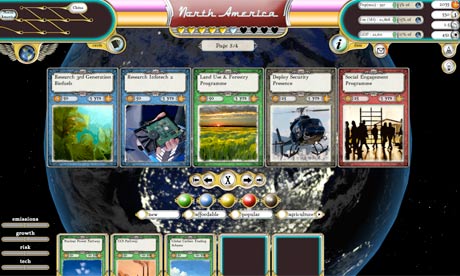
Arriving on PCs on Tuesday and Macs shortly after, the British-madeFate of the World puts players at the helm of a future World Trade Organisation-style environmental body with a task of saving the world by cutting carbon emissions or damning it by letting soaring temperatures wreak havoc through floods, droughts and fires.

The strategy game is already being hailed by gaming experts as a potential breakthrough for such social change titles, and welcomed by climate campaigners as a way of reaching new audiences. More >>>