Showing posts with label water storage. Show all posts

Wednesday, June 24, 2015

Parched Caribbean faces widespread drought, water shortages

The worst drought in five years is creeping across the Caribbean, prompting officials around the region to brace for a bone dry summer.

From Puerto Rico to Cuba to the eastern Caribbean island of St. Lucia, crops are withering, reservoirs are drying up and cattle are dying while forecasters worry that the situation could only grow worse in the coming months.

Thanks to El Nino, a warming of the tropical Pacific that affects global weather, and a quieter-than-normal hurricane season that began in June, forecasters expect a shorter wet season. That means less rain to help refill Puerto Rico's thirsty Carraizo and La Plata reservoirs as well as the La Plata river in the central island community of Naranjito. A tropical disturbance that hit the U.S. territory on Monday did not fill up those reservoirs as officials had anticipated.

Puerto Rico is among the Caribbean islands worst-hit by the , with more than 1.5 million people affected by the drought so far, according to the U.S. National Drought Mitigation Center.

Tens of thousands of people receive water only every third day under strict rationing recently imposed by the island government. Puerto Rico last week also activated National Guard troops to help distribute water and approved a resolution to impose fines on people and businesses for improper water use.

The Caribbean's last severe drought was in 2010. The current one could grow worse if the hurricane season ending in November produces scant rainfall and the region enters the dry season with parched reservoirs, said Cedric Van Meerbeeck, a climatologist with the Caribbean Institute for Meteorology and Hydrology.

"We might have serious water shortages ... for irrigation of crops, firefighting, domestic consumption or consumption by the hotel sector," he said.

The Caribbean isn't the only area in the Western Hemisphere dealing with extreme water shortages. Brazil has been struggling with its own severe drought that has drained reservoirs serving the metropolis of Sao Paulo.

In the Caribbean, the farm sector has lost more than $1 million in crops as well as tens of thousands of dollars in livestock, said Norman Gibson, scientific officer at the Trinidad-based Caribbean Agricultural Research and Development Institute.

On St. Lucia, which has been especially hard hit, farmers say crops including coconuts, cashews and oranges are withering.

"The outlook is very, very bad," said Anthony Herman, who oversees a local farm cooperative. "The trees are dying, the plants are dying ... It's stripping the very life of rivers."

Officials in Cuba say 75 percent of the island is enduring a drought that has killed cattle and destroyed thousands of hectares (acres) of crops including plantains, citrus, rice and beans. Recent heavy rains in some areas have alleviated the problem some, but all 200 government-run reservoirs are far below capacity.

In the nearby Dominican Republic, water shortages have been reported in hundreds of communities, said Martin Melendez, a civil engineer and hydrology expert who has worked as a government consultant. "We were 30 days away from the entire water system collapsing," he said.

The tourism sector has also been affected.

Most large hotels in Puerto Rico have big water tanks and some recycle wastewater to irrigate green areas, but many have curtailed water use, said Frank Comito, CEO of the Florida-based Caribbean Hotel & Tourism Association.

Other hotels have cut back on sprinkler time by up to 50 percent, said Carlos Martinez of Puerto Rico's Association of Hotels. "Everybody here is worried," he said. "They are selling water tanks like hot cakes ... and begging God for rain."

Guests at Puerto Rico's El Canario by the Lagoon hotel get a note with their room keys asking them to keep their showers short amid the water shortage. "We need your cooperation to avoid waste," says the message distributed at the front desk of the hotel in the popular Condado district.

At the Casa del Vega guesthouse in St. Lucia, tourists sometimes find the in their rooms turned off for the day, preventing them from taking a shower. "Even though we have a drought guests are not sympathetic to that," hotel manager Merlyn Compton said. More


Monday, May 25, 2015

Deciphering clues to prehistoric climate changes locked in cave deposits

It turns out that the steady dripping of water deep underground can reveal a surprising amount of information about the constantly changing cycles of heat and cold, precipitation and drought in the turbulent atmosphere above. The analysis of a stalagmite from a cave in north east India can detect the link between El Nino conditions in the Pacific Ocean and the Indian monsoon, a new study has found.

When the conversation turns to the weather and the climate, most people’s thoughts naturally drift upward toward the clouds, but Jessica Oster’s sink down into the subterranean world of stalactites and stalagmites.

That is because the assistant professor of earth and environmental sciences at Vanderbilt University is a member of a small group of earth scientists who are pioneering in the use of mineral cave deposits, collectively known as speleothems, as proxies for the prehistoric climate.

It turns out that the steady dripping of water deep underground can reveal a surprising amount of information about the constantly changing cycles of heat and cold, precipitation and drought in the turbulent atmosphere above.

As water seeps down through the ground it picks up minerals, most commonly calcium carbonate. When this mineral-rich water drips into caves, it leaves mineral deposits behind that form layers which grow during wet periods and form dusty skins when the water dries up.

Today, scientists can date these layers with extreme precision based on the radioactive decay of uranium into its daughter product thorium. Variations in the thickness of the layers is determined by a combination of the amount of water seeping into the cave and the concentration of carbon dioxide in the cave’s atmosphere so, when conditions are right, they can provide a measure of how the amount of precipitation above the cave varies over time. By analyzing the ratios of heavy to light isotopes of oxygen present in the layers, the researchers can track changes in the temperature at which the water originally condensed into droplets in the atmosphere changes and whether the rainfall’s point of origin was local or if traveled a long way before falling to the ground.

The value of this information is illustrated by the results of a study published May 19 in the journal Geophysical Research Letters by Oster’s group, working with colleagues from the Berkeley Geochronology Center, the Smithsonian Institution National Museum of Natural History and the University of Cambridge titled “Northeast Indian stalagmite records Pacific decadal climate change: Implications for moisture transport and drought in India.”

In the study, Oster and her team made a detailed record of the last 50 years of growth of a stalagmite that formed in Mawmluh Cave in the East Khasi Hills district in the northeastern Indian state of Meghalaya, an area credited as the rainiest place on Earth.

Studies of historical records in India suggest that reduced monsoon rainfall in central India has occurred when the sea surface temperatures in specific regions of the Pacific Ocean were warmer than normal. These naturally recurring sea surface temperature “anomalies” are known as the El Niño Modoki, which occurs in the central Pacific, and the Pacific Decadal Oscillation, which takes place in the northern Pacific. (By contrast, the historical record indicates that the traditional El Niño, which occurs in the eastern Pacific, has little effect on rainfall levels in the subcontinent.)

When the researchers analyzed the Mawmluh stalagmite record, the results were consistent with the historical record. Specifically, they found that during El Niño Modoki events, when drought was occurring in central India, the mineral chemistry suggested more localized storm events occurred above the cave, while during the non-El Niño periods, the water that seeped into the cave had traveled much farther before it fell, which is the typical monsoon pattern.

“Now that we have shown that the Mawmluh cave record agrees with the instrumental record for the last 50 years, we hope to use it to investigate relationships between the Indian monsoon and El Niño during prehistoric times such as the Holocene,” said Oster.

The Holocene Climate Optimum was a period of global climate warming that occurred between six to nine thousand years ago. At that time, the global average temperatures were somewhere between four to six degrees Celsius higher than they are today. That is the range of warming that climatologists are predicting due to the build-up of greenhouse gases in the atmosphere from human activity. So information about the behavior of the monsoon during the Holocene could provide clues to how it is likely to behave in the future. This knowledge could be very important for the 600 million people living on the Indian subcontinent who rely on the monsoon, which provides the area with 75 percent of its annual rainfall.

“The study actually grew out of an accidental discovery,” said Oster. Vanderbilt graduate student Chris Myers visited the cave, which co-author Sebastian Breitenbach from Cambridge has been studying for several years, to see if it contained enough broken speleothems so they could use them to date major prehistoric earthquakes in the area.

Myers found a number of columns that appear to have broken off in the magnitude 8.6 earthquake that hit Assam, Tibet in 1950. But he also discovered a number of new stalagmites that had begun growing on the broken bases. When he examined these in detail he found that they had very thick layers and high concentrates of uranium, which made them perfect for analysis.

Because of the large amount of water running into the cave, the stalagmite they choose to analyze had grown about 2.5 centimeters in 50 years. (If that seems slow, compare it with growth rates of a few millimeters in a thousand years found in caves in arid regions like the Sierra Nevada.) As a result, the annual layers averaged about 0.4 millimeters thick — wide enough for the researchers to get seven to eight samples per layer, which is slightly better than one measurement every two months. The amount of information about the climate that scientists can extract from the stalagmites and stalactites in a cave is amazing. But the value of this approach increases substantially as the number of caves that can act as climate proxies increases.

It is not a simple task. Because each cave is unique, the scientists have to study it for several years before they understand it well enough to use it as a proxy. For example, they must establish how long it takes water to move from the surface down to the cave, a factor that can vary from days to months.

Efforts to use the mineral deposits in caves as climate proxies began in the 1990’s. Currently, there are only a few dozen scientists who are pursuing this line of research and they have analyzed the mineral deposits from 100 to 200 caves in this fashion.

Story Source:

The above story is based on materials provided by Vanderbilt University. The original article was written by David Salisbury. Note: Materials may be edited for content and length.

Journal Reference:

  1. Christopher G. Myers, Jessica L. Oster, Warren D. Sharp, Ralf Bennartz, Neil P. Kelley, Aaron K. Covey, Sebastian F.M. Breitenbach. Northeast Indian stalagmite records Pacific decadal climate change: Implications for moisture transport and drought in India. Geophysical Research Letters, 2015; DOI: 10.1002/2015GL063826


Friday, January 2, 2015

A New Canal Through Central America Could Have Devastating Consequences

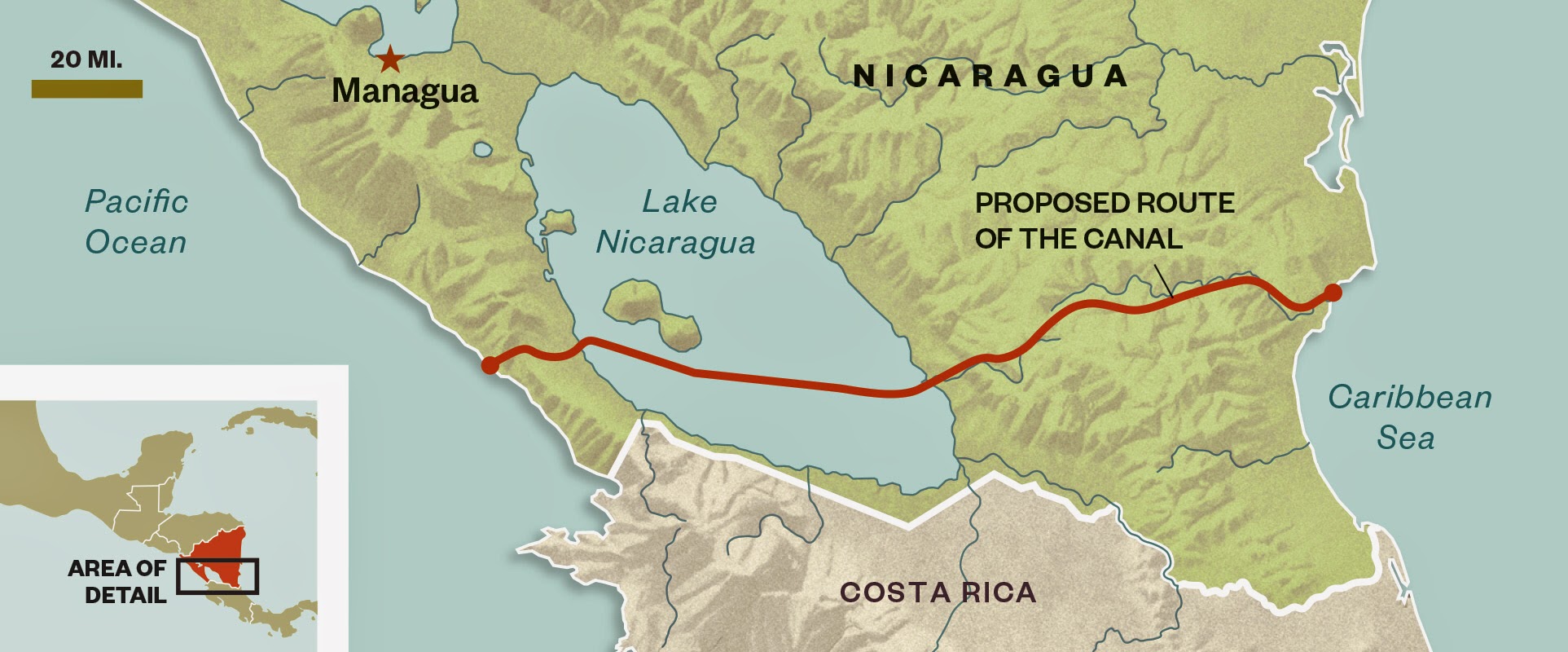
When construction crews begin digging a new canal this month across Nicaragua, connecting the Pacific and Atlantic, it’ll be a boon to global shipping and, the government says, to the economy of the second-poorest nation in the Americas.

But activists, scientists and others are increasingly alarmed by the environmental impact of a 173-mile artificial waterway—wider, deeper and three and a half times the length of the Panama Canal.

Developed by Wang Jing, an enigmatic Chinese industrialist with ties to China’s ruling party, the Grand Nicaragua Canal will cost an estimated $40 billion and take five years to build. At 90 feet deep and 1,706 feet across at its widest, the channel will accommodate the newest cargo supertankers, which are longer than the Empire State Building is tall and carry 18,000 shipping containers. The vessels are too big to pass through the Panama Canal (even after a $5 billion expansion is completed) or to dock in any U.S. port.

The new canal and its infrastructure, from roads to pipelines to power plants, will destroy or alter nearly one million acres of rainforest and wetlands. And that doesn’t include Lake Nicaragua, a beloved 3,191-square-mile inland reservoir that provides most Nicaraguans with drinking water. The canal cuts through the lake, and critics say ship traffic will pollute the water with industrial chemicals and introduce destructive invasive plants and animals.

Plus, the canal route lies in the middle of a hurricane belt, says Robert Stallard, a research hydrologist with the U.S. Geological Survey and the Smithsonian Tropical Research Institute. “You’re likely going to be looking at hurricanes vastly more powerful than anything that ever hit Panama, and ever will,” Stallard says. A storm like Hurricane Mitch, which killed 3,800 people in Nicaragua in 1998, would probably cause the canal to flood, triggering mudslides that would breach locks and dams. Communities, homes, roads and power lines would be swamped.

The Nicaraguan government has yet to release promised analyses of the canal’s likely environmental impacts, and has even dodged neighboring Costa Rica’s request to share disaster plans. “We’ve got a lack of information and a potentially big threat to the environment,” says Jorge A. Huete-Pérez, vice president of the Academy of Sciences of Nicaragua. “The government just wants to rush the thing through.” The canal’s true benefits can’t be calculated, Huete-Pérez and others argue, as long as the costs to Nicaragua’s forests, waterways and wildlife remain hidden. More


Tuesday, October 28, 2014

IPCC’s Fifth Assessment Report on Climate Change. What does it mean for the Caribbean?IPCC’s Fifth Assessment Report on Climate Change. What does it mean for the Caribbean?

The Caribbean’s response to Climate Change is grounded in a firm regional commitment, policy and strategy. Our three foundation documents – The Liliendaal Declaration (July 2009), The Regional Framework for Achieving Development Resilient to Climate Change (July 2009) and its Implementation Plan (March 2012) – are the basis for climate action in the region.

The Fifth Assessment Report (AR5) of the United Nations Intergovernmental Panel on Climate Change (IPCC) underscores the importance, scientific rigour and utility of these landmark documents. The IPCC’s latest assessment confirms the Caribbean Community’s longstanding call to limit global temperature rise to 1.5 degrees celsius as outlined in the Liliendaal Declaration. At the Nations Nation Framework Convention on Climate Change (UNFCCC) Conference of the Parties (COP) Meeting in 2009, which took place in Copenhagen, Denmark, the Caribbean Community indicated to the world community that a global temperature rise above 1.50C would seriously affect the survival of the community.

In 2010 at the UNFCCC COP Meeting in Cancun, governments agreed that emissions ought to be kept at a level that would ensure global temperature increases would be limited to below 20C. At that time, the Alliance of Small Island States (AOSIS), which includes the Caribbean, re-iterated that any rise in temperature above 1.50C would seriously affect their survival and compromise their development agenda. The United Nations Human Development Report (2008) and the State of the World Report (2009) of The Worldwatch Institute supports this position and have identified 20C as the threshold above which irreversible and dangerous Climate Change will become unavoidable.

Accordingly, the Caribbean welcomes the IPCC’s Fifth Assessment Report prepared by over 2000 eminent scientists. It verifies observations in the Caribbean that temperatures are rising, extreme weather events are occurring more frequently, sea levels are rising, and there are more incidences of coral bleaching. These climatic changes will further exacerbate the limited availability of fresh water, agricultural productivity, result in more erosion and inundation, and increase the migration of fish from the Caribbean to cooler waters and more hospitable habitats. The cumulative effect is reduced food security, malnutrition, and productivity, thus increasing the challenges to achieving poverty reduction and socio-economic development.

The report notes that greenhouse gases emissions, the cause of Climate Change, continues to rise at an ever increasing rate. Unless this trend is arrested and rectified by 2050, global temperatures could rise by at least 4°C by 2100. This would be catastrophic for the Caribbean. However, the report is not all gloom and doom. More than half of the new energy plants for electricity are from renewable resources, a trend that must accelerate substantially if the goal of limiting global warming to below 2°C by 2100 is to remain feasible.

The IPCC AR5 Report should therefore serve as a further wake up call to our region that we cannot continue on a business as usual trajectory. It is an imperative that Climate Change be integrated in every aspect of the region’s development agenda, as well as its short, medium and long-term planning. The region must also continue to aggressively engage its partners at the bilateral and multilateral levels to reduce their emissions. The best form of adaptation is reduction in emissions level.

Dr Kenrick Leslie

The IPCC will adopt the Synthesis Report of the AR5 in Copenhagen, Denmark in late October 2014. Caribbean negotiators are already preparing to ensure that the most important information from the report are captured in the Synthesis Report.

See the highlights of the Caribbean Launch of the UN IPCC AR5 Report in this video:

Learn more about the implications of the IPCC AR5 Report via www.caribbeanclimate.bz and @CaribbeanClimate.

* Dr Kenrick Leslie is the Executive Director of the Caribbean Community Climate Change Centre, the regional focal point for Climate Change.

Tuesday, September 30, 2014

We throw out more food than plastic, paper, metal, and glass

The much-anticipated U.N. Climate Summit, which began a few days ago in New York, and was ostensibly a platform for world leaders to leap frog debates over whether climate change is real, and skip straight to discussions centered around how to overcome the challenges it poses.

But it’s also an impetus for those beyond the sessions’ panels to illuminate troubling patterns of behavior that are contributing to our collective carbon footprint—and food waste is without question one of the most egregious, especially in the United States.

In 2012, the most recent year for which estimates are available, Americans threw out roughly 35 million tons of food, according to the Environmental Protection Agency. That’s almost 20 percent more food than the United States tossed out in 2000, 50 percent more than in 1990, and nearly three times what Americans discarded in 1960, when the country threw out a now seemingly paltry 12.2 million tons.

“Food waste is an incredible and absurd issue for the world today,” Jose Lopez, Nestle’s head of operations said of the issue earlier this month.

Take as percentages, not tonnage.

Roughly a third of the food produced worldwide never gets eaten. The problem is particularly egregious in developed countries, where food is seen as being more expendable than it is elsewhere. “Every year, consumers in rich countries waste almost as much food (222 million tonnes) as the entire net food production of sub-Saharan Africa (230 million tonnes),” the U.N. notes on its website.

This country is one of the worst offenders: a 2012 paper by the Natural Resources Defense Council estimated that as much as 40 percent of America’s food supply ends up in a dumpster.

The most obvious problem with this waste is that while Americans are throwing out their food, an estimated one in every nine people in the world still suffers from chronic hunger—that is, insufficient food—including more than 200 million in Sub-Saharan Africa and more than 500 million Asia. Even in the United States, where that number is significantly lower, some 14 percent of U.S. households still struggled to put food on the table for a portion of last year, according to the USDA.

The level of food waste suggests that curbing hunger isn’t a matter of producing more food so much as better preserving and distributing the food currently being produced. As the United Nations noted in its report on world hunger last week, there is actually enough food to feed all seven billion people living in the world today.

But there’s another less apparent problem with food waste: the threat to the environment. Landfills full of decomposing food release methane, which is said to be at least 20 times more lethal a greenhouse gas than carbon dioxide. And America’s landfills are full of food—organic waste is the second largest contributor to the country’s landfills. Those same landfills are the single largest producer of methane emissions in the United States—they produce almost a quarter of the country’s total methane emissions, according to the NRDC.

The environmental cost of food waste goes further than just methane emissions. Producing food is a costly affair for the environment—an estimated one third of global carbon emissions come from agriculture—but it’s one society pays to feed itself.

The price for producing food that never ends up in someone’s mouth is much more—it includes both the resources and environmental decay sacrificed for its making. The livestock industry contributes more than 15 percent of global carbon emissions, according to the U.N, which means that when Americans throw out meat, they are wasting some of the most environmentally costly food available. More

Given all the discussions concerning the creation of a new landfill here in the Cayman Islands, here a link to creating healthy soil using composted food scraps and hervested water, and helping to reduce waste going to the dump.

Read about what how you can build better soil with all that food "waste" in the WMG's Soil Resource Guide: Here or here from the Watershed Management group's site here


Monday, September 23, 2013

Children will bear brunt of climate change impact, new study says

Children will bear the brunt of the impact of climate change because of their increased risk of health problems, malnutrition and migration, according to a new study published on Monday. And food prices are likely to soar as a result of warming, undoing the progress made in combating world hunger.

The findings are published as scientists began meeting in Stockholm to produce the most comprehensive assessment yet of our knowledge of climate change. Over the next five days, the Intergovernmental Panel on Climate Change, bringing together the world's leading experts, will thrash out the final details of a message to the world's governments.

They are expected to warn that climate change is almost certainly caused by human actions, and that it will lead to a global temperature rise likely to top 2C, with related effects including the shrinking of the Arctic ice cap and glaciers, a rise in sea level by nearly 1 metre by the end of this century and more extreme rainfall in parts of the globe.

Unicef argues that, although children are more vulnerable to the effects of global warming, they have been largely left out of the debate. "We are hurtling towards a future where the gains being made for the world's children are threatened and their health, wellbeing, livelihoods and survival are compromised … despite being the least responsible for the causes," said David Bull, Unicef's UK executive director. "We need to listen to them."

Children born last year will come of age in 2030, by which time the effects of climate change in the form of an increase in droughts, floods and storms are likely to be more in evidence. In the 10 most vulnerable countries, including Bangladesh, India and the Philippines, there are 620 million children under 18.

Unicef estimates that 25 million more children will suffer malnourishment because of climate change, with a further 100 million suffering food insecurity, where they and their families are on the verge of running out. Children among the 150-200 million people estimated to have to flee their homes because of climate change will suffer more than adults because of their relative lack of resources and higher vulnerability to disease. In heatwaves, likely to grow more intense and frequent under climate change, babies and small children are more likely to die or suffer heatstroke because they find it difficult to regulate their body heat.

Separately, a report by Oxfam warned that global warming would cause rapid rises in food prices, causing severe consequences in poor countries. In pointed contrast to climate sceptics, who have seized on some of the areas of uncertainty in the IPCC assessment to claim that global warming is a far-off and minor problem, Oxfam listed recent examples of extreme weather that have caused food shortages and raised prices, quoting scientific estimates that these are likely to increase in number as warming continues. "Today one person in eight goes to bed hungry. Analysis suggests that the number of people at risk of hunger is projected to increase by 10-20% by 2050 as a result of climate change," the study found.

The authors cited the 2012 drought in Russia, which cut the grain harvest by a quarter, resulting in grain and bread prices rocketing and many farmers falling into serious debt and hardship. The same year, the worst drought in 50 years in the mid-west of the US cut maize yields by a quarter, leading to a 40% rise in prices. Two years before, the devastating Pakistan floods destroyed 570,000 hectares of crops, and 80% of food stored was lost in some areas. More


Monday, July 8, 2013

Global threat to food supply as water wells dry up, warns top environment expert

Lester Brown says grain harvests are already shrinking as US, India and China come close to 'peak water'

Iraq facing water shortages

Wells are drying up and underwater tables falling so fast in the Middle East and parts of India, China and the US that food supplies are seriously threatened, one of the world's leading resource analysts has warned.

In a major new essay Lester Brown, head of the Earth Policy Institute in Washington, claims that 18 countries, together containing half the world's people, are now overpumping their underground watertables to the point – known as "peak water" – where they are not replenishing and where harvests are getting smaller each year.

The situation is most serious in the Middle East. According to Brown: "Among the countries whose water supply has peaked and begun to decline are Saudi Arabia, Syria, Iraq and Yemen. By 2016 Saudi Arabia projects it will be importing some 15m tonnes of wheat, rice, corn and barley to feed its population of 30 million people. It is the first country to publicly project how aquifer depletion will shrink its grain harvest.

"The world is seeing the collision between population growth and water supply at the regional level. For the first time in history, grain production is dropping in a geographic region with nothing in sight to arrest the decline. Because of the failure of governments in the region to mesh population and water policies, each day now brings 10,000 more people to feed and less irrigation water with which to feed them."

Brown warns that Syria's grain production peaked in 2002 and since then has dropped 30%; Iraq has dropped its grain production 33% since 2004; and production in Iran dropped 10% between 2007 and 2012 as its irrigation wells started to go dry.

"Iran is already in deep trouble. It is feeling the effects of shrinking water supplies from overpumping. Yemen is fast becoming a hydrological basket case. Grain production has fallen there by half over the last 35 years. By 2015 irrigated fields will be a rarity and the country will be importing virtually all of its grain."

There is also concern about falling water tables in China, India and the US, the world's three largest food-producing countries. "In India, 175 million people are being fed with grain produced by overpumping, in China 130 million. In the United States the irrigated area is shrinking in leading farm states with rapid population growth, such as California and Texas, as aquifers are depleted and irrigation water is diverted to cities."

Falling water tables are already adversely affecting harvest prospects in China, which rivals the US as the world's largest grain producer, says Brown. "The water table under the North China Plain, an area that produces more than half of the country's wheat and a third of its maize is falling fast. Overpumping has largely depleted the shallow aquifer, forcing well drillers to turn to the region's deep aquifer, which is not replenishable."

The situation in India may be even worse, given that well drillers are now using modified oil-drilling technology to reach water half a mile or more deep. "The harvest has been expanding rapidly in recent years, but only because of massive overpumping from the water table. The margin between food consumption and survival is precarious in India, whose population is growing by 18 million per year and where irrigation depends almost entirely on underground water. Farmers have drilled some 21m irrigation wells and are pumping vast amounts of underground water, and water tables are declining at an accelerating rate in Punjab, Haryana, Rajasthan, Gujarat and Tamil Nadu."

In the US, farmers are overpumping in the Western Great Plains, including in several leading grain-producing states such as Texas, Oklahoma, Kansas and Nebraska. Irrigated agriculture has thrived in these states, but the water is drawn from the Ogallala aquifer, a huge underground water body that stretches from Nebraska southwards to the Texas Panhandle. "It is, unfortunately, a fossil aquifer, one that does not recharge. Once it is depleted, the wells go dry and farmers either go back to dryland farming or abandon farming altogether, depending on local conditions," says Brown.

"In Texas, located on the shallow end of the aquifer, the irrigated area peaked in 1975 and has dropped 37% since then. In Oklahoma irrigation peaked in 1982 and has dropped by 25%. In Kansas the peak did not come until 2009, but during the three years since then it has dropped precipitously, falling nearly 30%. Nebraska saw its irrigated area peak in 2007. Since then its grain harvest has shrunk by 15%."

Brown warned that many other countries may be on the verge of declining harvests. "With less water for irrigation, Mexico may be on the verge of a downturn in its grain harvest. Pakistan may also have reached peak water. If so, peak grain may not be far behind."


Sunday, May 26, 2013

CBS Breaks Climate Silence With Panel Connecting Climate Change To Extreme Weather

May 26th 2013 Over the last few years, media outlets have been among the worst offenders maintaining virtual radio silence on how extreme weather patterns may be the result of manmade climate change.


But CBS broke this so-called “climate silence” on Face the Nation Sunday, hosting a panel of meteorologists and climatologists to discuss the floods, droughts, and tornadoes that have plagued the country with increasing ferocity.

The panel — consisting of CBS meteorologist David Bernard, Chief Climatologist for Climate Central Heidi Cullen, TIME journalist Jeffrey Kluger, and President of the American Meteorological Society, Dr. J. Marshall Shepherd — didn’t shy away from addressing the overall patterns that indicate global climate change is driven by human production of carbon dioxide. “We’re getting a level of consensus on thousands of peer reviewed studies over decades that have established the human contribution to climate change,” Kluger told host Bob Schieffer.

Even as some studies suggest the potential for double-digit warming across the globe, the media has been stubbornly silent, treating climate change as an issue that is still up for political debate, instead of a scientific reality. Cullen summed up this problem well during the panel discussion, saying that addressing climate change is “the biggest procrastination problem in the sense that the longer you wait to fix it the tougher it gets to fix, so the sooner we start the better off we are.”

Members of the panel also suggested some solutions. Kluger focused on “a slow transition to renewables, the increase in mileage standards for cars,” but warned that such measures were “sort of putting out the fringes of the wildfire that’s blazing. We have to get to the heart of it and begin shut it down.” Bernard took the less optimistic, but more realistic approach, suggesting that “we have to learn to live with the way climate is going and that means responsible development. We can’t keep building in the same places that maybe more prone to floods.”

Earlier this month, as the midwest was plagued by devastating floods, only three percent of media coverage even mentioned the term “climate change.” Overall in 2012, media coverage of climate change increased slightly, though it was still down sharply from a 2009 peak. More


Monday, May 13, 2013

Climate Change in the Caribbean

Étang Saumâtre and Lago Enriquillo are saline lakes along the border between Haiti and the Dominican Republic.

Located on the floor of a rift valley which offers no outflow, incoming water is balanced only by evaporation. Water levels have been rising in recent years because of increased rainfall and increased runoff and sedimentation due to forest reduction. The higher lake levels have flooded adjacent towns and agricultural lands and have occasionally blocked the road between Haiti and the Dominican Republic. More

Rainfall may now be increasing, however, it is also possible that it may decrease in the future. All Caribbean nations therefore have to be aware of Water Security. Editor


Tuesday, April 30, 2013

How to Moderate Climate Change: Plant More Trees to Avoid Warming

How do we moderate climate change? Plant more trees. A new study reveals that plants can actually release gases that help form clouds and cool the atmosphere. That's sure to provide some incentive for drought-stricken areas.

Researchers have known for quite some time that aerosols, which are particles that float in the atmosphere, tend to cool the climate as they form cloud droplets which reflect sunlight. These aerosols can come from many different sources, including human emissions. However, the effects of a biogenic aerosol, which is particulate matter that originates from plants, aren't as well-studied.

Plants actually release gases that, after atmospheric oxidation, tend to stick to aerosol particles. This causes the original particles to grow and reflect more sunlight. This also serves as the basis for cloud droplets.

In order to understand a bit more about this phenomenon and how it might affect our climate, researchers collected data at 11 different sites from around the world. They measured the concentrations of aerosol particles in the atmosphere, along with the concentrations of plant gases and temperature. They also reanalyzed estimates for the height of the boundary layer, which is the layer of air closest to Earth in which gases and particles mix effectively. This layer actually changes with weather, which made it a key variable in the scientists' estimates.

So what did researchers find? They discovered that as temperatures rise, there's an increase of natural aerosols which have a cooling effect on the atmosphere. In other words, plants actually reacted to changes in temperature and aided in the cooling effect.

That's not going to save us from climate change, though. The effect of enhanced plant gas emissions on climate only countered about one percent of warming. However, that effect had far more of an impact on the regional scale; it could potentially counter 30 percent of warming in more rural, forested areas where anthropogenic emissions of aerosols were much lower in comparison to the natural aerosols.

While this study may show that trees won't have a major impact on cooling, it does show how they might affect something else. The research could have major implications for climate models. More


Sunday, April 28, 2013

Entering a resource-shock world

Brace yourself. You may not be able to tell yet, but according to global experts and the US intelligence community, the earth is already shifting under you. Whether you know it or not, you are on a new planet, a resource-shock world of a sort humanity has never before experienced.

Two nightmare scenarios - a global scarcity of vital resources and the onset of extreme climate change - are already beginning to converge and in the coming decades are likely to produce a tidal wave of unrest, rebellion, competition and conflict. Just what this tsunami of disaster will look like may, as yet, be hard to discern, but experts warn of “water wars” over contested river systems, global food riots sparked by soaring prices for life’s basics, mass migrations of climate refugees (with resulting anti-migrant violence) and the breakdown of social order or the collapse of states. At first, such mayhem is likely to arise largely in Africa, Central Asia and other areas of the underdeveloped South, but in time all regions of the planet will be affected.

To appreciate the power of this encroaching catastrophe, it’s necessary to examine each of the forces that are combining to produce this future cataclysm.

Resource shortages

Start with one simple given: the prospect of future scarcities of vital natural resources, including energy, water, land, food and critical minerals. This in itself would guarantee social unrest, geopolitical friction and war.

It is important to note that absolute scarcity does not have to be on the horizon in any given resource category for this scenario to kick in. A lack of adequate supplies to meet the needs of a growing, ever more urbanised and industrialised global population is enough. Given the wave of extinctions that scientists are recording, some resources - particular species of fish, animals and trees, for example - will become less abundant in the decades to come, and may even disappear altogether. But key materials for modern civilisation like oil, uranium and copper will simply prove harder and more costly to acquire, leading to supply bottlenecks and periodic shortages.

Oil - the single most important commodity in the international economy - provides an apt example. Although global oil supplies may actually grow in the coming decades, many experts doubt that they can be expanded sufficiently to meet the needs of a rising global middle class that is, for instance, expected to buy millions of new cars in the near future. In its 2011 World Energy Outlook, the International Energy Agency claimed that an anticipated global oil demand of 104 million barrels per day in 2035 will be satisfied. This, the report suggested, would be thanks in large part to additional supplies of “unconventional oil” (Canadian tar sands, shale oil and so on), as well as 55 million barrels of new oil from fields “yet to be found” and “yet to be developed”.

However, many analysts scoff at this optimistic assessment, arguing that rising production costs (for energy that will be ever more difficult and costly to extract), environmental opposition, warfare, corruption and other impediments will make it extremely difficult to achieve increases of this magnitude. In other words, even if production manages for a time to top the 2010 level of 87 million barrels per day, the goal of 104 million barrels will never be reached and the world’s major consumers will face virtual, if not absolute, scarcity.

Water provides another potent example. On an annual basis, the supply of drinking water provided by natural precipitation remains more or less constant: about 40,000 cubic kilometres. But much of this precipitation lands on Greenland, Antarctica, Siberia and inner Amazonia where there are very few people, so the supply available to major concentrations of humanity is often surprisingly limited. In many regions with high population levels, water supplies are already relatively sparse. This is especially true of North Africa, Central Asia and the Middle East, where the demand for water continues to grow as a result of rising populations, urbanisation and the emergence of new water-intensive industries. The result, even when the supply remains constant, is an environment of increasing scarcity.

Wherever you look, the picture is roughly the same: supplies of critical resources may be rising or falling, but rarely do they appear to be outpacing demand, producing a sense of widespread and systemic scarcity. However generated, a perception of scarcity - or imminent scarcity - regularly leads to anxiety, resentment, hostility and contentiousness. This pattern is very well understood and has been evident throughout human history.

In his book Constant Battles, for example, Steven LeBlanc, director of collections for Harvard’s Peabody Museum of Archaeology and Ethnology, notes that many ancient civilisations experienced higher levels of warfare when faced with resource shortages brought about by population growth, crop failures, or persistent drought. Jared Diamond, author of the bestseller Collapse, has detected a similar pattern in Mayan civilisation and the Anasazi culture of New Mexico’s Chaco Canyon. More recently, concern over adequate food for the home population was a significant factor in Japan’s invasion of Manchuria in 1931 and Germany’s invasions of Poland in 1939 and the Soviet Union in 1941, according to Lizzie Collingham, author of The Taste of War.

Resource-related conflict

Although the global supply of most basic commodities has grown enormously since the end of World War II, analysts see the persistence of resource-related conflict in areas where materials remain scarce or there is anxiety about the future reliability of supplies. Many experts believe, for example, that the fighting in Darfur and other war-ravaged areas of North Africa has been driven, at least in part, by competition among desert tribes for access to scarce water supplies, exacerbated in some cases by rising population levels.

“In Darfur,” says a 2009 report from the UN Environment Programme on the role of natural resources in the conflict, “recurrent drought, increasing demographic pressures, and political marginalisation are among the forces that have pushed the region into a spiral of lawlessness and violence that has led to 300,000 deaths and the displacement of more than two million people since 2003.”

Anxiety over future supplies is often also a factor in conflicts that break out over access to oil or control of contested undersea reserves of oil and natural gas. In 1979, for instance, when the Islamic revolution in Iran overthrew the Shah and the Soviets invaded Afghanistan, Washington began to fear that someday it might be denied access to Persian Gulf oil. At that point, President Jimmy Carter promptly announced what came to be called the Carter Doctrine. In his 1980 State of the Union Address, Carter affirmed that any move to impede the flow of oil from the Gulf would be viewed as a threat to America’s “vital interests” and would be repelled by “any means necessary, including military force”.

In 1990, this principle was invoked by President George HW Bush to justify intervention in the first Persian Gulf War, just as his son would use it, in part, to justify the 2003 invasion of Iraq. Today, it remains the basis for US plans to employ force to stop the Iranians from closing the Strait of Hormuz, the strategic waterway connecting the Persian Gulf to the Indian Ocean through which about 35 percent of the world’s seaborne oil commerce passes.

Recently, a set of resource conflicts have been rising toward the boiling point between China and its neighbours in Southeast Asia when it comes to control of offshore oil and gas reserves in the South China Sea. Although the resulting naval clashes have yet to result in a loss of life, a strong possibility of military escalation exists. A similar situation has also arisen in the East China Sea, where China and Japan are jousting for control over similarly valuable undersea reserves. Meanwhile, in the South Atlantic Ocean, Argentina and Britain are once again squabbling over the Falkland Islands (called Las Malvinas by the Argentinians) because oil has been discovered in surrounding waters. More


Saturday, April 20, 2013

Sir John Beddington warns of major global crisis by 2030

One of Britain's leading scientists is warning that the growth of the world's population will reach crisis point by the year 2030.

John Beddington, the UK government's chief scientific adviser, says food and water supplies will come under severe pressure as the Earth's population swells to 8.5 billion people.


He says the answer is in embracing new agricultural technology.


Harry Smith reports.


Monday, March 25, 2013

Tibetan Plateau glaciers shrinking

About 90 per cent of glaciers in the Third Pole region are shrinking, accelerated by black carbon being transferred from South Asia to the Tibetan Plateau, a top scientist has warned.

Change between 1968 and 2007

The Third Pole region, which is centred on the Tibetan Plateau and concerns the interests of the surrounding countries and regions, covers more than 5 million square kilometers and has an average altitude of more than 4,000 meters.

The area has the largest number of glaciers outside the polar regions and exerts a direct influence on the social and economic development of some of the most densely populated regions on earth, including China and India.

The glaciers are at the headwaters of many prominent Asian rivers.

Influenced by global warming, its alpine glaciers have seen drastic changes in recent years, such as thinning and shrinkage, which pose potential geological hazards to people both on and around the plateau.

Like Antarctica and the Arctic, the Third Pole is drawing increased attention from the international academic community, but the results of former international studies in this area are inconsistent, said Yao Tandong, director of the Chinese Academy of Sciences' Institute of Tibetan Plateau Research.

The scientist, a member of the Chinese People's Political Consultative Conference National Committee, said some people believe the glaciers will retreat and finally disappear by 2030, while others argue they will remain unchanged.

There are even people who argue that the glaciers have even moved forward, he said.

Researchers at Yao's institute say they can now draw a more comprehensive picture of the region, by showing data on the glaciers' status over the past 30 years. An investigation using topographic maps and satellite images revealed the retreat of 82 glaciers, area reduction by 7,090 glaciers and the mass-balance change of 15 glaciers.

"Systematic differences in glacier status are apparent from region to region, with the most pronounced shrinkage in the Himalayas, the southeastern part of the region.

Some of the glaciers there are very likely to disappear by 2030," Yao said. More