This blog contains articles and commentary on Climate Change / Global Warming. These changes will have an affect on the entire planet and all of us who reside therein.
Life as we know it will change drastically. There is also the view that there is a high likelihood of climate change being a precursor of conflits triggered by resource shortges.
At least one-fifth of the population of the Borrowing Member Countries (BMCs) of the Caribbean Development Bank (CDB) remains in poverty; and one out of every 10 persons is considered “food poor” or indigent. Tackling poverty is one of our Region’s biggest challenges.
Caribbean countries have joined other members of the United Nations in adopting the 2030 Agenda for Sustainable Development and agreed to 17 Sustainable Development Goals to end poverty, protect the planet and ensure prosperity for all.
The obligations under this global initiative closely align with CDB’s ongoing commitment, embedded in our Strategic Plan 2015-19, to help our BMCs to identify and exploit opportunities for achieving inclusive and sustainable growth and development. Being a catalyst for development resources and targeting the systematic reduction of poverty in our BMCs through social and economic development is the mission of CDB.
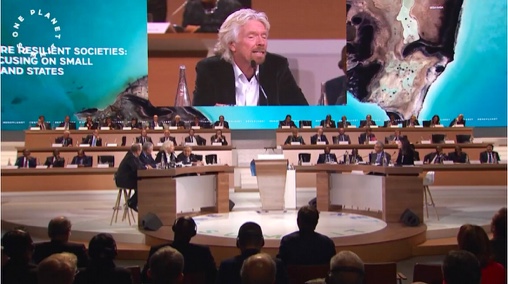
It’s been a great pleasure to be at the One Planet Summit, hosted by President Emmanuel Macron in Paris, two years after the historic agreement in the global fight against climate change. I was honoured to join my friend and partner, Prime Minister Keith Mitchell of Grenada, onstage to talk about the Caribbean Climate-Smart Coalition, and wanted to share some of my thoughts from the event with you all.
I’ve lived in the Caribbean for most of my life now, and have never seen anything like the devastation caused by Hurricanes Irma and Maria. How much more destruction is needed to show that the way we treat our planet is having serious, unacceptable consequences.
Three months on, tens of thousands of people continue to be without shelter, power and access to clean drinking water. From Puerto Rico to the BVI and Dominica, this is still very much a relief operation. But we have to start thinking beyond emergency relief and turn our attention to the islands’ long-term recovery and reconstruction. As hurricanes hit more often and with growing intensity in the Caribbean, how can we avoid destruction becoming the norm?
Caribbean economies suffer from some of the highest electricity prices in the world. Despite their abundance of renewable energy sources, Cayman has a relatively low level of renewable energy penetration; the economy continues to spend a large proportion of its GDP on imported fossil fuels.
The Caribbean Transitional Energy Conference (CTEC) is about building our resilience as a small nation, about diversifying our energy sector and the way that we do business.
It is about ensuring sustainable social and economic growth through strong leadership, recognising the threat of climate change and the vulnerability of islands across the world and voicing our commitment to take the measures that we can take now. More
Green Aruba is an annual conference born in 2010 with the specific aim to place dedicated emphasis on Aruba's energy transition to 100% fuel independence.
Besides showcasing Aruba's progress and challenges to the accelerated penetration of renewables in the total energy mix, Green Aruba also exhibits the experiences and knowledge of other institutions and island nations in this field. Over the past six years, Green Aruba has evolved into a practical and valuable well-known platform within the region for the exchange of information and applied knowledge on sustainable and best practices for the shift to cleaner, more environmentally friendly energy sources and resources.
Green Aruba VI – Share Sustainability
At this year's Green Aruba conference to be held October 27th and 28th, the main theme will focus on sharing sustainability by together confronting the common barriers we face, identifying the solutions moving forward and creating the essential roadmaps to achieve our desired growth paths of the sustainability journey for our island nations.
Aruba has made remarkable progress over the years in the penetration level of renewables and/or efficiency at production level, with in 2015 reaching close to the 20% mark. With the ongoing and upcoming planned projects operational by the end of 2017, the 40% barrier will be surpassed by 2018!
With our goal to reach 100% fuel free energy production by 2020, and in order to surpass the 40% level, it is fundamental to embark on a "deep dive" into our existing energy mix. Aruba is examining cutting-edge technologies and new business models for our utility companies, all in conjunction with our RAS framework, to create a balance between Reliable and Sustainable investments. This balancing act will only be achievable if energy production costs remain Affordable for the customer base.
Local utility stakeholders together with foreign renowned institutions are preparing for this dive known as the Aruba Renewable Integration Study (ARIS), and will present their approach and concept at the upcoming conference. The ARIS will provide models that map out the road forward towards Aruba's aspiring renewable energy goals, while maintaining grid reliability and minimizing overall system costs, and can serve as a prototype or starting point for fellow island nations. More
11 September 2015: The 9th Latin American and Caribbean Carbon Forum (LACCF 2015) concluded with calls for the use of market-based mechanisms and other forms of carbon pricing and climate finance to be included as mitigation and development tools in the global climate agreement expected to be adopted at the 21st session of the Conference of the Parties (COP 21) to the UN Framework Convention on Climate Change (UNFCCC).
The Forum, which took place from 9-11 September 2015, in Santiago, Chile, was organized by the World Bank Group, the Latin American Energy Organization (OLADE), the International Emissions Trading Association (IETA), the UN Environment Programme (UNEP) and the UNEP DTU Partnership, the Inter-American Development Bank (IADB), the UNFCCC Secretariat, the UN Development Programme (UNDP) and the Development Bank of Latin America (CAF).
It brought together key business and government representatives and other stakeholders from across the Latin America and the Caribbean (LAC) region to share, among other things: the most recent developments on carbon pricing, climate financing and green investments in LAC; and best practices and lessons learned from the implementation of the CDM in LAC.
The Forum provided a platform to showcase successful examples of the use of market-based approaches such as the Clean Development Mechanism (CDM), innovative financial instruments, and carbon pricing policies in the region. Discussions at the Forum also highlighted the need to bridge the gap between public and private sector actions so as to leverage the finance needed to address climate change in the region.
The Forum concluded, inter alia, that the expected Paris agreement should not overlook any mechanism that could be used to put the LAC region and the world on a low-carbon development pathway. [UNFCCC Press Release] [UNEP DTU Press Release] [LACCF 2015 Website] More
In the Caribbean, the CDB signed a €4.45 million grant contribution agreement with the EU-Caribbean Investment Facility (EU-CIF) in support of the Sustainable Energy for the Eastern Caribbean (SEEC) Programme, which will provide technical assistance and investment grants for sustainable energy solutions in six countries: Antigua and Barbuda, Grenada, Dominica, St. Kitts and Nevis, St. Lucia, and St. Vincent and the Grenadines. [CDB Press Release] More
In early March, Stéphane Tromilin, a sustainable energy attaché in the French government, gave a United Nations webinar on the French government’s work on French islands.
In it, he spent most of the time discussing the unique challenges of islands, specifically those in the Caribbean like Guadeloupe, but also noted an island’s value as “laboratories to develop renewable energy solutions.”
Christophe Mazurier, a European financier and climate defender, has seen these laboratories in action, specifically in the Caribbean, where he has a home in the Bahamas. While many of these nations are at greater risk of climate disasters - in the form of devastating hurricanes and other storms - than most other places on earth, many refuse to become victims of the global intransigence on climate change. Instead, many Caribbean nations are taking it upon themselves to be the change they wish to see in their developed-nation counterparts.
Guadeloupe, the overseas French territory mentioned earlier, is getting nearly 30 percent of its energy from solar, a number on par with climate leaders Germany. Aruba gets 20% of its energy from wind, and is aiming to be totally sustainable by 2020. Ten island nations, including the Bahamas, the British Virgin Islands, Grenada, Dominica and more have joined the Ten Island Challenge, launched by Richard Branson as a means to give these Caribbean island clear renewable goals and support them in meeting those goals.
Mazurier says that in many ways, the Caribbean’s move to solar was preordained. Not because they are at the forefront of climate change susceptibility, but because of their incredibly high energy costs. Most Caribbean island nations pay around 33 cents per kWh of energy, while for comparison the United States pays 10 cents per kWh. Even with the price of fuel bottoming out, and energy costs in places like Jamaica being cut in half, Jamaica and others were already well on their way to a renewable future.
In 2013, Jamaica signed a deal that would bring 36 MW of wind power for $63 million, which would help it divest from diesel oil in the long-term. By investing heavily in renewables now, the islands can avoid paying for diesel in the future… No matter how the price fluctuates. Mazurier says that this is the key for these Caribbean island nations, who don’t have multimillion dollar climate budgets. These nations cannot just throw money at the problem in hopes that they can play a role in the ultimate cooling of the climate. Their emissions are negligible in the grand scheme of things. The only aspect that can get these nations to buy in if they know they will ultimately pay less for energy than they do now. The positives for the overall climate and the state of the planet are simply a secondary byproduct of these finance-driven deals.
Whichever way it breaks out, says Mazurier, the Caribbean turn toward renewable energy is a refreshing and encouraging sign. The question now becomes: Can the larger nations take note of their island peers? More
5 February 2015: The Caribbean Centre for Renewable Energy and Energy Efficiency (CCREEE) and the Caribbean region's sustainable energy strategies were at the center stage at two Special Meetings of the Council for Trade and Economic Development (COTED) of the Caribbean Community (CARICOM).
The ministerial meetings on energy and the environment focused on the establishment of the CCREEE, regional energy coordination and sustainable energy strategies, and the post-2015 development agenda, among other themes.
The establishment of the CCREEE, which was endorsed by COTED in November 2014, was on the agenda of the Special Meetings on Energy, and Energy and the Environment, held in Georgetown, Guyana, from 4-5 February. The meetings, among other things, explored “the full ramifications and optimum exploitations of CCREEE.” CCREEE is currently in the process of being established with the assistance of the UN Industrial Development Organisation (UNIDO), Austrian Government and SIDS DOCK initiative of the Alliance of Small Island States (AOSIS). The Centre's mandate will be technical, namely to support and coordinate the execution of CARICOM's sub-regional and regional renewable energy and energy efficiency programmes, projects and activities.
Calling for a “cohesive regional effort” to achieve sustainable energy security, Chair of the Special Meeting on Energy, and Minister of Science, Technology, Energy and Mining of Jamaica Phillip Paulwell said that “although sustainable energy solutions have made great strides” in the CARICOM region, significant gaps and barriers remained in the areas of renewable energy access, energy efficiency and reliable grid development and deployment.
CARICOM Deputy Secretary-General Manorma Soeknandan similarly noted that, despite progress made, “significant additional changes” would need to be made to meet the demands for reliable, secure, efficient and cost-effective energy services, suggesting that “energy is about sustainable livelihoods and job creation alike.”
Twenty-six countries, together with seven regional and international organizations, have released a joint statement in support of the transformation of the energy systems of Caribbean countries. The signatories of the statement, signed during the Caribbean Energy Security Summit, commit to pursuing comprehensive approaches to an energy transition toward "clean sustainable energy for all" and reforms that support the creation of favourable policy and regulatory environments for sustainable energy.
The Summit, which was co-hosted by the US Department of State, the Council of the Americas and the Atlantic Council, brought together finance and private sector leaders from the US and the Caribbean, and representatives of the international community. The event showcased the initiatives under the Caribbean Energy Security Initiative (CESI) in the areas of improved governance, access to finance and donor coordination, and featured discussions by partner countries on comprehensive energy diversification strategies.
During the event, the US Government announced enhanced support for technical assistance and capacity-building programs in the Caribbean, through the Energy and Climate Partnership of the Americas (ECPA) initiative, among others, with the aim of promoting a cleaner and more secure energy future in the region. Caribbean leaders agreed to pursue comprehensive energy diversification programs and facilitate the deployment of clean energy.
Furthermore, presentations and updates were provided by, inter alia: Caribbean leaders on energy sector goals; the World Bank on a proposed Caribbean Energy Investment Network for improved coordination and communication among partners; and the US Overseas Private Investment Corporation (OPIC) on a new focus on clean energy project development in the Caribbean, which includes US$43 million in financing for a 34 MW wind energy project in Jamaica.
Highlighting the role of the Organization of American States (OAS) in supporting the transition to sustainable energy in the Caribbean, OAS Secretary General José Miguel Insulza said the past five years had seen an "unprecedented push" in the Caribbean toward the development of the region’s renewable energy sources, noting this was "doubly impressive" "in a time of low oil prices."
The Summit, which took place on 26 January 2015, in Washington, DC, US, is part of CESI, launched by US Vice President Joseph Biden in June 2014. The regional and international organizations signing the statement were the Caribbean Community (CARICOM) Secretariat, the Caribbean Development Bank, the EU, the Inter-American Development Bank (IADB), the International Renewable Energy Agency (IRENA), the OAS and the World Bank.
The joint statement was also signed by the Governments of Antigua and Barbuda, Aruba, Bahamas, Barbados, Belize, Canada, Colombia, Curacao, Dominica, Dominican Republic, France, Germany, Grenada, Guyana, Haiti, Jamaica, Mexico, New Zealand, Spain, St. Kitts and Nevis, St. Lucia, St. Vincent and the Grenadines, Suriname, Trinidad and Tobago, United Kingdom, and the United States. More
The Caribbean’s response to Climate Change is grounded in a firm regional commitment, policy and strategy. Our three foundation documents – The Liliendaal Declaration (July 2009), The Regional Framework for Achieving Development Resilient to Climate Change (July 2009) and its Implementation Plan (March 2012) – are the basis for climate action in the region.
The Fifth Assessment Report (AR5) of the United Nations Intergovernmental Panel on Climate Change (IPCC) underscores the importance, scientific rigour and utility of these landmark documents. The IPCC’s latest assessment confirms the Caribbean Community’s longstanding call to limit global temperature rise to 1.5 degrees celsius as outlined in the Liliendaal Declaration. At the Nations Nation Framework Convention on Climate Change (UNFCCC) Conference of the Parties (COP) Meeting in 2009, which took place in Copenhagen, Denmark, the Caribbean Community indicated to the world community that a global temperature rise above 1.50C would seriously affect the survival of the community.
In 2010 at the UNFCCC COP Meeting in Cancun, governments agreed that emissions ought to be kept at a level that would ensure global temperature increases would be limited to below 20C. At that time, the Alliance of Small Island States (AOSIS), which includes the Caribbean, re-iterated that any rise in temperature above 1.50C would seriously affect their survival and compromise their development agenda. The United Nations Human Development Report (2008) and the State of the World Report (2009) of The Worldwatch Institute supports this position and have identified 20C as the threshold above which irreversible and dangerous Climate Change will become unavoidable.
Accordingly, the Caribbean welcomes the IPCC’s Fifth Assessment Report prepared by over 2000 eminent scientists. It verifies observations in the Caribbean that temperatures are rising, extreme weather events are occurring more frequently, sea levels are rising, and there are more incidences of coral bleaching. These climatic changes will further exacerbate the limited availability of fresh water, agricultural productivity, result in more erosion and inundation, and increase the migration of fish from the Caribbean to cooler waters and more hospitable habitats. The cumulative effect is reduced food security, malnutrition, and productivity, thus increasing the challenges to achieving poverty reduction and socio-economic development.
The report notes that greenhouse gases emissions, the cause of Climate Change, continues to rise at an ever increasing rate. Unless this trend is arrested and rectified by 2050, global temperatures could rise by at least 4°C by 2100. This would be catastrophic for the Caribbean. However, the report is not all gloom and doom. More than half of the new energy plants for electricity are from renewable resources, a trend that must accelerate substantially if the goal of limiting global warming to below 2°C by 2100 is to remain feasible.
The IPCC AR5 Report should therefore serve as a further wake up call to our region that we cannot continue on a business as usual trajectory. It is an imperative that Climate Change be integrated in every aspect of the region’s development agenda, as well as its short, medium and long-term planning. The region must also continue to aggressively engage its partners at the bilateral and multilateral levels to reduce their emissions. The best form of adaptation is reduction in emissions level.
Dr Kenrick Leslie
The IPCC will adopt the Synthesis Report of the AR5 in Copenhagen, Denmark in late October 2014. Caribbean negotiators are already preparing to ensure that the most important information from the report are captured in the Synthesis Report.
See the highlights of the Caribbean Launch of the UN IPCC AR5 Report in this video:
Learn more about the implications of the IPCC AR5 Report via www.caribbeanclimate.bz and @CaribbeanClimate.
Étang Saumâtre and Lago Enriquillo are saline lakes along the border between Haiti and the Dominican Republic.
Located on the floor of a rift valley which offers no outflow, incoming water is balanced only by evaporation. Water levels have been rising in recent years because of increased rainfall and increased runoff and sedimentation due to forest reduction. The higher lake levels have flooded adjacent towns and agricultural lands and have occasionally blocked the road between Haiti and the Dominican Republic. More
Rainfall may now be increasing, however, it is also possible that it may decrease in the future. All Caribbean nations therefore have to be aware of Water Security. Editor
Measurements from three satellites showed that on July 8 (right) about 40 percent of the ice sheet had undergone thawing at or near the surface. In just a few days (July 12), an estimated 97 percent of the ice sheet surface had thawed. The areas classified as “probable melt” (light pink) correspond to those sites where at least one satellite detected surface melting. The areas classified as “melt” (dark pink) correspond to sites where two or three satellites detected surface melting. Nicolo E. DiGirolamo, SSAI/NASA GSFC, and Jesse Allen, NASA Earth Observatory/AP
Greenland ice, it seems, can vanish in a flash, with new satellite images showing that over just a few days this month nearly all of the veneer of surface ice atop the island's massive ice sheet had thawed.
That's a record for the largest area of surface melt on Greenland in more than 30 years of satellite observations, according toNASA and university scientists.
The images, snapped by three satellites, showed that about 40 percent of the ice sheet had thawed at or near the surface on July 8; just days later, on July 12, images showed a dramatic increase in melting with thawing across 97 percent of the ice sheet surface.
Nghiem had reason to be baffled, as this record ice-melt is well above average: About half of Greenland's surface ice tends to melt every summer, with the meltwater at higher elevations quickly refreezing in place and the coastal meltwater either pooling on top of the ice or draining into the sea. [Giant Ice: Photos of Greenland's Glaciers]
Instruments on two other satellites proved out Nghiem's findings — the Moderate-resolution Imaging Spectroradiometer (MODIS) on NASA's Terra and Aqua satellites
Data from the Special Sensor Microwave Imager/Sounder on a U.S. Air Force meteorological satellite also confirmed the mind-blowing melt.
As for what caused the disappearing ice, University of Georgia, Athens climatologist Thomas Mote suggests it could be a ridge or dome of warm air hovering over Greenland that coincided with the extreme melt.
"Each successive ridge has been stronger than the previous one," Mote said in a NASA statement. The latest in a series of these heat domes, which have dominated Greenland weather since May, began to move over Greenland on July 8, before coming to a halt over the ice sheet some three days later. By July 16, the heat dome had started to dissipate.
Signs of ice melt were even found around Summit Station in central Greenland, which at 2 miles (3.2 kilometers) above sea level is near to the highest point of the ice sheet.
"Ice cores from Summit show that melting events of this type occur about once every 150 years on average," said study researcher Lora Koenig, a glaciologist at NASA's Goddard Space Flight Center in Greenbelt, Md. "With the last one happening in 1889, this event is right on time," Koenig said in a statement.
The melting of such a huge ice sheet — spanning an area of 656,000 square miles (1.7 million square kilometers) — is important for various reasons, particularly its potential effect on sea levels. If melted completely, the Greenland ice sheetcould contribute 23 feet (7 meters) to global sea-level rise, according to a 2007 report by the Intergovernmental Panel on Climate Change (IPCC), the international body charged with assessing climate change. More
Losses could reach US$100 billion per year, according to the IDB.
BOGOTÁ, Colombia – Melting glaciers in the Andes.
Coral bleaching in the Caribbean Sea.
Extreme rains in Colombia and in the basin of the Grijalva and Usumacinta rivers, shared by Guatemala and Mexico.
They are all evidence of the impact climate change is having on Latin America and the Caribbean.
A group of researchers from the Inter-American Development Bank (IDB), in partnership with the World Wildlife Fund (WWF) and the Economic Commission for Latin America and the Caribbean (ECLAC), sought to quantify the economic impact caused by climate change in the region.
The final report, titled “The Climate and Development Challenge for Latin America and the Caribbean: Options for Climate Resilient Low Carbon Development,” shows that a temperature increase of 2°C relative to the levels seen prior to the industrial revolution could have an annual economic impact of about US$100 billion by 2050.
The study shows the biggest losses will come from the decline in agricultural exports, rising sea levels, reduced hydropower production in Brazil, coral bleaching and the loss of biomass in the Amazon rainforest.
The multibillion-dollar figure does not include the loss of biodiversity in the region, which covers six of the most diverse countries in the world in terms of flora and fauna: Brazil, Peru, Colombia, Ecuador, Venezuela and Mexico.
Melting glaciers
Meanwhile, glaciers melting in the Andes could affect the water supply reaching cities and agricultural operations, among other impacts.
In Chile, 70% of the water supplied to the population comes from glaciers, according to a study by the United Nations Environment Program (UNEP).
“The tropical glaciers of the Andes are melting at a speed that may compromise glaciers located less than 5,000 meters (16,404 feet) above sea level in the next 20 years,” says Walter Vergara, the head of the Climate Change and Sustainability Division at the IDB and leader of the study. “Over the last two decades, approximately 25% of these remaining glaciers have disappeared.”
The resulting rise in sea levels could threaten mangroves, compromising the birthplace of a variety of species in countries such as Ecuador, Brazil and Colombia.
In addition, the phenomenon would damage roads, ports and housing, according to the IDB.
The United Nations Human Settlements Program (UN-HABITAT) has calculated that Latin America and the Caribbean are home to 27% of the 3,351 cities located less than 10 meters (32.8 feet) above sea level.
In the Caribbean region alone, a one-meter rise in sea level would cost US$68.2 billion by 2080 – equivalent to 8.3% of the gross domestic product (GDP) for the period – due to the costs of rebuilding infrastructure, relocation and the loss of territory, according to the report titled “Turn Down the Heat,” published by the World Bank in November.
Climate change is expected to provoke changes in soil characteristics and precipitation levels, affecting the cultivation of wheat and oilseeds, such as soybeans, Vergara says.
The melting glaciers in the Andes may affect the supply of water reaching cities and agriculture. (Andina/AFP)
Annual losses in the region’s agricultural exports are expected to reach between US$32 billion to US$54 billion by 2050, according to the IDB.
Vergara said the impact on the Amazon region is the most important consequence of climate changes in South America.
Known in the international scientific community as the Amazon dieback, the loss of Amazon biomass as a result of climate change could result in a reduction of water for agriculture.
“If the Amazon dieback happens, and there is evidence that it is already happening, the quantity of the water that the forest injects into the atmosphere would be impacted, which could affect agriculture in southern Brazil, northern Argentina and Uruguay,” Vergara says. “The impact on the Amazon basin will have local, regional and global consequences.”
Vulnerability of the region
Climate change will cause a significant impact on the region because its consequences are in addition to other effects from human activities.
“Deforestation, pollution and urban expansion also represent a major threat to the quality of life in Latin America,” says Rodney Martínez, the director of the International Research Center on El Niño (CIIFEN), which is located in Ecuador.
Vulnerability to these impacts does not depend solely on geographical factors.
“The major challenges that make the region so vulnerable are related to governance, social and economic factors, such as poverty levels and the region’s dependence on natural resources,” Martínez says.
The World Bank reports that 149 million people in Latin America and the Caribbean live on less than US$4 per day.
“Poverty and inequality, which are persistent problems in the region despite its economic growth, may be aggravated by the impacts from climate change,” says Mayte Gonzalez, a consultant for the Regional Gateway for Technology Transfer and Climate Change Action in Latin America and the Caribbean (REGATTA), located in Panama. More




 ©
©