Showing posts with label heat. Show all posts

Wednesday, August 29, 2018

Trump Nudges Global Climate-Change Politics to the Right - The Atlantic

Without Visionary Leadership and a Global Effort Homo Sapiens future looks exceedingly bleak


At a basic level, this pattern holds up, well, everywhere. Every country except the United States supports the Paris Agreement on climate change. But no major developed country is on track to meet its Paris climate goals, according to the Climate Action Tracker, an independent analysis produced by three European research organizations. Even Germany, Japan, and the United Kingdom—where right-wing governments have made combatting climate change a national priority—seem likely to miss their goals.

Simply put: This kind of failure, writ large, would devastate Earth in the century to come. The world would blow its stated goal of limiting atmospheric temperature rise. Heatwaves might regularly last for six punishing weeks, sea levels could soar by feet in a few short decades, and certain fragile ecosystems—like the delicate Arctic permafrost or the kaleidoscopic plenty of coral reefs—would disappear from the planet entirely. Read More

Monday, March 31, 2014

Planet at Risk

Human interference with the climate system is occurring, and climate change poses risks for human and natural systems . The assessment of impacts, adaptation, and vulnerability in the Working Group II contribution to the IPCC's Fifth Assessment Report (WGII AR5) evaluates how patterns of risks and potential benefits are shifting due to climate change. It considers how impacts and risks related to climate change can be reduced and managed through adaptation and mitigation. The report assesses needs, options, opportunities, constraints, resilience, limits, and other aspects associated with adaptation.

Climate change involves complex interactions and changing likelihoods of diverse impacts. A focus on risk, which is new in this report, supports decision-making in the context of climate change, and complements other elements of the report. People and societies may perceive or rank risks and potential benefits differently, given diverse values and goals.

Compared to past WGII reports, the WGII AR5 assesses a substantially larger knowledge base of relevant scientific, technical, and socioeconomic literature. Increased literature has facilitated comprehensive assessment across a broader set of topics and sectors, with expanded coverage of human systems, adaptation, and the ocean. More


Sunday, March 24, 2013

Climate Change Now Seen as Security Threat Worldwide

WASHINGTON, Mar 22 2013 (IPS) - Defence establishments around the world increasingly see climate change as posing potentially serious threats to national and international security, according to a review of high-level statements by the world’s governments released here Thursday.

The review, “The Global Security Defense Index on Climate Change: Preliminary Results,” found that nearly three out of four governments for which relevant information is available view the possible effects of climate change as a serious national security issue.

In many nations, the armed forces are the most respected arm of government, and their action on climate change can raise awareness throughout the country.

It found that the wealthy developed countries of North America, Europe and East Asia, including China, have made the most progress in integrating climate change into their national security strategies.

With the notable exception of India, leaders of South Asian countries have also made strong statements about the security threats posed by climate change, while smaller countries in the Pacific, the Caribbean, and Central America have expressed alarm at the possible catastrophic impacts of climate change on them, according to the review.

It was officially released at the this week’s Climate Security Conference in the Asia-Pacific Region in Seoul, South Korea by the American Security Project (ASP), a non-partisan group headed by former senior U.S. government and military officials.

The Index, which will go online later this spring and be constantly updated, will catalogue official documents and statements by national governments – and particularly their military establishments — about the relationship between climate change and security issues.

“In many nations, the armed forces are the most respected arm of government, and their action on climate change can raise awareness throughout the country,” according to ASP’s Andrew Holland, who co-authored the report with Xander Vagg.

The review’s release comes amidst growing frustration among both climate scientists and activists over the slow pace and weakness of multilateral and unilateral efforts to curb the emission of greenhouse gases that contribute to global warming.

Governments’ failure to take stronger action has been attributed in part to the fact that climate change has been seen primarily as an environmental issue. As such, it has been accorded a lower priority than other challenges faced by countries, particularly economic growth.

In recent years, however, governments in a growing number of countries have recognised climate change as a national security issue – a recognition welcomed by activists who believe it should bolster their efforts to push the issue up the national and international agenda.

Here in the U.S., such an effort has been underway for some time. Just last month, a bipartisan group of 38 former senior and cabinet-level U.S. foreign policy officials, military officers, and lawmakers published an “open letter” to President Barack Obama and Congress calling for urgent action, especially in funding programmes designed to help poor countries both curb emissions and adapt to climate change.

Unless such action is forthcoming, “climate change impacts abroad could spur mass migrations, influence civil conflict and ultimately lead to a more unpredictable world,” the letter, sponsored by the Partnership for a Secure America, warned.

“…(P)rotecting U.S. interests under these conditions would progressively exhaust American military, diplomatic and development resources as we struggle to meet growing demands for emergency international engagement.”

A recent joint report by the Center for American Progress, the Stimson Center, and the Center for Climate and Security found that crop failures resulting from both severe droughts and flooding in various parts of the world contributed to food shortages that helped spark popular unrest in key Arab countries, paving the way for the upheavals known as the Arab Spring.

In his annual global threat assessment report issued last week, the director for national intelligence (DNI) warned that “(e)xtreme weather events (floods, droughts, heat waves) will increasingly disrupt food and energy markets, exacerbating state weakness, forcing human migrations, and triggering riots, civil disobedience, and vandalism.”

At the same time, head of the U.S. Pacific Command (PACOM), Adm. Samuel Locklear, warned that the impact of climate change on his region was “probably the most likely thing that is going to happen …that will cripple the security environment, probably more likely than the other scenarios we all often talk about.”

He told the Boston Globe that his command was already engaging the militaries of other regional countries, including China and India, about co-operation in addressing the challenge.

But the security implications of climate change are by no means confined to the U.S. and other wealthy countries with large military establishments, according to the ASP review.

It found that the governments and militaries of a least 110 of 155 countries for which relevant information was available have identified climate as a threat to their security. And many of those have integrated into their defence and national security planning documents.

“It was fascinating to learn how many different nations with such a variety of political systems, economic practices, and geographic locales share a common view on the dangers posed by climate change,” Vagg told IPS in an email.

“More to the point, these states all share the view that climate change — and its direct/indirect effects — should no longer be treated as a purely environmental threat, but rather a full-blown national security issue.”

Of the 32 countries identified by the study as resisting the view that climate change poses a security threat, India and Brazil were by far the most important.

Both countries opposed a move last month sponsored by Pakistan and Britain to put climate change on the U.N. Security Council’s agenda, according to Vagg.

Russia and China also opposed “securitising” the issue by placing it under the Security Council’s jurisdiction, although senior political and military leaders in both countries have defined climate change as a security threat, along with other non-traditional threats, such as global pandemics, terrorism, and transnational crime networks. More


Sunday, March 17, 2013

The least sustainable city: Phoenix as a harbinger for our hot future

Of course, it’s an easy city to pick on. The nation’s 13th largest metropolitan area (nudging out Detroit) crams 4.3 million people into a low bowl in a hot desert, where horrific heat waves and windstorms visit it regularly. It snuggles next to the nation’s largest nuclear plant and, having exhausted local sources, it depends on an improbable infrastructure to suck water from the distant (and dwindling) Colorado River.

In Phoenix, you don’t ask: What could go wrong? You ask: What couldn’t?

And that’s the point, really. Phoenix’s multiple vulnerabilities, which are plenty daunting taken one by one, have the capacity to magnify one another, like compounding illnesses. In this regard, it’s a quintessentially modern city, a pyramid of complexities requiring large energy inputs to keep the whole apparatus humming. The urban disasters of our time — New Orleans hit by Katrina, New York City swamped by Sandy — may arise from single storms, but the damage they do is the result of a chain reaction of failures — grids going down, levees failing, backup systems not backing up. As you might expect, academics have come up with a name for such breakdowns:infrastructure failure interdependencies. You wouldn’t want to use it in a poem, but it does catch an emerging theme of our time.

Phoenix’s pyramid of complexities looks shakier than most because it stands squarely in the crosshairs of climate change. The area, like much of the rest of the American Southwest, is already hot and dry; it’s getting ever hotter and drier, and is increasingly battered by powerful storms. Sandy and Katrina previewed how coastal cities can expect to fare as seas rise and storms strengthen. Phoenix pulls back the curtain on the future of inland empires. If you want a taste of the brutal new climate to come, the place to look is where that climate is already harsh, and growing more so — the aptly named Valley of the Sun.

In Phoenix, it’s the convergence of heat, drought, and violent winds, interacting and amplifying each other, that you worry about. Generally speaking, in contemporary society, nothing that matters happens for just one reason, and in Phoenix there are all too many “reasons” primed to collaborate and produce big problems, with climate change foremost among them, juicing up the heat, the drought, and the wind to ever greater extremes, like so many sluggers on steroids. Notably, each of these nemeses, in its own way, has the potential to undermine the sine qua non of modern urban life, the electrical grid, which in Phoenix merits special attention.

If, in summer, the grid there fails on a large scale and for a significant period of time, the fallout will make the consequences of Superstorm Sandy look mild. Sure, people will hunt madly for power outlets to charge their cellphones and struggle to keep their milk fresh, but communications and food refrigeration will not top their list of priorities. Phoenix is an air-conditioned city. If the power goes out, people fry.

In the summer of 2003, a heat wave swept Europe and killed 70,000 people. The temperature in London touched 100 degrees F for the first time since records had been kept, and in portions of France the mercury climbed as high as 104 degrees F. Those temperatures, however, are child’s play in Phoenix, where readings commonly exceed100 degrees F for more than 100 days a year. In 2011, the city set a new record for days over 110 degrees F: There were 33 of them, more than a month of spectacularly superheated days ushering in a new era.

In flight from the sun

It goes without saying that Phoenix’s desert setting is hot by nature, but we’ve made it hotter. The city is a masonry world, with asphalt and concrete everywhere. The hard, heavy materials of its buildings and roads absorb heat efficiently and give it back more slowly than the naked land. In a sense, the whole city is really a thermal battery, soaking up energy by day and releasing it at night. The result is an “urban heat island,” which, in turn, prevents the cool of the desert night from providing much relief.

Sixty years ago, when Phoenix was just embarking on its career of manic growth, nighttime lows never crept above 90 degrees F. Today such temperatures are commonplace, and the vigil has begun for the first night that doesn’t dip below 100 degrees F. Studies indicate that Phoenix’s urban-heat-island effect may boost nighttime temperatures [PDF] by as much as 10 degrees F. It’s as though the city has doubled down on climate change, finding a way to magnify its most unwanted effects even before it hits the rest of us full blast.

Predictably, the poor suffer most from the heat. They live in the hottest neighborhoods with the least greenery to mitigate the heat-island effect, and they possess the fewest resources for combating high temperatures. For most Phoenicians, however, none of this is more than an inconvenience as long as the AC keeps humming and the utility bill gets paid. When the heat intensifies, they learn to scurry from building to car and into the next building, essentially holding their breath. In those cars, the second thing they touch after the ignition is the fan control for the AC. The steering wheel comes later.

In the blazing brilliance of July and August, you venture out undefended to walk or run only in the half-light of dawn or dusk. The idea for residents of the Valley of the Sun is to learn to dodge the heat, not challenge it.

Heat, however, is a tricky adversary. It stresses everything, including electrical equipment. Transformers, when they get too hot, can fail. Likewise, thermoelectric generating stations, whether fired by coal, gas, or neutrons, become less efficient [PDF] as the mercury soars. And the great hydroelectric dams of the Colorado River, including Glen Canyon, which serves greater Phoenix, won’t be able to supply the “peaking power” they do now if the reservoirs behind them are fatally shrunken by drought, as multiple studies forecast they will be. Much of this can be mitigated with upgraded equipment, smart grid technologies, and redundant systems. But then along comes thehaboob.

A haboob is a dust/sand/windstorm, usually caused by the collapse of a thunderstorm cell. The plunging air hits the ground and roils outward, picking up debris across the open desert. As the Arabic name suggests, such storms are native to arid regions, but — although Phoenix is no stranger to storm-driven dust — the term haboob has only lately entered the local lexicon. It seems to have been imported to describe a new class of storms, spectacular in their vehemence, which bring visibility to zero and life to a standstill. They sandblast cars, close the airport, and occasionally cause the lights — and AC — to go out. Not to worry, say the two major utilities serving the Phoenix metroplex, Arizona Public Service and the Salt River Project. And the outages have indeed been brief. So far.

Before Katrina hit, the Army Corps of Engineers was similarly reassuring to the people of New Orleans. And until Superstorm Sandy landed, almost no one worried about storm surges filling the subway tunnels of New York.

Every system, like every city, has its vulnerabilities. Climate change, in almost every instance, will worsen them. The beefed-up, juiced-up, greenhouse-gassed, overheated weather of the future will give ushaboobs of a sort we can’t yet imagine, packed with ever greater amounts of energy. In all likelihood, the emergence of such storms as a feature of Phoenix life results from an overheating environment, abetted by the loose sand and dust of abandoned farmland (which dried up when water was diverted to the city’s growing subdivisions).

Water, water, everywhere (but not for long)

In dystopic portraits of Phoenix’s unsustainable future, water — or rather the lack of it — is usually painted as the agent of collapse. Indeed, the metropolitan area, a jumble of jurisdictions that includes Scottsdale, Glendale, Tempe, Mesa, Sun City, Chandler, and 15 other municipalities, long ago made full use of such local rivers as the Salt, Verde, and Gila. Next, people sank wells and mined enough groundwater to lower the water table by 400 feet.

Sometimes the land sank, too. Near some wells it subsided by 10 feet or more. All along, everyone knew that the furious extraction of groundwater couldn’t last, so they fixed their hopes on a new bonanza called the Central Arizona Project (CAP), a river-sized, open-air canal supported by an elaborate array of pumps, siphons, and tunnels that would bring Colorado River water across the breadth of Arizona to Phoenix and Tucson.

The CAP came on line in the early 1990s and today is the engine of Arizona’s growth. Unfortunately, in order to win authorization and funding to build it, state officials had to make a bargain with the devil, which in this case turned out to be California. Arizona’s delegation in the House of Representatives was tiny, California’s was huge, and its representatives jealously protected their longstanding stranglehold on the Colorado River. The concession California forced on Arizona was simple: It had to agree that its CAP water rights would take second place to California’s claims. More


Wednesday, February 13, 2013

Global Temperature by Janet Larsen Earth Policy Institute

Warmest Decade on Record Brings Record Temperatures and Weather Extremes

In recent years weather events have whiplashed between the extremes of heat and cold, flooding and drought. Carbon dioxide and other greenhouse gases—largely from the burning of coal, oil, and natural gas—have loaded up in the atmosphere, heating the planet and pushing humanity onto a climatic seesaw of weather irregularities. High-temperature records in many places are already being broken with startling frequency, and hotter temperatures are in store. Without a dramatic reduction in fossil fuel use, we will veer even further away from the “normal” temperatures and weather patterns that civilization is adapted to.

The world has warmed by 1.4 degrees Fahrenheit (0.8 degrees Celsius) since the Industrial Revolution, with most of the rise in temperature coming since the 1970s. Such rapid warming is unprecedented over at least 20,000 years. The average global temperature in 2012 was 58.2 degrees Fahrenheit (14.56 degrees Celsius). This sets it among the 10 warmest years on record—all of which, according to NASA data dating back to 1880, have occurred in the last 14 years. (See data.)

The two headline-dominating weather events of 2012 both occurred in the United States: the intense summertime drought and heat that baked the country’s midsection and Superstorm Sandy, which clobbered the East Coast in late October. Overall, 2012 was the hottest year in U.S. history, topping the twentieth-century average by more than 3 degrees Fahrenheit.

After a winter that never seemed to take hold over much of the United States&‐with snow coverage across the lower 48 states the third lowest on record—summer-like weather arrived in March. Close to 15,000 new high-temperature records were set. Thus began the warmest spring in U.S. history, setting the stage for further high temperatures and an epic drought. July 2012 was the hottest month ever in the continental United States, according to the National Climatic Data Center. A third of the U.S. population witnessed summer temperatures of 100 degrees Fahrenheit or higher for 10 or more days. At its peak, drought covered nearly two thirds of the country. Power plants shut down because of the lack of cooling water. Low water levels disrupted Mississippi River barge traffic. Crops withered; corn yields in key producing areas were cut by a fifth or more. Purdue University economist Chris Hurt estimates the cost of the drought could exceed $75 billion. And with drought lingering into the new year, particularly in the Great Plains, the odds of a second year of harvest shortfalls are increasing.

The other most expensive weather event of 2012 was the opposite precipitation extreme: Superstorm Sandy. Sandy was number 18 of 19 named Atlantic storms in a season that began even before its official start, with two storms forming in May. After bringing heavy rain to the Caribbean and killing 72 people, Sandy merged with a winter storm, transforming into a meteorological chimera. Rather than travelling a more typical pathway out to sea, Sandy made an abrupt left-hand turn to make landfall on the U.S. East Coast. Fueled by high sea-surface temperatures and loaded with extra moisture due to warmer air temperatures, Sandy brought more than a foot of rainfall to parts of the mid-Atlantic region. Coasts from Maryland to Massachusetts were hit by a tremendous storm surge that in Lower Manhattan reached more than 9 feet above the normal high-tide level. In New York and New Jersey close to 100 people died, and more than a half-million homes were damaged or destroyed. Blizzards blanketed parts of Appalachia with the most snow ever recorded for a U.S. storm in October. Costs are still being tallied, but state governments report damages of $62 billion.

Some scientists propose that Sandy was pushed onto its unusual trajectory because of changes in atmospheric circulation caused by the loss of sea ice in the rapidly warming Arctic. As the Arctic’s reflective ice cover shrinks, more heat is absorbed, resulting in a smaller temperature differential between the North Pole and higher latitudes. This can cause the jet stream to slow down or become more wavy, stalling typical weather patterns and leading to prolonged extreme events. The regional warming is also accelerating ice melt on Greenland, which contains enough water to raise global sea level by 23 feet (7 meters). In late May 2012, southern Greenland reached a balmy 76.6 degrees Fahrenheit. In mid-July, 97 percent of its surface area showed signs of melting.

The year was exceptionally warm in Canada, where summer 2012 was the warmest on record. For Russia it was the second warmest, just behind summer 2010, when Moscow was smothered by heat and choked with smoke from rampant wildfires. In both years crops suffered, contributing to a jump in food prices. In France, an unusually late and sudden heat wave toward the end of August broke the high-temperature records set during the 2003 heat wave that killed nearly 15,000 people nationwide. More


Wednesday, February 6, 2013

Climate change means catastrophe in UK, not café culture says professor

Professor Kevin Anderson, Director of the Tyndall Centre for Climate Change Research, said Government and local authorities are failing to grasp the risks to Britain of global warming.

He accused people of focusing on the chance of warmer evenings, rather than realising heatwaves will cause deaths.

"We may like to think of it as a nice café culture, sitting outside sipping lattes – but we will be struggling to sleep because our buildings won't cool down at night.

"That's when you see the deaths occurring. We can think about this in advance."

The Met Office predicts that summer temperatures will could rise by up to 5C by the 2080s.

Heatwaves, like the one that killed 2,000 people in 2003, could become more frequent.

Prof Anderson pointed out that UK buildings and hospitals are not equipped for these temperatures.

He called on politicians to 'bite the bullet' by upgrading houses so ventilation is better and making sure hospitals are prepared for illness caused by heat.

Prof Anderson also said flooding could become more frequent because of rising sea levels and more intense rainfall.

Last year was the wettest on record and the Met Office has warned that the frequency of extreme rainfall in the UK may already be increasing.

He said councils have to improve drainage in cities and ensure homes are prepared and not built on flood plains.

However, first Prof Anderson said the UK must try to prevent climate change from happening so fast and temperatures reaching dangerous levels by reducing carbon emissions.

He recommended investment in public transport and renewable energy.

"The new president of the World Bank has said he expects to see people fighting for food and water everywhere.

"Hopefully we would be more organised and find a rationing system.

"We are not talking about many many generations away. We are talking about our own lifetimes and the lives of our children." More


Wednesday, December 19, 2012

Climate Change Is Taking Place 'Before Our Eyes'


When in September the Arctic sea ice that freezes and melts each year shrank to its lowest extent ever recorded and then contracted a further 500,000 sq km, the small world of ice scientists was shocked.

This was unprecedented, yet there was nothing unusual about the meteorological conditions in the Arctic in 2012, no vast storms to break up the ice, or heatwave to hasten the retreat.

Only widespread warming of the atmosphere could have been responsible for less ice growth during the winter and more ice melt during the summer, the scientists concluded.

It was, said the World Meteorological Organisation (WMO), just one of dozens of major physical events in 2012 that convinced many people that the extremes have become normal.

The most dramatic event was possibly hurricane Sandy, which swept through the Caribbean and up the east coast of the United States, leaving hundreds dead and thousands without power or shelter.

But just a few weeks later it was possibly surpassed in strength by super-typhoon Bopha, which roared across Mindanao in the Philippines killing at least 900 people and leaving hundreds of thousands of people displaced.

Typhoons aren’t unusual in the Philippines or the US, but both of these were well outside their normal timescale and location.

Officially, said the WMO, the first 10 months of 2012 were the ninth-warmest since records began in the mid-19th century, with early months cooled by a La Niña weather event in the Pacific. In addition, 2012 broke the record for carbon dioxide concentration in the atmosphere.

Governments saw records tumble almost every season. According to Nasa, it’s now been 28 years since the globe experienced temperatures cooler than the 1951-1980 average. Globally, 10 of the 11 hottest years have now been in the last 11 years.

The US was on course to experience by far its hottest year on record. Nearly 15,000 new daily heat records were set and Europe had its warmest spring ever recorded.

Heatwaves, droughts, floods and hurricanes battered vulnerable countries. “The danger signs are all around. One-third of the world’s population lives in countries with moderate to high water stress; land degradation affects 1.5 billion people. Ice caps are showing unprecedented melting, permafrost is thawing, sea levels are rising. The abnormal is now the new normal,” said UN secretary general Ban Ki-moon.

Former US vice-president Al Gore backed this up: “Every night on the news now, practically, is like a nature hike through the Book of Revelation.”

“Far-reaching changes [are] taking place on Earth’s oceans and biosphere. Climate change is taking place before our eyes and will continue to do so as a result of the concentrations of greenhouse gases in the atmosphere, which have risen constantly and again reached new records,” said Michel Jarraud, head of the Geneva-based WMO. More


Wednesday, October 10, 2012

Global Warming May Shift Summer Weather Patterns

By altering the heat balance between land and sea, manmade global warming may be altering summer weather patterns in the Northern Hemisphere, a new study found.

The study, published on Sept. 30 in Nature Geoscience, shows that the sprawling high pressure areas that set up shop over the Western North Atlantic and North Pacific Oceans during the summer months have become larger and stronger during the past 40 years, and these trends are likely to continue during the next several decades as temperatures increase.

These changing weather patterns could have far-reaching impacts, from redirecting powerful hurricanes toward the East Coast, to making the Southeast and Central states see-saw more frequently between extremely hot and dry summers and cooler, wetter summers. In addition, a shift in the strength and shape of the North Pacific subtropical high could affect the South Asian Monsoon, which is already being altered by warming and increased regional pollution.

The study does not formally attribute the cause of the recent trends, but says that the future changes will most likely be driven by global warming.

Although highs (the big "H" symbols on your local TV weathercast) are typically associated with pleasant weather, the position and shape of these systems shape large-scale weather patterns, helping to determine the locations of subtropical deserts. More importantly for the U.S., they help steer the most powerful storms on Earth, and modulate rainfall amounts in the Central, Southeast, and Mid-Atlantic states.

The Atlantic subtropical high, more commonly known as the “Bermuda High” because of its semi-permanent location near that Western Atlantic island during the summer months, helps determine whether Atlantic hurricanes recurve harmlessly out to sea before reaching the East Coast, or make landfall with potentially devastating impacts.

Hurricanes tend to skirt around the edges of the high by catching a ride on the clockwise flow of air around the periphery.

The Bermuda High also helps draw warm and humid air up the Eastern seaboard, contributing to some of the most intense heatwaves on record.

The study, which relies on climate model simulations as well as weather data for the past 40 years, shows that the Bermuda High has already expanded westward, which could be making summertime rainfall in the Central and Southeast U.S. much more variable. More


Thursday, September 6, 2012

A Summer of Extremes Signifies the New Normal - By Bill McKibben

This summer has seen record heat waves and wildfires in the U.S, the worst flooding in Beijing’s modern history, and droughts that devastated the U.S. corn crop and led India to set up “refugee camps” for livestock. These extreme events were not freak occurrences — this is how the earth works now.

Bill McKibben
Just as the baseball season now stretches nearly into November, and the National Football League keeps adding games, so the summer season is in danger of extending on both ends, a kind of megalomaniac power grab fueled by the carbon pouring into the atmosphere.

In fact, you could argue that the North American summer actually started two days before the official end of winter this year, when the town of Winner, South Dakota turned in a 94-degree temperature reading. It was part of that wild July-in-March heat wave that stretched across two-thirds of the country, a stretch of weather so bizarre that historian Christopher Burt called it “probably the most extraordinary anomalous heat event” that the nation has ever seen. International Falls, “the icebox of the nation,” broke its heat records 10 straight days, and Chicago nine. In Traverse City, Michigan, on March 21, the record high was 87 degrees. But the low was 62 degrees, which was 4 degrees higher than the previous record high. The technical word for that is, insane.

In Dodge City, Kansas, the temperature reached 111 degrees for the first time since record keeping began in 1874.

And it wasn’t just the U.S. — new March records were set everywhere from Perth to Reykjavik, not to mention (this is the gun on the wall in Act One) Summit Station at the top of the Greenland Ice Cap.

Plants, responding in their plantlike ways, blossomed. And so, though April was warmer than normal, the expected frosts killed an awful lot of fruit before it could ever get started. Traverse City, for instance, sits at the heart of the U.S. cherry crop — but not this year. Still, April was a warmish pause, and May warm as well, with the heat gathering. And then right around the solstice in June, all hell broke loose — or at least something of a similar temperature. More


Tuesday, August 21, 2012

Europe swelters in summer heat wave

Europe is basking in a mid-August heatwave as temperatures soar in parts of the continent, breaking records and prompting officials to issue heat alerts.

Germany experienced its hottest day of the year on Sunday as temperatures neared 40 C, according to local media.

Over the weekend, parts of the U.K. encountered temperatures higher than in much of the Caribbean, reaching 32 C, the Telegraph reported.

France’s ministry of health has issued a weather alert urging the public to remain on guard against possible health risks.

The country’s weather services forecasted temperatures in the mid to high 30 C in the coming days, according to French media.

The heat has also sparked a number of fires across the continent.

Forest fires ravaged the eastern Greek Aegean island of Chios for a fourth day on Tuesday. Wildfires also threatened areas of Bosnia where temperatures reached 40 C.

In 2003, Europe was hit with a severe heat wave that killed thousands of people. More


Saturday, June 30, 2012

US wildfires are what global warming really looks like, scientists warn

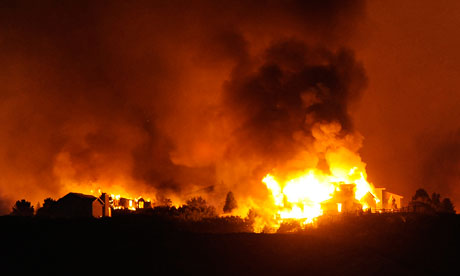
Scorching heat, high winds and bone-dry conditions are fueling catastrophic wildfires in the US west that offer a preview of the kind of disasters that human-caused climate change could bring, a trio of scientists said on Thursday.

Homes are destroyed by the Waldo Canyon fire in the Mountain Shadows area of Colorado Springs. Scientists say the fires offer a preview into the kind of disaters that climate change could bring. Photograph: Jerilee Bennett/AP

"What we're seeing is a window into what global warming really looks like," said Princeton University's Michael Oppenheimer, a lead author for the UN's climate science panel. "It looks like heat, it looks like fires, it looks like this kind of environmental disaster … This provides vivid images of what we can expect to see more of in the future."

In Colorado, wildfires that have raged for weeks have killed four people, displaced thousands and destroyed hundreds of homes. Because winter snowpack was lighter than usual and melted sooner, fire season started earlier in the US west, with wildfires out of control in Colorado, Montana and Utah.

The high temperatures that are helping drive these fires are consistent with projections by the UN Intergovernmental Panel on Climate Change (IPCC), which said this kind of extreme heat, with little cooling overnight, is one kind of damaging impact of global warming.

Others include more severe storms, floods and droughts, Oppenheimer said.

The stage was set for these fires when winter snowpack was lighter than usual, said Steven Running, a forest ecologist at the University of Montana.

Mountain snows melted an average of two weeks earlier than normal this year, Running said. "That just sets us up for a longer, drier summer. Then all you need is an ignition source and wind."

Warmer-than-usual winters also allow tree-killing mountain pine beetles to survive the winter and attack western forests, leaving behind dry wood to fuel wildfires earlier in the season, Running said.

"Now we have a lot of dead trees to burn … it's not even July yet," he said. Trying to stop such blazes driven by high winds is a bit like to trying to stop a hurricane, Running said. More