Showing posts with label carbon-dioxide. Show all posts

Monday, April 18, 2016

New Secretary for the Intergovernmental Panel on Climate Change (IPCC)

 
Nairobi, 13 April 2016 - Current Vice-President of the World Meteorological Organization (WMO) Mr. Abdalah Mokssit, from Morocco, has been offered and accepted the position of new Secretary of the Intergovernmental Panel on Climate Change (IPCC).    The announcement was made at the forty-third session of the IPCC, convening in Nairobi this week.   Dr. Petteri Taalas, Secretary-General of WMO said, "I have had the pleasure to collaborate with Mr. Mokssit for more than a decade as a colleague, WMO Director and as an Executive Council member. He has special organizational and diplomatic skills; these will be needed to engage more developing country experts and governments in the IPCC's work. I am convinced that he will be a very useful asset for IPCC."   UN Under-Secretary-General and Executive Director of the UN Environment Programme (UNEP) Achim Steiner said, "I welcome the selection of Mr. Mokssit as the New IPCC Secretary. He brings to the position years of experience at the national, regional and global levels and UNEP looks forward to continuing to support the vital work of the IPCC, especially through the joint efforts of the UNEP-WMO Secretariat."     Mr. Mokssit has extensive experience with the IPCC, WMO and at the national level. Under his leadership, the Meteorological Service of Morocco became one of the leading meteorological agencies in Africa, meeting high international standards.   The final selection for the position was made by WMO Secretary General, the UNEP Executive Director and the IPCC Chair, following UN procedures.   About the IPCC The Intergovernmental Panel on Climate Change (IPCC) is the world body for assessing the science related to climate change. The IPCC was set up in 1988 by the World Meteorological Organization (WMO) and United Nations Environment Programme (UNEP), endorsed by the United Nations General Assembly, to provide policymakers with regular assessments of the scientific basis of climate change, its impacts and future risks, and options for adaptation and mitigation.   The IPCC does not do its own research, conduct climate measurements or produce its own climate models; it assesses the thousands of scientific papers published each year to tell policymakers what we know and don't know about the risks related to climate change. The IPCC identifies where there is agreement in the scientific community, where there are differences of opinion, and where further research is needed.     Thus the IPCC offers policymakers a snapshot of what the scientific community understands about climate change rather than promoting a particular view. IPCC reports are policy-relevant without being policy-prescriptive. The IPCC may set out options for policymakers to choose from in pursuit of goals decided by policymakers, but it does not tell governments what to do.   To produce its reports, the IPCC mobilizes hundreds of scientists who work as volunteers. These scientists and officials are drawn from diverse backgrounds. Only fourteen permanent staff work in the IPCC's Secretariat.   The members of the IPCC, comprising the Panel, are the195 member states of the UN and WMO. They work by consensus to endorse the reports of the IPCC and set its procedures and budget in plenary meetings of the Panel. The word "Intergovernmental" in the organization's name reflects this.   IPCC reports are requested by the member governments and developed by authors drawn from the scientific community in an extensive process of repeated drafting and review. Scientists and other experts participate in this review process through a self-declaration of expertise. The Panel endorses these reports in a process of dialogue between the governments that request the reports and will work with them and the scientists that write them. In this discussion the scientists have the last word on any additions or changes, although the Panel may agree by consensus to change something in the summaries for policymakers of the reports.   The IPCC produces comprehensive assessment reports on climate change every six years or so. Among its other products it also issues special reports on particular topics requested by its members, and methodology reports and software to help members report their greenhouse gas inventories (emissions minus removals).   The IPCC completed the Fifth Assessment Report (AR5) with the release of the Synthesis Report on 2 November 2014. AR5 is the most comprehensive assessment of climate change ever undertaken. Over 830 scientists from over 80 countries were selected to form the author teams producing the report. They in turn drew on the work of over 1,000 contributing authors and over 1,000 expert reviewers. AR5 assessed over 30,000 scientific papers.  

Further Resources

For more information, please contact   Shereen Zorba, Head of News & Media, UNEP, +254788526000, unepnewsdesk@unep.org

Monday, December 14, 2015

No longer National Security: It is now Planetary Security

George Monbiot superbly sums up the talks, saying: “By comparison to what it could have been, it’s a miracle. By comparison to what it should have been, it’s a disaster.”

The Path From Paris

He writes that: “A maximum of 1.5C, now an aspirational and unlikely target, was eminently achievable when the first UN climate change conference took place in Berlin in 1995. Two decades of procrastination, caused by lobbying – overt, covert and often downright sinister – by the fossil fuel lobby, coupled with the reluctance of governments to explain to their electorates that short-term thinking has long-term costs, ensure that the window of opportunity is now three-quarters shut. The talks in Paris are the best there have ever been. And that is a terrible indictment.””

Here is 350’s Bill McKibben, following up on the Avaaz positive clarion call to arms with a powerful article in today’s Guardian titled ‘Climate deal: the pistol has fired, so why aren’t we running?’

“With the climate talks in Paris now over, the world has set itself a serious goal: limit temperature rise to 1.5C. Or failing that, 2C. Hitting those targets is absolutely necessary: even the one-degree rise that we’ve already seen is wreaking havoc on everything from ice caps to ocean chemistry. But meeting it won’t be easy, given that we’re currently on track for between 4C and 5C. Our only hope is to decisively pick up the pace . . . the only important question, is: how fast . . .

“You’ve got to stop fracking right away (in fact, that may be the greatest imperative of all, since methane gas does its climate damage so fast). You have to start installing solar panels and windmills at a breakneck pace – and all over the world. The huge subsidies doled out to fossil fuel have to end yesterday, and the huge subsidies to renewable energy had better begin tomorrow. You have to raise the price of carbon steeply and quickly, so everyone gets a clear signal to get off of it . . .

“The world’s fossil fuel companies still have five times the carbon we can burn and have any hope of meeting even the 2C target – and they’re still determined to burn it. The Koch Brothers will spend $900m on this year’s American elections. As we know from the ongoing Exxon scandal, there’s every reason to think that this industry will lie at every turn in an effort to hold on to their power –

What this boils down to is not an issue of National Security, but of Global Security, of Planetary Security. The huge subsidies doled out to fossil fuel companies must be clawed back and put towards the Clean Energy Agenda. This is particularly an issue given what we know from the ongoing Exxon scandal, there’s every reason to think that this industry will lie at every turn unless made to pay for their endangerment of humanity.

We have to raise the price of carbon steeply and quickly and use this income to mitigate and sequester carbon in the atmosphere.

Kevin Anderson concludes that we have to make: “Fundamental changes to the political and economic framing of contemporary society. This is a mitigation challenge far beyond anything discussed in Paris – yet without it our well-intended aspirations will all too soon wither and die on the vine. We owe our children, our planet and ourselves more than that. So let Paris be the catalyst for a new paradigm – one in which we deliver a sustainable, equitable and prosperous future for all.”

We must remember that the Montreal Treaty did work. Kofi Annan, Former Secretary General of the United Nations stated "Perhaps the single most successful international agreement to date has been the Montreal Protocol" Remember; "It always seems impossible until it's done" Nelson Mandela. More


Wednesday, November 25, 2015

Bahamas, Saint Lucia, Saint Vincent and the Grenadines Submit INDCs

18 November 2015: The UNFCCC Secretariat has reported that the Bahamas, Saint Lucia, and Saint Vincent and the Grenadines have formally submitted their intended nationally determined contributions (INDCs), bringing the total number of Parties that have made their submissions to 168.


The submission from the Bahamas covers the energy and forestry sectors; that from Saint Lucia covers energy, electricity generation and transport; and Saint Vincent's INDC focuses on energy (including domestic transport), industrial processes and product use, agriculture, land use, land-use change and forestry (LULUCF), and waste.


Noting that fossil fuels are primarily consumed in the transport and electricity sectors of the country, the mitigation contribution from the Bahamas is based on the country's National Energy Policy, which sets a target of reaching 30% renewables in the energy mix by 2030. A 10% Residential Energy Self Generation Programme will also be implemented, which focuses on efficiency improvement and energy diversification. The INDC outlines a number of energy efficiency measures planned for the transport sector, such as efficient traffic management, and states that the construction industry will be subject to energy efficiency standards as laid out in a building code. The INDC also addresses adaptation options in the agriculture, tourism, health, financial and insurance, coastal and marine resources/fisheries, energy, forestry, human settlement, transportation and water resources sectors.


Saint Lucia's INDC contains conditional targets of reducing economy-wide emissions by 16% relative to a business-as-usual (BAU) scenario by 2025 and reaching a 23% reduction compared to BAU by 2030. Among the proposed interventions to reach these targets are: energy-efficient buildings; energy-efficient appliances; water distribution and network efficiency; an increase in renewable sources of power in the electricity generation mix; improvements to grid distribution and transmission efficiency; efficient vehicles; and expanded and improved public transit. The costs, as estimated in the INDC, of reaching the 2030 mitigation targets are approximately US$218 million. On adaptation, the Party notes the recently approved Saint Lucia Climate Change Adaptation Policy (CCAP) (2015).


In the INDC submitted by Saint Vincent and the Grenadines, the Party communicates its intention to achieve an unconditional, economy-wide reduction in greenhouse gas (GHG) emissions of 22% compared to its BAU scenario by 2025. The INDC explains that the energy sector is the focus of its mitigation activity, with plans to build a geothermal power plant by 2018 and to achieve a 15% reduction in national electricity consumption compared to a BAU scenario by 2025 through, inter alia, street light retrofitting and energy labeling for appliances. The submission also outlines mitigation measures for the transport and LULUCF sectors. On adaptation, the contribution includes examples of Saint Vincent's efforts to adapt to climate change, such as the national climate change adaptation programmes.


All Parties to the UNFCCC are expected to submit INDCs in advance of the Paris Climate Change Conference, which will take place from 30 November - 11 December 2015. At the Conference, Parties are anticipated to agree on a global climate change agreement to take effect in 2020. More


[UNFCCC Press Release, Bahamas] [Bahamas' INDC] [UNFCCC Press Release, Saint Lucia] [Saint Lucia's INDC] [UNFCCC Press Release, Saint Vincent and the Grenadines] [Saint Vincent and the Grenadines's INDC] [UNFCCC INDC Portal]


UNFCCC18 November 2015: The UNFCCC Secretariat has reported that the Bahamas, Saint Lucia, and Saint Vincent and the Grenadines have formally submitted their intended nationally determined contributions (INDCs), bringing the total number of Parties that have made their submissions to 168. The submission from the Bahamas covers the energy and forestry sectors; that from Saint Lucia covers energy, electricity generation and transport; and Saint Vincent's INDC focuses on energy (including domestic transport), industrial processes and product use, agriculture, land use, land-use change and forestry (LULUCF), and waste.


Noting that fossil fuels are primarily consumed in the transport and electricity sectors of the country, the mitigation contribution from the Bahamas is based on the country's National Energy Policy, which sets a target of reaching 30% renewables in the energy mix by 2030. A 10% Residential Energy Self Generation Programme will also be implemented, which focuses on efficiency improvement and energy diversification. The INDC outlines a number of energy efficiency measures planned for the transport sector, such as efficient traffic management, and states that the construction industry will be subject to energy efficiency standards as laid out in a building code. The INDC also addresses adaptation options in the agriculture, tourism, health, financial and insurance, coastal and marine resources/fisheries, energy, forestry, human settlement, transportation and water resources sectors.


Saint Lucia's INDC contains conditional targets of reducing economy-wide emissions by 16% relative to a business-as-usual (BAU) scenario by 2025 and reaching a 23% reduction compared to BAU by 2030. Among the proposed interventions to reach these targets are: energy-efficient buildings; energy-efficient appliances; water distribution and network efficiency; an increase in renewable sources of power in the electricity generation mix; improvements to grid distribution and transmission efficiency; efficient vehicles; and expanded and improved public transit. The costs, as estimated in the INDC, of reaching the 2030 mitigation targets are approximately US$218 million. On adaptation, the Party notes the recently approved Saint Lucia Climate Change Adaptation Policy (CCAP) (2015).


In the INDC submitted by Saint Vincent and the Grenadines, the Party communicates its intention to achieve an unconditional, economy-wide reduction in greenhouse gas (GHG) emissions of 22% compared to its BAU scenario by 2025. The INDC explains that the energy sector is the focus of its mitigation activity, with plans to build a geothermal power plant by 2018 and to achieve a 15% reduction in national electricity consumption compared to a BAU scenario by 2025 through, inter alia, street light retrofitting and energy labeling for appliances. The submission also outlines mitigation measures for the transport and LULUCF sectors. On adaptation, the contribution includes examples of Saint Vincent's efforts to adapt to climate change, such as the national climate change adaptation programmes.


All Parties to the UNFCCC are expected to submit INDCs in advance of the Paris Climate Change Conference, which will take place from 30 November - 11 December 2015. At the Conference, Parties are anticipated to agree on a global climate change agreement to take effect in 2020. [UNFCCC Press Release, Bahamas] [Bahamas' INDC] [UNFCCC Press Release, Saint Lucia] [Saint Lucia's INDC] [UNFCCC Press Release, Saint Vincent and the Grenadines] [Saint Vincent and the Grenadines's INDC] [UNFCCC INDC Portal]


read more: http://sids-l.iisd.org/news/bahamas-saint-lucia-saint-vincent-and-the-grenadines-submit-indcs/


Thursday, June 18, 2015

Pope Francis, in Sweeping Encyclical, Calls for Swift Action on Climate Change

VATICAN CITY — Pope Francis on Thursday called for a radical transformation of politics, economics and individual lifestyles to confront environmental degradation and climate change, as his much-awaited papal encyclical blended a biting critique of consumerism and irresponsible development with a plea for swift and unified global action.

The vision that Francis outlined in the 184-page encyclical is sweeping in ambition and scope: He described a relentless exploitation and destruction of the environment, which he blamed on apathy, the reckless pursuit of profits, excessive faith in technology, and political shortsightedness. The most vulnerable victims are the world’s poorest people, he declared, who are being dislocated and disregarded.

"Climate change is a global problem with grave implications: environmental, social, economic, political and for the distribution of goods," he wrote. "It represents one of the principal challenges facing humanity in our day."

The first pope from the developing world, Francis, an Argentine, used the encyclical — titled "Laudato Si’," or "Praise Be to You" — to highlight the crisis posed by climate change. He placed most of the blame on fossil fuels and human activity while warning of an "unprecedented destruction of ecosystems, with serious consequence for all of us" if swift action is not taken. Developed, industrialized countries were mostly responsible, he said, and were obligated to help poorer nations confront the crisis.

"Climate change is a global problem with grave implications: environmental, social, economic, political and for the distribution of goods," he wrote. "It represents one of the principal challenges facing humanity in our day." More


Thursday, May 7, 2015

Global carbon dioxide levels break 400ppm milestone

Record carbon dioxide (CO2) concentrations in the atmosphere were reported worldwide in March, in what scientists said marked a significant milestone for global warming.

Figures released by the US science agency Noaa on Wednesday show that for the first time since records began, the parts per million (ppm) of CO2 in the atmosphere were over 400 globally for a month.

The measure is the key indicator of the amount of planet-warming gases man is putting into the atmosphere at record rates, and the current concentrations are unprecedented in millions of years.

The new global record follows the breaking of the 400ppm CO2 threshold in some local areas in 2012 and 2013, and comes nearly three decades after what is considered the ‘safe’ level of 350ppm was passed.

“Reaching 400ppm as a global average is a significant milestone,” said Pieter Tans, lead scientist on Noaa’s greenhouse gas network.

“This marks the fact that humans burning fossil fuels have caused global carbon dioxide concentrations to rise more than 120ppm since pre-industrial times,” added Tans. “Half of that rise has occurred since 1980.”

World leaders are due to meet in Paris for a UN climate summit later this year in an attempt to reach agreement on cutting countries’ carbon emissions to avoid dangerous global warming.

Dr Ed Hawkins, a climate scientist at the University of Reading told the Guardian: “This event is a milestone on a road to unprecedented climate change for the human race. The last time the Earth had this much carbon dioxide in the atmosphere was more than a million years ago, when modern humans hadn’t even evolved yet.

“Reaching 400ppm doesn’t mean much in itself, but the steady increase in atmospheric greenhouse gases should serve as a stark reminder of the task facing politicians as they sit down in Paris later this year.”

Greenhouse gas emissions from power plants stalled for the first time last year without the influence of a strict economic recession, according to the International Energy Agency, an influential thinktank.

Nick Nuttall, a spokesman for the UN Framework Convention on Climate Change (UNFCCC) which oversees the international climate negotiations, said: “These numbers underline the urgency of nations delivering a decisive new universal agreement in Paris in December – one that marks a serious and significant departure from the past.

“The agreement and the decisions surrounding it needs to be a long term development plan providing the policies, pathways and finance for triggering a peaking of global emissions in 10 years’ time followed by a deep, decarbonisation of the global economy by the second half of the century.”

But even if manmade emissions were dramatically cut much deeper than most countries are planning, the concentrations of CO2 in the atmosphere would only stabilise, not fall, scientists said.

James Butler, director of Noaa’s global monitoring division, said: “Elimination of about 80% of fossil fuel emissions would essentially stop the rise in carbon dioxide in the atmosphere, but concentrations of carbon dioxide would not start decreasing until even further reductions are made and then it would only do so slowly.”

Concentrations of CO2 were at 400.83ppm in March compared to 398.10ppm in March 2014, the preliminary Noaa data showed. They are are expected to stay above 400pm during May, when levels peak because of CO2 being taken up by plants growing in the northern hemisphere.

Noaa used air samples taken from 40 sites worldwide, and analysed them at its centre in Boulder, Colorado. The agency added that the average growth rate in concentrations was 2.25ppm per year from 2012-2014, the highest ever recorded for three consecutive years. More


World headed for irreversible climate change in five years, IEA warns

The world is likely to build so many fossil-fuelled power stations, energy-guzzling factories and inefficient buildings in the next five years that it will become impossible to hold global warming to safe levels, and the last chance of combating dangerous climate change will be “lost for ever”, according to the most thorough analysis yet of world energy infrastructure.

Anything built from now on that produces carbon will do so for decades, and this “lock-in” effect will be the single factor most likely to produce irreversible climate change, the world’s foremost authority on energy economics has found. If this is not rapidly changed within the next five years, the results are likely to be disastrous.

“The door is closing,” Fatih Birol, chief economist at the International Energy Agency, said. “I am very worried – if we don’t change direction now on how we use energy, we will end up beyond what scientists tell us is the minimum [for safety]. The door will be closed forever.”

If the world is to stay below 2C of warming, which scientists regard as the limit of safety, then emissions must be held to no more than 450 parts per million (ppm) of carbon dioxide in the atmosphere; the level is currently around 390ppm. But the world’s existing infrastructure is already producing 80% of that “carbon budget”, according to the IEA’s analysis, published on Wednesday. This gives an ever-narrowing gap in which to reform the global economy on to a low-carbon footing.

If current trends continue, and we go on building high-carbon energy generation, then by 2015 at least 90% of the available “carbon budget” will be swallowed up by our energy and industrial infrastructure. By 2017, there will be no room for manoeuvre at all – the whole of the carbon budget will be spoken for, according to the IEA’s calculations. More


Thursday, November 6, 2014

Lord Stern: global warming may create billions of climate refugees

Lord Nicholas Stern, one of the world’s most influential voices on climate economics, does not mince his words when it comes to criticising those who take a narrow view of prosperity and highlighting the devastating consequences of global warming.
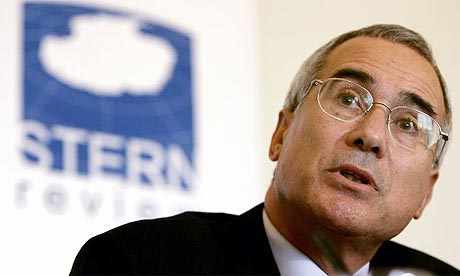
Nicholas Stern

"You have to be a complete idiot to think that GDP sums up prosperity," says Stern, who believes we need to develop broader measures of success and combine this with a return to core values if we are to convince people to act to prevent runaway climate change.

Stern, who wrote the landmark 2006 Stern review of the economics of climate change, says if we fail to take heed of the danger signals, we risk temperatures rising this century to levels we haven’t seen for tens of millions of years.

"Hundreds of millions of people, perhaps billions of people would have to move," he warns. "If we’ve learned anything from history that means severe and extended conflict.

"We couldn’t just turn it off. You can’t make a peace treaty with the planet, you can’t negotiate with the laws of physics. You’re in there, you’re stuck. Those are the stakes we’re playing for and that’s why we have to make this second transformation, the climate transformation and move to low carbon economy."

Stern has co-authored the recently published New Climate Economy report, which argues that the world can head off the worst effects of climate change, and enjoy the fruits of continued economic expansion, if it moves quickly to invest in a low-carbon economy.

He says he hopes the study will influence key decision makers because it was written with the support of a coalition of respected politicians, economists, think tanks and institutions, including the World Bank, the International Monetary Fund, the OECD, the International Energy Agency and the UN.

He dismisses the arguments of more radical economists who believe that we need to stop our fixation with growth, arguing that the economy needs to keep expanding if we are to have a hope of eradicating poverty.

"To those who want to knock out growth from objectives, I find they’re close to reprehensible because for me the two defining challenges of this century are overcoming poverty and managing climate change.

"We fail on one, we fail on the other. So I think to say that we should just switch off growth is to miss big aspects of what matters about poverty. And so it worries me. It’s also politically very naive. If you turn it into a pissing contest between growth on the one hand and climate and environment on the other and say you’ve got to choose, you’re setting yourself up for failure."

Stern says investments in renewable energy must be combined with a rethinking of our understanding of prosperity, which he believes will lead to what he terms better growth.

"It means thinking differently about health, about the way we live in our cities and about the strengths of our communities," he says. "It’s not that GDP is idiotic but it’s mostly about the use of labour resources and what it produces. But there are very important parts of this story about prosperity that get missed out."

How does Stern, who is president of the British Academy, believe we can start to measure prosperity that goes beyond GDP?

He says it is vital to start from the perspective of people understanding what they mean by wellbeing and what they value, whether it is family, community, arts or sport.

"You can be reasonably empirical about what moves people and then you go and try to collect data on that," he says. "Once you understand what it is it you’re trying to capture and create indicators, you can then start to talk about policy."

The 68-year-old peer says it’s vital we go back to recognising the importance of Aristotle’s belief in the need to understand what it means to be a virtuous person and to whom we owe a duty of care.

"I’ve been an academic all my life and I look at the evidence of what works and what doesn’t work," he says. "But if you ask yourself what you’re trying to do, that’s spurred by values, by what’s important to you."

For Stern, the heart of his values lies in the importance of family. Speaking immediately after introducing his two-week old granddaughter Rosa on stage at a TEDx talk in New York, he said: "I’m 68 and I am thinking what will Rosa be like when she’s 68? We’re talking about towards the end of this century and what we do now will determine whether the next 100 years is the best of centuries or the worst of centuries."

"Are we going to look our grandchildren in the eye and tell them that we understood the issues, that we recognised the dangers and the opportunities, and still we failed to act?"

Stern believes that it is time for religious leaders, politicians and the media to act more responsibly, pointing in particular to the importance of the Pope’s statement earlier this year that if we destroy creation, creation will destroy us.

Also key to changing hearts and minds is the field of arts, with Stern pointing to Barbara Kingsolver’s book Flight Behaviour, which he says is not only wonderful in describing the human condition but also in questioning our relationship with the environment.

"It’s not just the policy wonks like me we need to try to assemble the evidence and set it out," he says. "You have to do that because emotional argument without rational evidence on cause and effect doesn’t get you all that far. But rational argument about cause and effect alone doesn’t get you there either." More


Monday, September 22, 2014

Whether We Engage or Do Nothing... This Changes Everything

The following is an excerpt taken from the introduction of Naomi Klein's newly published book, This Changes Everything: Capitalism vs. the Climate, and appears at Common Dreams with permission from the book's publisher Simon & Shuster. All rights reserved.

“Most projections of climate change presume that future changes—greenhouse gas emissions, temperature increases and effects such as sea level rise—will happen incrementally. A given amount of emission will lead to a given amount of temperature increase that will lead to a given amount of smooth incremental sea level rise. However, the geological record for the climate reflects instances where a relatively small change in one element of climate led to abrupt changes in the system as a whole. In other words, pushing global temperatures past certain thresholds could trigger abrupt, unpredictable and potentially irreversible changes that have massively disruptive and large-scale impacts. At that point, even if we do not add any additional CO2 to the atmosphere, potentially unstoppable processes are set in motion. We can think of this as sudden climate brake and steering failure where the problem and its consequences are no longer something we can control.” —Report by the American Association for the Advancement of Science, the world’s largest general scientific society, 2014

“I love that smell of the emissions.” — Sarah Palin, 2011

I denied climate change for longer than I care to admit. I knew it was happening, sure. Not like Donald Trump and the Tea Partiers going on about how the continued existence of winter proves it’s all a hoax. But I stayed pretty hazy on the details and only skimmed most of the news stories, especially the really scary ones. I told myself the science was too complicated and that the environmentalists were dealing with it. And I continued to behave as if there was nothing wrong with the shiny card in my wallet attesting to my “elite” frequent flyer status

Climate change is... hard to keep it in your head for very long. We engage in this odd form of on-again-off-again ecological amnesia for perfectly rational reasons. We deny because we fear that letting in the full reality of this crisis will change everything. And we are right."

A great many of us engage in this kind of climate change denial. We look for a split second and then we look away. Or we look but then turn it into a joke (“more signs of the Apocalypse!”). Which is another way of looking away.

Or we look but tell ourselves comforting stories about how humans are clever and will come up with a technological miracle that will safely suck the carbon out of the skies or magically turn down the heat of the sun. Which, I was to discover while researching this book, is yet another way of looking away.

"Climate change is... hard to keep it in your head for very long. We engage in this odd form of on-again-off-again ecological amnesia for perfectly rational reasons. We deny because we fear that letting in the full reality of this crisis will change everything. And we are right."

Or we look but try to be hyper-rational about it (“dollar for dollar it’s more efficient to focus on economic development than climate change, since wealth is the best protection from weather extremes”)—as if having a few more dollars will make much difference when your city is underwater. Which is a way of looking away if you happen to be a policy wonk. Or we look but tell ourselves we are too busy to care about something so distant and abstract—even though we saw the water in the subways in New York City, and the people on their rooftops in New Orleans, and know that no one is safe, the most vulnerable least of all. And though perfectly understandable, this too is a way of looking away.

Or we look but tell ourselves that all we can do is focus on ourselves. Meditate and shop at farmers’ markets and stop driving—but forget trying to actually change the systems that are making the crisis inevitable because that’s too much “bad energy” and it will never work. And at first it may appear as if we are looking, because many of these lifestyle changes are indeed part of the solution, but we still have one eye tightly shut.

Or maybe we do look—really look—but then, inevitably, we seem to forget. Remember and then forget again. Climate change is like that; it’s hard to keep it in your head for very long. We engage in this odd form of on-again-off-again ecological amnesia for perfectly rational reasons. We deny because we fear that letting in the full reality of this crisis will change everything. And we are right.

We know that if we continue on our current path of allowing emissions to rise year after year, climate change will change everything about our world. Major cities will very likely drown, ancient cultures will be swallowed by the seas, and there is a very high chance that our children will spend a great deal of their lives fleeing and recovering from vicious storms and extreme droughts. And we don’t have to do anything to bring about this future. All we have to do is nothing. Just continue to do what we are doing now, whether it’s counting on a techno-fix or tending to our gardens or telling ourselves we’re unfortunately too busy to deal with it.

All we have to do is not react as if this is a full-blown crisis. All we have to do is keep on denying how frightened we actually are. And then, bit by bit, we will have arrived at the place we most fear, the thing from which we have been averting our eyes. No additional effort required.

There are ways of preventing this grim future, or at least making it a lot less dire. But the catch is that these also involve changing everything. For us high consumers, it involves changing how we live, how our economies function, even the stories we tell about our place on earth. The good news is that many of these changes are distinctly un-catastrophic. Many are downright exciting. But I didn’t discover this for a long while.

"All we have to do is not react as if this is a full-blown crisis. All we have to do is keep on denying how frightened we actually are. And then, bit by bit, we will have arrived at the place we most fear, the thing from which we have been averting our eyes. No additional effort required."

I remember the precise moment when I stopped averting my eyes to the reality of climate change, or at least when I first allowed my eyes to rest there for a good while. It was in Geneva, in April 2009, and I was meeting with Bolivia’s ambassador to the World Trade Organization (WTO), who was then a surprisingly young woman named Angélica Navarro Llanos. Bolivia being a poor country with a small international budget, Navarro Llanos had recently taken on the climate portfolio in addition to her trade responsibilities. Over lunch in an empty Chinese restaurant, she explained to me (using chopsticks as props to make a graph of the global emission trajectory) that she saw climate change both as a terrible threat to her people—but also an opportunity.

A threat for the obvious reasons: Bolivia is extraordinarily dependent on glaciers for its drinking and irrigation water and those white-capped mountains that tower over its capital were turning gray and brown at an alarming rate. The opportunity, Navarro Llanos said, was that since countries like hers had done almost nothing to send emissions soaring, they were in a position to declare themselves “climate creditors,” owed money and technology support from the large emitters to defray the hefty costs of coping with more climate-related disasters, as well as to help them develop on a green energy path.

She had recently given a speech at a United Nations climate conference in which she laid out the case for these kinds of wealth transfers, and she gave me a copy. “Millions of people,” it read, “in small islands, least developed countries, landlocked countries as well as vulnerable communities in Brazil, India and China, and all around the world—are suffering from the effects of a problem to which they did not contribute. . . . If we are to curb emissions in the next decade, we need a massive mobilization larger than any in history. We need a Marshall Plan for the Earth. This plan must mobilize financing and technology transfer on scales never seen before. It must get technology onto the ground in every country to ensure we reduce emissions while raising people’s quality of life. We have only a decade.” More


Tuesday, September 2, 2014

We need your help

Young people around the world are asking what our leaders are going to do about climate change -- and they're submitting their questions on video for a chance to have them presented at the United Nations Climate Summit in New York City.

We've been receiving videos from around the world. We've heard questions about solar power in Italy, flooding in the Philippines, and climate change negotiations from a young man in Dubai. The young people asking them are intelligent. They're passionate. And they're going to represent their generation on the world's stage.

But now we need to increase the numbers, to make their combined voices as loud and persuasive as possible. So please help us by persuading young friends and family members to upload a video. If every Climate Reality Leader can help get one more video, we'll be hearing the voices of thousands. The deadline for submission is September 8, so please make sure every 13-21 year-old you know visits our site and submits their video. The clock is ticking:

http://www.askwhywhynot.org

Judging from the knowledge and commitment shown by the inspiring young people who have already uploaded videos, I'm more convinced than ever that we can overcome climate change. We just need to make sure the world's leaders are listening.

750 NINTH STREET, NW, SUITE 520 WASHINGTON, DC, 20001, USA

©2014 THE CLIMATE REALITY PROJECT. ALL RIGHTS RESERVED.


Monday, August 25, 2014

Al Gore’s “Turning Point”

Eight years after Al Gore wrote a book and made a movie to impress upon us the "planetary emergency of global warming" (his subtitle for An Inconvenient Truth), he wrote an article with a more optimistic feel- ing in the 18 June 2014 issue of Rolling Stone. He begins "The Turning Point: New Hope for Climate" as follows:

Al Gore - Climate Reality Leadership Corp

In the struggle to solve the climate crisis, a powerful, largely unnoticed shift is taking place. The forward journey for human civilization will be difficult and dangerous, but it is now clear that we will ultimately prevail. The only question is how quickly we can accelerate and com- plete the transition to a low-carbon civilization.

The "surprising – even shocking – good news" is "our ability to convert sunshine into usable energy . . . much cheaper far more rapidly than anyone had predicted," Gore writes: the cost of photovoltaic electricity is competitive with that from other sources in at least 79 countries, and the 43% decrease in cost of wind- generated electricity since 2009 has made it cheaper than coal-generated electricity. By 2020 more than 80% of world population will live where photovoltaic electricity is competi- tive with other sources.

As evidence of this "largely unnoticed shift," he notes that Germany now generates 37% of its electricity from wind and solar, a percentage expected to reach 50% by 2020, and that nine of ten European coal and gas plants are losing money. Worldwide, capacity for 17 gi- gawatts of solar electricity was installed in 2010, for 39 in 2003, with expectations of 55 in 2014. China claims it will have a capacity of 70 solar gigawatts by 2017. (A gigawatt is the power generating capacity of a standard electric power plant.)

Gore states that in the U.S. 166 coal-fired plants have closed or announced closings in the last 4.5 years, and 183 proposed coal-fired plants have been canceled since 2005. He acknowledges that some of this shift from coal is to natural gas obtained by hydrofracturing ("fracking") but focuses on the emergence of "on-site and grid battery storage and microgrids," noting that the Edison Electric Institute (the U.S. utility trade group) has labeled this trend as the "largest near-term threat" to the present elec- tric utility system. He likens this threat to that posed by cell phones to the landline telephone system. He cites Citigroup’s recognition of the decreased cost of solar and wind electricity and battery storage (long seen as a barrier to intermittent energy from renewable). In addition, he notes a reduction of 49% in energy intensity (energy in- put per dollar output in gross domestic product) since 1980.

Gore observes that the Koch brothers have led the fight against rooftop solar electricity and for keeping the present fossil-fueled electric plants, one of their arguments being that net metering allows producers of solar electricity to benefit from the grid without paying for it. Al- though Gore neglects to mention that in net metering the utility pays the generator only the wholesale price for the surplus generation, he does note that solar electricity gen- eration has the advantage of peaking with electricity de- mand, thereby saving utilities from having to install new peak generation capacity (a point also made by keynoter Perez at the kickoff to develop the solar lessons for School Power Naturally, reported in our Winter 2003 issue).

Gore likens global warming to a fever for planet Earth and notes that the presently-gathering El Niño is expected to result in a pronounced global temperature increase. (Coverage in our Winter 2010 issue of a talk to the American Physical Society and the American Association of Physics Teachers on 15 February 2010 by Judith Lean of the Naval Research Laboratory attributes this to the phase of the 22-year solar cycle.) He correlates the de- struction from Supertyphoon Haiyan and Superstorm Sandy with greater surface water temperature (5.4oF for the former, 9oF for the latter). He notes that higher water temperatures also mean higher sea level and disruption of water supplies that depend on snowmelt. And he adds that even more severe catastrophes are in the offing, like the irreversible collapse of a portion of the West Antarc- tic ice sheet. In addition to heightened sea level, warmer climate also means an atmosphere capable of holding more water vapor and delivering more severe storms, as have been seen in Pensacola (FL), and Nashville (TN). At the same time, global warming will exacerbate the dryness of the drier parts of the Earth through greater evaporation of what little water there is in the ground. Gore also observes that climate change brings concern to the military for both the safety of its bases and the new types of world conflict it will have to deal with.

Gore concedes that these many "knock-on consequences of the climate crisis" are enough to cause anyone to despair. But, as he writes in his opening paragraph, "we will have to take care to guard against despair," lest we become deterred from the action we must pursue. Though there be light at the end of the tunnel, he points out that we are in the tunnel. Among the things he says we need are "a price on carbon in our markets" and "green banks" to finance "green" projects.

"Damage has been done, and the period of consequences will continue for some time to come, but there is still time to avoid the catastrophes that most threaten our future."

Though U.S. greenhouse gas emissions had decreased from 2008 to 2012, due to recovery from the recession, they increased 2.4% in 2013. Gore calls for the U.S. to match the European Union’s commitment to reduce carbon dioxide emissions 40% by 2030.

Gore’s concluding reasons for optimism are that "Rapid technological advancements in renewable energy are stranding carbon investments; grassroots movements are building opposition to the holding of such assets; and new legal restrictions on collateral flows of pollution . . . are further reducing the value of coal, tar sands, and oil and gas assets." "Damage has been done," he adds, "and the period of consequences will continue for some time to come, but there is still time to avoid the catastrophes that most threaten our future."


Thursday, June 19, 2014

Solar is here

Solar is here.

That's right. You know the solutions to the climate crisis are available today; we simply need the public (and political) will to implement them. Clean energy is urgently necessary, abundant, and becoming increasingly more affordable. That's why on June 21, The Climate Reality Project is joining 12 other organizations in a day of action to support clean-energy solutions and show our commitment to bringing solar power to communities around the world.

If you don't already have plans to take part on Saturday, don't despair! Here are a few last minute ways to get involved:

  1. Sign: Send President Obama an email thanking him for putting solar panels on the roof of the White House.
  2. Share: Take your own #PutSolarOnIt photo and share it with your social media network.
  3. Discover: Check out the Mosaic website to find out if solar is right for you.
  4. Participate: Check out OFA's website to find an event near you, some of which are being hosted by your fellow Climate Reality Leaders.

The reality is this: solar is affordable. It's clean. And it's powerful. The cost of solar panels has plummeted 60 percent since early 2011, and the number of installations keeps growing. The United States now has enough installed solar capacity to power more than 2.2 million homes. In several states, solar power is now competitive with other sources of energy without emitting the dangerous greenhouse gases that cause climate change.

Climate Reality Leaders are the first responders to the climate crisis and lead action across the globe. We're proud so many of you will be participating on Saturday by hosting presentations, organizing events, and informing others about the benefits of solar power.

The Climate Reality Leadership Corps Team

Solar Array at Caledonian Bank, George Town, Cayman Islands


Monday, June 16, 2014

Climate change will ‘cost world far more than estimated’

Lord Stern, the world’s most authoritative climate economist, has issued a stark warning that the financial damage caused by global warming will be considerably greater than current models predict.

This makes it more important than ever to take urgent and drastic action to curb climate change by reducing carbon emissions, he argues.

Lord Stern, who wrote a hugely influential review on the financial implications of climate change in 2006, says the economic models that have been used to calculate the fiscal fallout from climate change are woefully inadequate and severely underestimate the scale of the threat.

As a result, even the recent and hugely authoritative series of reports from the UN Intergovernmental Panel on Climate Change (IPCC) are significantly flawed, he said.

“It is extremely important to understand the severe limitations of standard economic models, such as those cited in the IPCC report, which have made assumptions that simply do not reflect current knowledge about climate change and its ... impacts on the economy,” said Lord Stern, a professor at the Grantham Institute, a research centre at the London School of Economics.

Professor Stern and his colleague Dr Simon Dietz will today publish the peer-reviewed findings of their research into climate change economic modelling in the The Economic Journal.

Their review is highly critical of established economic models which, among other things, fail to acknowledge the full breadth of climate change’s likely impact on the economy and are predicated on assumptions about global warming’s effect on output that are “without scientific foundation”.

Professor Stern, whose earlier research said it is far cheaper to tackle climate change now than in the future, added: “I hope our paper will prompt ... economists to strive for much better models [and] ... help policy-makers and the public recognise the immensity of the potential risks of unmanaged climate change.”

“Models that assume catastrophic damages are not possible fail to take account of the magnitude of the issues and the implications of the science,” he said.

Professor Stern and Dr Dietz say their findings strengthen the case for strong cuts in greenhouse gas emissions and imply that, unless this happens, living standards could even start to decline later this century.

For the study, they modified key features of the “dynamic integrated climate-economy” (Dice) model, initially devised by William Nordhaus in the 1990s. The changes take into account the latest scientific findings and some of the uncertainties about the major risks of climate change that are usually omitted.

The standard Dice model has been used in a wide range of economic studies of the potential impacts of climate change, some of which have been cited in the most recent IPCC report which has been released in three parts over the past nine months.

Dr Dietz said: “While this standard economic model has been useful for economists who estimate the potential impacts of climate change, our paper shows some major improvements are needed before it can reflect the extent of the risks indicated by the science.”

Dr Dietz said his aim was to show how a new version of the model could produce a range of results that are much more representative of the science and economics of climate change, taking into account the uncertainties.

“The new version of this standard economic model, for instance, suggests that the risks from climate change are bigger than portrayed by previous economic models and therefore strengthens the case for strong cuts in emissions of greenhouse gases,” he said.

The new model differs in that it considers a wider temperature range when estimating the impact of doubling the atmospheric concentration of greenhouse gases – a measure of “climate sensitivity”.

Whereas the standard model usually assumes a single temperature for climate sensitivity of about 3C, the new model uses a range of 1.5C to 6C, which the authors say more accurately reflects the scientific consensus.

The standard model also “implausibly” suggests a loss of global output of 50 per cent would only result after a rise in global average temperature of 18C, even though such warming would likely render the Earth uninhabitable for most species, including humans, Dr Dietz contends.

The new model includes the possibility that such damage could occur at much lower levels of global warming. Standard economic models rule out the possibility that global warming of 5-6C above pre-industrial levels could cause catastrophic damages, even though such temperatures have not occurred on Earth for tens of millions of years. Such an assertion, he says, is without scientific foundation and embodies a false assumption that the risks are known, with great confidence, to be small.

The new model also takes into account that climate change can damage not just economic output, but productivity. The standard model assumes that rising levels of greenhouse gases in the atmosphere only affect economic growth in a very limited way, according to Dr Dietz. More


Saturday, June 7, 2014

Saving trees in tropics could cut emissions by one-fifth, study shows

Reducing deforestation in the tropics would significantly cut the amount of carbon dioxide emitted into the atmosphere -- by as much as one-fifth -- research shows. In the first study of its kind, scientists have calculated the amount of carbon absorbed by the world's tropical forests and the amounts of greenhouse gas emissions created by loss of trees, as a result of human activity.

Reducing deforestation in the tropics would significantly cut the amount of carbon dioxide emitted into the atmosphere -- by as much as one-fifth -- research shows.

In the first study of its kind, scientists have calculated the amount of carbon absorbed by the world's tropical forests and the amounts of greenhouse gas emissions created by loss of trees, as a result of human activity.

They found that tropical forests absorb almost two billion tonnes of carbon each year, equivalent to one-fifth of the world's carbon emissions, by storing it in their bark, leaves and soil. However, an equivalent amount is lost through logging, clearing of land for grazing, and growing biofuel crops such as palm oil, soya bean and sugar. Peat fires in forests add significantly to the greenhouse gas emissions.

Researchers estimate that if all human-related deforestation of the tropics were to stop, the forests could absorb more carbon than at present, equivalent to one-fifth of global emissions.

Researchers say carbon emissions from tropical forests will increase as the climate warms, as rising temperatures accelerate the decay of dead plants and trees, giving off more CO2. Global temperatures are forecast to rise by two degrees by the year 2099, which is predicted to increase annual carbon emissions from the forest by three-quarters of a billion tonnes.

Scientists from the Universities of Edinburgh and Leeds analysed data from multiple previous studies, including satellite studies, to determine the amount of carbon absorbed and emitted by the world's tropical forests in South and Central America, equatorial Africa and Asia.

Their study, published in Global Change Biology, was supported by the Natural Environment Research Council.

Professor John Grace of the University of Edinburgh's School of GeoSciences, who led the study, said: "If we limit human activity in the tropical forests of the world, this could play a valuable role in helping to curb the rise in carbon dioxide in the atmosphere. Preventing further losses of carbon from our tropical forests must remain a high priority." More


Story Source:

The above story is based on materials provided by University of Edinburgh. Note: Materials may be edited for content and length.

Journal Reference:

  1. John Grace, Edward Mitchard, Emanuel Gloor. Perturbations in the carbon budget of the tropics. Global Change Biology, 2014; DOI: 10.1111/gcb.12600