UMD Council on the Environment Inaugural Distinguished Lecture Series featuring Dr. Lester R. Brown. The topic is Full Planet, Empty Plates.

Monday, December 17, 2012
Friday, December 14, 2012
Ticking Arctic Carbon Bomb May Be Bigger Than Thought
Ticking Arctic Carbon Bomb May Be Bigger Than Thought by Eli Kintisch on 7 December 2012, 11:52 AM 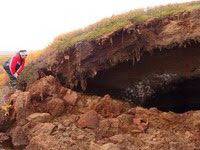 SAN FRANCISCO, CALIFORNIA—Scientists are expressing fresh concerns about the carbon locked in the Arctic's vast expanse of frozen soil. New field studies, presented here this week at the fall meeting of the American Geophysical Union, quantify the amount of soil carbon at 1.9 trillion metric tons, suggesting that previous estimates underestimated the climate risk if this carbon is liberated. Meanwhile, a new analysis of laboratory experiments that simulate carbon release by thawed soil is bolstering worries that continued carbon emissions could unleash a massive Arctic carbon wallop.

Disappearing Arctic ice, which gets most of the attention from climate scientists, is an effect of humanmade climate change. By contrast, the melting of frozen soil, or permafrost, can drive warming. As it thaws, microbes devour carbon previously locked inside, unleashing carbon dioxide—a potent greenhouse gas—in the process. The carbon dioxide amplifies the warming power of carbon pollution in a vicious feedback loop.
Scientists have struggled, however, to quantify this threat. Permafrost occurs on a quarter of the Northern Hemisphere landmass—from Alaska to Canada and across Siberia—but researchers have taken far too few readings to feel very confident about the risk. "We are working on really large landmasses with limited data," says physical geographer Gustaf Hugelius of Stockholm University. Measuring the carbon content of permafrost requires muddy field work with heavy drilling machinery, operated in remote areas, and satellite data help little.
Those logistical constraints have largely limited researchers' previous estimates of carbon to the top meter of permafrost. But scientists think that carbon down to a depth of 3 meters is susceptible to thawing and release as well. An influential 2009 estimate that Arctic permafrost held 1.6 trillion metric tons of carbon included only 45 field sites analyzed down to that depth. In the new study, Hugelius added 405 new analyses of field sites that went to 3 meters, some through new field work he and colleagues performed, some from archived data. Adding up the carbon found in different soil types he says, yields an initial new estimate of 1894 billion metric tons of carbon locked into permafrost across the Arctic, 13% more than the previous estimate.
After better quantifying the size of stored Arctic carbon, the next question for <http://news.sciencemag.org/sciencenow/2012/12/editor-content.html?cs=UTF-8> researchers is how much permafrost will thaw as the planet warms. A modeling study published earlier this year suggested that if global emissions trends stay constant, by 2100 permafrost holding 436 gigatons of carbon could thaw. But determining the size of the permafrost threat also requires calculating how much of the carbon in thawed permafrost will be decomposed by microbes and released as CO2. In a presentation at the meeting, soil biogeochemist Christina Schaedel of the University of Florida in Gainesville discussed that question. She analyzed nine previous studies in which researchers took samples of thawed permafrost to discover how much carbon would be released. In those studies, researchers incubated the soil in bottles at constant temperatures in their laboratories for a year or more. Over 50 years, she concludes, thawed permafrost could release 20% of its available carbon, a figure she called "a conservative estimate."
That could amount to a carbon pulse larger than 2 years' worth of global humanmade emissions. In terms of global climate change, the new studies show that "the actual situation is worse" than policymakers realize, says Peter Griffith, an ecosystems ecologist with NASA's Goddard Space Flight Center in Greenbelt, Maryland. The result could be an acceleration of impacts from humanmade greenhouse gas pollution: sea level rise, more intense droughts, and ocean acidification. "What happens in the Arctic doesn't stay in the Arctic," he says.
Painting a more complete picture of the threat means tackling the data dearth, says Hugelius, who hopes new collaborations with Russian scientists will provide a wealth of archived soil data from various laboratories across northern Asia. In addition, Hugelius and Schaedel are members of a network<http://www.biology.ufl.edu/permafrostcarbon/> of scientists studying permafrost carbon in the Arctic, and Griffith is leading a new project by NASA in which scientists will fan out across the Arctic over the next decade to obtain more data on soil carbon and ice.
In terms of Arctic studies, "ice gets all the love," Griffith says. "That's because we have a very robust [satellite] capability for remotely sensing ice." To understand the threat hidden within permafrost, it's time for more scientists to get their boots dirty. More


Thursday, December 13, 2012
Doha summit launches climate damage aid
THINGS took an interesting twist at the latest UN climate summit held in Doha, Qatar, over the past two weeks when nations began talks over paying for the damage caused by climate change.
Delegates were split over a deal under which rich nations would pay when poor ones suffered the consequences of global warming. Developing countries demanded future compensation and developed ones - particularly the US - were unsurprisingly reluctant to agree.
The talks ended with yet another agreement to agree, but many are calling this small victory a significant step forward. The deal offers a distant promise of climate aid. But first, science will have to catch up with politics.
All countries will suffer as a result of climate change, even if humanity slashes its emissions and stops temperatures rising more than 2 °C above pre-industrial levels - the stated goal of the UN negotiations. At current rates, a 3 or 4 °C rise is likely this century.
As a consequence, deserts will spread and lethal heatwaves will become more frequent. Changes in rainfall will bring droughts, floods and storms, andrising seas will swamp low-lying areas, obliterating valuable territory.
So far, climate negotiations have taken a two-pronged approach to the problem. On the one hand, they have sought to create incentives or imperatives to cut emissions. On the other, they have established funds to help poor nations pay for "adaptation" measures, such as sea walls and irrigation systems, to help fend off the unavoidable consequences.
That, according to some, leaves a third element missing. Some consequences cannot easily be kept at bay. Countries will suffer food shortages and more frequent and more severe storm surges. On 28 November, the charities ActionAid, CARE International and WWF released a report arguing that rich countries should compensate poor ones for such damages. Doing so is a moral obligation and must be part of any treaty on climate change, says Niklas Höhne of renewable energy consultancy Ecofys in Utrecht, the Netherlands.
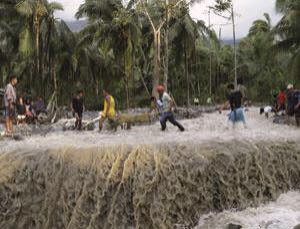
In Doha, a coalition including China, the Alliance of Small Island States and the G77 group of developing countries proposed a scheme that would decide when countries had suffered climate damages, and compensate them for their loss. The idea gained momentum after typhoon Bopha struck the Philippines last week. That country's negotiator Naderev Saño broke down in tears during a speech. "As we sit here, every single hour, even as we vacillate and procrastinate here, we are suffering."
Developed nations balked at the prospect of being held accountable for the consequences of emissions. Early versions of the text included the word "compensation" but they objected that it implied blame. In the end, they agreed to create "arrangements [...] to address loss and damage associated with the impacts of climate change".
The deal poses a fundamental challenge to climate science, because it is difficult to work out whether trends and events are caused by greenhouse gases or would have happened anyway. "We can't say that an individual event was caused by climate change," says Nigel Arnell of the University of Reading, UK. "What we can do is say that the chance of it happening was greater."
Computer models can be made to replicate the decades preceding a natural disaster with and without humanity's impact. If the odds turn out to be different with and without greenhouse gas emissions, it suggests that emissions were at least partially to blame. In this way, studies led by Myles Allen at the University of Oxford have shown that the 2003 European heatwave and 2011 Texas drought were both made more likely by human emissions.
The costs of such extreme events is relatively straightforward to calculate. But "attribution" science is in its infancy. Kevin Trenberth of the National Center for Atmospheric Research in Boulder, Colorado, speculates that superstorm Sandy would not have flooded the New York subways without climate change, but says it is not possible to prove that.
On the other hand, we can link slow processes like rising global temperatures or sea level rise to emissions. For this reason, many people think we should focus first on compensating people harmed by these processes - Pacific islands whose shorelines are gradually disappearing underwater for instance - and worry about extreme weather events once the science has caught up. The trouble is, unlike the damage caused by a hurricane, it is difficult to work out how much these slow processes cost. According to Arnell, the problem may prove unworkable. More
 |
| Who Pays |
The talks ended with yet another agreement to agree, but many are calling this small victory a significant step forward. The deal offers a distant promise of climate aid. But first, science will have to catch up with politics.
All countries will suffer as a result of climate change, even if humanity slashes its emissions and stops temperatures rising more than 2 °C above pre-industrial levels - the stated goal of the UN negotiations. At current rates, a 3 or 4 °C rise is likely this century.
As a consequence, deserts will spread and lethal heatwaves will become more frequent. Changes in rainfall will bring droughts, floods and storms, andrising seas will swamp low-lying areas, obliterating valuable territory.
So far, climate negotiations have taken a two-pronged approach to the problem. On the one hand, they have sought to create incentives or imperatives to cut emissions. On the other, they have established funds to help poor nations pay for "adaptation" measures, such as sea walls and irrigation systems, to help fend off the unavoidable consequences.
That, according to some, leaves a third element missing. Some consequences cannot easily be kept at bay. Countries will suffer food shortages and more frequent and more severe storm surges. On 28 November, the charities ActionAid, CARE International and WWF released a report arguing that rich countries should compensate poor ones for such damages. Doing so is a moral obligation and must be part of any treaty on climate change, says Niklas Höhne of renewable energy consultancy Ecofys in Utrecht, the Netherlands.
In Doha, a coalition including China, the Alliance of Small Island States and the G77 group of developing countries proposed a scheme that would decide when countries had suffered climate damages, and compensate them for their loss. The idea gained momentum after typhoon Bopha struck the Philippines last week. That country's negotiator Naderev Saño broke down in tears during a speech. "As we sit here, every single hour, even as we vacillate and procrastinate here, we are suffering."
Developed nations balked at the prospect of being held accountable for the consequences of emissions. Early versions of the text included the word "compensation" but they objected that it implied blame. In the end, they agreed to create "arrangements [...] to address loss and damage associated with the impacts of climate change".
The deal poses a fundamental challenge to climate science, because it is difficult to work out whether trends and events are caused by greenhouse gases or would have happened anyway. "We can't say that an individual event was caused by climate change," says Nigel Arnell of the University of Reading, UK. "What we can do is say that the chance of it happening was greater."
Computer models can be made to replicate the decades preceding a natural disaster with and without humanity's impact. If the odds turn out to be different with and without greenhouse gas emissions, it suggests that emissions were at least partially to blame. In this way, studies led by Myles Allen at the University of Oxford have shown that the 2003 European heatwave and 2011 Texas drought were both made more likely by human emissions.
The costs of such extreme events is relatively straightforward to calculate. But "attribution" science is in its infancy. Kevin Trenberth of the National Center for Atmospheric Research in Boulder, Colorado, speculates that superstorm Sandy would not have flooded the New York subways
without climate change, but says it is not possible to prove that.On the other hand, we can link slow processes like rising global temperatures or sea level rise to emissions. For this reason, many people think we should focus first on compensating people harmed by these processes - Pacific islands whose shorelines are gradually disappearing underwater for instance - and worry about extreme weather events once the science has caught up. The trouble is, unlike the damage caused by a hurricane, it is difficult to work out how much these slow processes cost. According to Arnell, the problem may prove unworkable. More
Monday, December 10, 2012
Climate Change and Development short course
Climate Change and Development Short Course
International Development UEA, University of East Anglia, Norwich, UK

2 week residential course
Dates
September 4-17 2013
Places
20
Fee
£3200
Language
The course is conducted in English. Full competence in English, written and spoken is an essential requirement.
Target audience
The course is designed for professionals who want to gain a greater understanding of the implications of climate change for developing countries and of the processes, issues and debates surrounding adaptation and mitigation. It is aimed at building the knowledge base of staff from government agencies and NGOs who do not have an existing specialism in the field but who may have new responsibility or interest in the integration of climate change management into development planning, projects and policy.
"Exceptionally well organised and well delivered course. Well done Roger (Dr Roger Few, Course Director) and his team of experts. A big thank you!"
2011 participant from UK Commonwealth Secretariat
Location
International Development UEA, university of East Anglia, Norwich, UK
Contact devco.train@uea.ac.uk for all further information
download a pdf of the course brochure
Apply for this course
Climate change has profound implications for developing countries and increasingly, professionals working in or for developing countries are being asked to integrate climate change management into planning, projects and policy. National governments are also engaged in official communications to the United Nations Framework Convention on Climate Change and other initiatives which require analysis of vulnerability and adaptive capacity.
Objectives
The purpose of this short course it to equip non-specialists with a broad understanding of what climate change may mean for low-income populations. It will examine the scope and prospects for adapting to change and contributing to emissions reduction in the context of development issues and property reduction. The course does not set out to provide a practical ‘toolkit' guide for policy and practice. Instead it is designed to equip participants with a deeper awareness of the ideas, opportunities and trade-offs represented by adaptation and mitigation; an awareness that is increasingly needed if effective action on climate change is to be achieved. Participants have the opportunity to gain state-of-the-art knowledge and to develop their analytical skills in this field.
Course content and structure
Participants will gain grounding in a broad range of climate change issues from the underlying science of climate change, through its implications for development pathways to the international political agenda of climate change mitigation and adaptation.
Key emphasis is then placed on vulnerability and adaption in the context of poverty reduction – exploring what climate change implies in terms of impacts and vulnerability in developing countries and how to go about building resilience and adaptive capacity at all scales.
Expert inputs will include:
- Climate science
- International policy and implementation mechanisms
- Impacts and vulnerability in the context of development
- Adaptation and resilience: examples and lessons from different sectors
- Mitigation and development pathways
- Linkages with poverty reduction
The course is structured to encourage participants to share their ideas through interactive and small-group work. During the course, participants will also be expected to work on the preparation and presentation of a project related to their country context or specific professional sector. This will ensure the knowledge and insight gained from the course is immediately grounded in the work that has practical relevance for the participant.
Course Director
Course Director Dr Roger Few is Senior Research Fellow in the School of International Development, UEA and a Researcher with the Tyndall Centre for Climate Change Research. He has a background in human geography, political ecology and environment and health in developing countries. His research focuses on vulnerability and adaptation to natural hazards/disasters and climate change, with special interest in how households, communities and institutions respond to the health risks associated with extreme weather events and climatic changes. For this short course Roger draws together expertise from some of the world's leading research institutes on climate change such as the Tyndall Centre for Climate Change Research. the School of International Development and the School of Environmental Sciences at the University of East Anglia (UEA).
Recent contributors include:
Professor Neil Adger, Professor Kevin Anderson, Dr Nick Brooks, Professor Kate Brown, Professor Declan Conway, Dr Roger Few, Dr Marisa Goulden, Professor Bruce Lankford, Professor Corinne Le Quéré, Professor Peter Newell and Dr Heike Schroeder.
Apply for this course
International Development UEA, university of East Anglia, Norwich, UK
Contact devco.train@uea.ac.uk for all further information
Skills Development and Training Office
International Development UEA
School of International Development
University of East Anglia
Norwich NR4 7TJ
Tel: +44 (0)1603 592340
Fax: +44 (0)1603 591170
Sunday, December 9, 2012
How Many More Sandy's Will It Take
Ambassador Ronny Jumeau, leader of the Seychelles delegation, speaks out as the 18th UN Climate Summit in Doha threatens a disappointing end.
Mr. President, Tear Down This Wall Washington’s Iranian Future
Imagine, for a moment, a world in which the United States is a regional power, not a superpower. A world in which the globe’s mightiest nation, China, invades Mexico and Canada, deposing the leaders of both countries. A world in which China has also ringed the Americas, from Canada to Central America, with military bases.
A world in which Chinese officials openly brag about conducting covert operations against and within the United States. A world in which the Chinese launch a sophisticated and crippling cyber attack on America’s nuclear facilities. A world in which the Chinese send spy drones soaring over the United States and position aircraft carrier battle groups off its shores. What would Americans think? How would Washington react? Perhaps something like Iran’s theocratic leadership today. After all, Iran has seen the United States invade its neighbors Iraq and Afghanistan, announce covert operations against it, surround it with military bases, fly drones over it, carry out naval operationsoff its coast, conduct a gigantic build-up of military forces all around it, and launch a cyberwar against it.
Imagine again, in this alternate universe, that China forged military alliances throughout the Americas, pulling Mexico and Canada, as well as Caribbean and Central American nations into its orbit. Imagine that it started selling advanced military technology to those countries. How might the U.S. government and its citizens respond?
It’s a question worth pondering given Washington’s recent actions. Last month, for instance, the U.S. quietly announced plans to further flood the Middle East with advanced weaponry. According to November notices sent by the Pentagon to Congress, the Department of Defense intends to oversee a $300 million deal with Saudi Arabia for spare parts for Abrams Tanks, Bradley Fighting Vehicles, and Humvees, and another for $6.7 billion in new advanced aircraft. Add to this a proposed sale of $9.9 billion in Patriot missiles to Qatar, a $96 million deal with Oman for hundreds of Javelin guided missiles, and more than $1.1 billion in Terminal High Altitude Area Defense (THAAD) missiles for the United Arab Emirates. And this was on top of deals struck earlier in the year that include a $63 million sale of Huey II helicopters to Lebanon, $4.2 billion in Patriot missiles for Kuwait, a $3 billion agreement to arm Qatar with advanced Apache attack helicopters, more than $1 billion in upgrades for Abrams tanks belonging to Morocco’s military, and the sale of $428 million worth of radar equipment and tactical vehicles to Iraq.
In Election 2012’s theatre-of-the-absurd “foreign policy” debate, Iran came up no less than 47 times. Despite all the fear, loathing, threats, and lies in that billionaire’s circus of a campaign season, Americans were nonetheless offered virtually nothing substantial about Iran, although its (non-existent) WMDs were relentlessly hawked as the top U.S. national security issue. (The world was, however, astonished to learn from candidate Romney that Syria, not the Persian Gulf, was that country’s “route to the sea.”)
Now, with the campaign Sturm und Drang behind us but the threats still around, the question is: Can Obama 2.0 bridge the gap between current U.S. policy (we don't want war, but there will be war if you try to build a bomb) and Persian optics (we don't want a bomb -- the Supreme Leader said so -- and we want a deal, but only if you grant us some measure of respect)? Don’t forget that a soon-to-be-reelected President Obama signaled in October the tiniest of possible openings toward reconciliation while talking about the “pressure” he was applying to that country, when he spoke of “our policy of... potentially having bilateral discussions with the Iranians to end their nuclear program.” More
Saturday, December 8, 2012
At Doha Climate Talks: Failed Ambition and Unfulfilled Promises

December 8, 2012
Contact:
Niranjali Amerasinghe, +1-202-288-2204, +974-6646-9833, namerasinghe@ciel.org
Alyssa Johl, +1-510-435-6892, ajohl@ciel.org
AT DOHA CLIMATE TALKS: FAILED AMBITION AND UNFULFILLED PROMISES
DOHA, QATAR—Today, countries again recognized the need for urgent action to respond to climate change, and again failed to take that action, says the Center for International Environmental Law. The last-minute deal lacks meaningful commitments and leaves critical details to be resolved at a later date.
"This outcome represents a failure of ambition and yet another failure of political will—the latest in a long line of pledges to take real action someday, but not today." said CIEL President Carroll Muffett. "Governments have now squandered decades that could have been spent averting climate disaster.
Nations adopted a new commitment period under the existing Kyoto Protocol. However, Canada, Japan, Russia, and New Zealand backed out of the second commitment period, and the remaining emission reduction targets are weak. Countries completed negotiations under the Bali Action Plan, but most of the work is incomplete and will be carried forward over the next two years. They also agreed on a general work plan for the Durban Platform, which is supposed to lead to a legally binding agreement by 2015 and spur more action in the short-term.
"In an effort to close the negotiations, Parties have stripped the substance from the outcome,” said Niranjali Amerasinghe, CIEL's Climate Change Program Director. "This was the moment for developed countries, particularly the United States, to show leadership, to fulfill their obligations to lead the fight against climate change. And they have not.”
Results across the board display a serious lack of ambition to address important issues. The process for increasing mitigation commitments is weak. There is no certainty that developed countries will increase public finance to support mitigation and adaptation in developing countries. Decisions that could have been made on efforts to reduce emissions from deforestation, known as REDD+, were pushed to next year. However, countries did agree to discuss the role that forests play in providing benefits beyond carbon reduction, which is essential for effective forest governance.
After contentious negotiations, action on much-needed loss and damage mechanism was stalled by a handful of developed countries, led by the United States. “The international community has failed to deliver what’s needed to protect the rights of affected people through mitigation and adaptation,” said CIEL’s Alyssa Johl. “Now we’re forced to discuss what’s needed to compensate vulnerable countries for loss of lives, livelihoods, property and culture. Today, this decision has been delayed by those countries unwilling to accept responsibility for their historic contributions to this crisis.”
“In the wake of Doha, interest in climate action outside the UNFCCC will continue to rise,” said Muffett. “While leaders may be willing to wait until 2020 to respond to climate change, their people are not. We are seeing more protests, more opposition to dirty energy and a growing body of climate litigation in countries around the world for the simple reason that climate change is the greatest threat facing humankind. The world can no longer wait for governments to catch up to reality in this process.”
About CIEL
Founded in 1989, the Center for International Environmental Law (CIEL), www.ciel.org, uses the power of law to protect the environment, promote human rights and ensure a just and sustainable society. With offices in Washington, DC and Geneva, CIEL’s staff of international attorneys and experts work in the areas of human rights and the environment, climate change, law and communities, chemicals, trade and the environment, international environmental governance, biodiversity and international financial institutions by providing legal counsel and advocacy, policy research and capacity building.
1350 Connecticut Avenue N.W. Suite 1100 · Washington D.C. 20036-1739
Phone: 202-785-8700 · Fax: 202-785-8701 · Email: info@ciel.org · Internet: http://www.ciel.org
15 rue des Savoises, 1205 Geneva, Switzerland
Phone: 41-22-789-0500 · Fax: 41-22-789-0739 · Email: geneva@ciel.org · Internet: http://www.ciel.org
Subscribe to:
Posts (Atom)