Saturday, February 2, 2013

Delhi Sustainable Development Summit 2013 Explores Global Climate Change Challenges

NEW DELHI -- Seychelles is flooding, Mali is parched, Kiribati is eroding and the one bright spot would seem to be the fact that the United States president finally uttered the words "climate change."
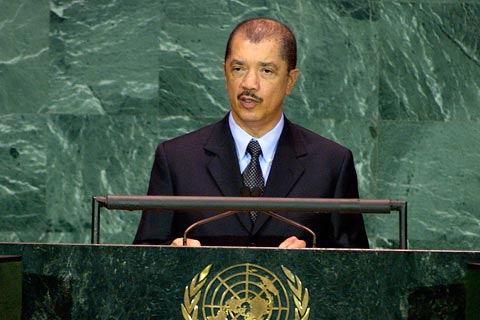
Seychelles President James Michel

Nations on the front lines of climate change expressed hesitant optimism for the U.S., as delegates gathered for The Energy and Resources Institute's 13th annual Delhi Sustainable Development Summit, whose goal is to tackle resource efficiency challenges.

Around the world, leaders pointed to the ways a changing climate was already affecting their nations.

Kiribati President Anote Tong told HuffPost his island nation is experiencing unprecedented coastal erosion, forcing some communities to relocate.

Seychelles President James Michel was unable to attend the summit because of recent flooding. As Seychelles Foreign Minister Jean-Paul Adam suggested, "We are very good fishermen, but we're not used to having to use our boats on the street."

Maldives Minister of Environment and Energy Dr. Mariyam Shakeela told a panel that extreme weather is now common. She added, "Dependence on unsustainable fossil fuel-based energy increases global warming and threatens climate security, which in turn affects our biodiversity, food and water security through droughts, floods and extreme weather events."

African Development Bank President Donald Kaberuka told a small group of journalists, "Seasons have become completely unpredictable. Farmers no longer know when to plant." Citing 2011's Horn of Africa drought as an example, he explained that "for farmers who live on nature, who live on a good understanding of seasons, this is a disaster." More


Friday, February 1, 2013

Increases in Extreme Rainfall Linked to Global Warming

Feb. 1, 2013 — A worldwide review of global rainfall data led by the University of Adelaide has found that the intensity of the most extreme rainfall events is increasing across the globe as temperatures rise.

In the most comprehensive review of changes to extreme rainfall ever undertaken, researchers evaluated the association between extreme rainfall and atmospheric temperatures at more than 8000 weather gauging stations around the world.


Lead author Dr Seth Westra said, "The results are that rainfall extremes are increasing on average globally. They show that there is a 7% increase in extreme rainfall intensity for every degree increase in global atmospheric temperature.

"Assuming an increase in global average temperature by 3 to 5 degrees Celsius by the end of the 21st century, this could mean very substantial increases in rainfall intensity as a result of climate change."

Dr Westra, a Senior Lecturer with the University of Adelaide's School of Civil, Environmental and Mining Engineering and member of the Environment Institute, said trends in rainfall extremes were examined over the period from 1900 to 2009 to determine whether they were becoming more intense or occurring more frequently.

"The results show that rainfall extremes were increasing over this period, and appear to be linked to the increase in global temperature of nearly a degree which also took place over this time.

"If extreme rainfall events continue to intensify, we can expect to see floods occurring more frequently around the world." Dr Westra said.

The strongest increases occurred in the tropical countries, although some level of increase seems to be taking place at the majority of weather gauging stations. More


Sunday, January 27, 2013

2013: A new plan to save the planet

1,000,000
705,613

705,613 have signed. Help us get to 1,000,000

Posted: 11 January 2013

In 2012, 700,000 of us took the issue of fossil fuel subsidies and thrust it into the political mainstream at the Rio Earth Summit and the Doha climate talks. While these meetings didn’t deliver any bold commitments, they did get almost every country to agree that paying polluters nearly one trillion dollars a year is crazy!


Now let's grow our call in 2013 and take it directly to key summits and meetings as they happen.Together we can stop these mad polluter payments and put some meat on the bones of the weak agreements leaders have already made. If we demand they act now on their word and divert this huge sum into renewable energy, experts say we could actually save our planet!

It's a simple no-brainer that most of our leaders have already agreed to. Let's hold their feet to the fire, and push the world's governments to turn these polluting subsidies green. Sign the petition on the right and forward this to everyone -- a massive campaign now can force them from talk to action. More


Nicholas Stern: 'I got it wrong on climate change – it's far, far worse'

Lord Stern, author of the government-commissioned review on climate change that became the reference work for politicians and green campaigners, now says he underestimated the risks, and should have been more "blunt" about the threat posed to the economy by rising temperatures.

In an interview at the World Economic Forum in Davos, Stern, who is now a crossbench peer, said: "Looking back, I underestimated the risks. The planet and the atmosphere seem to be absorbing less carbon than we expected, and emissions are rising pretty strongly. Some of the effects are coming through more quickly than we thought then."

The Stern review, published in 2006, pointed to a 75% chance that global temperatures would rise by between two and three degrees above the long-term average; he now believes we are "on track for something like four ". Had he known the way the situation would evolve, he says, "I think I would have been a bit more blunt. I would have been much more strong about the risks of a four- or five-degree rise."

He said some countries, including China, had now started to grasp the seriousness of the risks, but governments should now act forcefully to shift their economies towards less energy-intensive, more environmentally sustainable technologies.

"This is potentially so dangerous that we have to act strongly. Do we want to play Russian roulette with two bullets or one? These risks for many people are existential."

Stern said he backed the UK's Climate Change Act, which commits the government to ambitious carbon reduction targets. But he called for increased investment in greening the economy, saying: "It's a very exciting growth story."

David Cameron made much of his environmental credentials before the 2010 election, travelling to the Arctic to highlight his commitment to tackling global warming. But the coalition's commitment to green policies has recently been questioned, amid scepticism among Tory backbenchers about the benefits of wind power, and the chancellor's enthusiasm for exploiting Britain's shale gas reserves.

Stern's comments came as Jim Yong Kim, the new president of the World Bank, also at Davos, gave a grave warning about the risk of conflicts over natural resources should the forecast of a four-degree global increase above the historical average prove accurate.

"There will be water and food fights everywhere," Kim said as he pledged to make tackling climate change a priority of his five-year term.

Kim said action was needed to create a carbon market, eliminate fossil-fuel subsidies and "green" the world's 100 megacities, which are responsible for 60 to 70% of global emissions.

He added that the 2012 droughts in the US, which pushed up the price of wheat and maize, had led to the world's poor eating less. For the first time, the bank president said, extreme weather had been attributed to man-made climate change. "People are starting to connect the dots. If they start to forget, I am there to remind them. More


Saturday, January 26, 2013

Collapse

http://www.youtube.com/playlist?list=PL6919413BFA2CB0F6

Documentario NatGeo legendado National.Geographic.Collapse.

Thursday, January 24, 2013

Global food security a central topic at Davos 2013

Global leaders who gathered at the World Economic Forum Annual Meeting in Davos Wednesday called for “step up to scale up” efforts for strengthening the world’s food security by improving sustainable food production.

Working through the World Economic Forum’s New Vision for Agriculture initiative, more than 250 organizations are collaborating to improve sustainable food production and opportunities for farmers in 11 countries in Africa, Asia and Latin America, according to a news release posted at forum’s website (www.weforum.org). Together these activities will directly impact over 12 million smallholder farmers in the next three to five years, according to the news release.

“We have created new partnerships and new opportunities for smallholder farmers through our work with the New Vision for Agriculture initiative,” said Cao Duc Phat, Minister of Agriculture and Rural Development, Vietnam. The initiative helped to form and support a public-private task force engaging 30 organizations to focus investment and innovation on five crops prioritized by Vietnam’s national agriculture plan. The group is implementing projects to train, finance and engage smallholder farmers to increase sustainable production and farmer incomes.

A new report launched this week in Davos, titled Achieving the New Vision for Agriculture: New Models for Action, assesses progress to date and recommends action steps to advance progress in the 11 countries. Strengthening environmental sustainability, expanding access to finance, broadening stakeholder engagement and investing in local capacity-building are among its key recommendations.

“The New Vision for Agriculture has provided a way for stakeholders to align efforts to achieve sustainable agricultural growth,” said Michael Mack, Chief Executive Officer of Syngenta. “As a result, our company has developed significant new investments and partnerships in coordination with country leaders.”

The World Economic Forum and its constituents are hosting 12 sessions related to food security, nutrition and agriculture during Davos. “We are committed to engaging all stakeholders to create a stronger global food system,” said Sarita Nayyar, Managing Director of the World Economic Forum. “Engaging the private sector is an important part of that effort, to bring investment, innovation and efficiency into partnership efforts.”

Eight African countries are working with New Vision for Agriculture partners through Grow Africa, a partnership jointly convened by the African Union, NEPAD and the World Economic Forum. In Davos, African and global leaders will discuss implementation of more than US$ 3 billion in private-sector investment commitments in 2012. More


Tuesday, January 8, 2013

The Global Economy’s Dangerous Myopia – Are We Ignoring Future Crises?: Joseph Stiglitz

As global leaders continue to deal with their economies’ immediate problems, long-term issues such as global warming, inequality and poverty are being compromised – with potentially dangerous ramifications. Although today’s crises undoubtedly warrant immediate action, we should be asking whether we are responding in ways that will exacerbate our long-term problems.

NEW YORK – In the shadow of the euro crisis and America’s fiscal cliff, it is easy to ignore the global economy’s long-term problems. But, while we focus on immediate concerns, they continue to fester, and we overlook them at our peril.

The most serious is global warming. While the global economy’s weak performance has led to a corresponding slowdown in the increase in carbon emissions, it amounts to only a short respite.

And we are far behind the curve: Because we have been so slow to respond to climate change, achieving the targeted limit of a two-degree (centigrade) rise in global temperature, will require sharp reductions in emissions in the future.

Some suggest that, given the economic slowdown, we should put global warming on the backburner. On the contrary, retrofitting the global economy for climate change would help to restore aggregate demand and growth.

At the same time, the pace of technological progress and globalization necessitates rapid structural changes in both developed and developing countries alike. Such changes can be traumatic, and markets often do not handle them well.

Just as the Great Depression arose in part from the difficulties in moving from a rural, agrarian economy to an urban, manufacturing one, so today’s problems arise partly from the need to move from manufacturing to services. New firms must be created, and modern financial markets are better at speculation and exploitation than they are at providing funds for new enterprises, especially small and medium-size companies.

Moreover, making the transition requires investments in human capital that individuals often cannot afford. Among the services that people want are health and education, two sectors in which government naturally plays an important role (owing to inherent market imperfections in these sectors and concerns about equity). More