Sunday, November 9, 2014

The end of beaches? Why the world’s shorelines are in serious trouble

We can have our beachfront properties — our Miami high-rises, our Hamptons mansions, our Jersey boardwalks — or we can have our beaches. But as geologist and Duke University emeritus professor Orrin Pilkey has been arguing for decades now, we can’t have both.
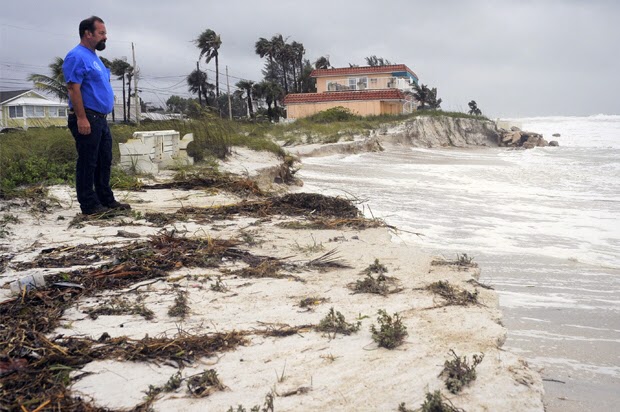
Bradenton Beach, June 2012

As the oceans warm and sea levels rise, coastal living is becoming an increasingly risky proposition. Any climate scientist would tell you not to invest in a beach house, and yet large-scale migration inland is something we’ve yet to see. The beaches themselves can withstand extreme weather, of course. But it’s our attempts to hold them in place, through techno-fixes like seawalls and beach replenishment, that ironically enough will end up destroying them. Sooner or later, Pilkey argues, we’re going to be forced to retreat. The question is whether there’ll be any beach left by then.

The Last Beach,” which Pilkey co-wrote with J. Andrew G. Cooper, a professor of coastal studies at the University of Ulster, is but his latest attempt to drive home just how wrong-headed our push to build on and preserve shorelines is. It’s been an uphill battle; for Pilkey, what counts as progress was that people acknowledged his plea not to rebuild after Superstorm Sandy instead of just attacking him for suggesting it — even if they didn’t really end up following his advice.

Bring pollution, oil spills and the destructive business of sand mining into the picture, and it’s not so extreme, Pilkey told Salon, to imagine a future where beaches as we know them — as places to live and even as places to visit — will no longer exist.

Our conversation, which has been lightly edited for length and clarity, follows.

We don’t typically think of beaches as something that can “go extinct,” but it seems like that’s basically what you’re arguing here.

That’s exactly what we argue: that beaches in developed areas will not be there, that they will be replaced by seawalls large and small. There will be beaches left in remote places and on national seashores and things like that, perhaps — although they’ll be suffering too, because they’ll be eroding and retreating back separately from the developed areas, which will be standing still for a while.

By the time we really begin to see what’s happening, like we are right now in Florida, we’ll be worrying about Manhattan and Queens and Boston and Washington, D.C., Philadelphia, Miami, Charleston, all those cities. We fully expect that the great expense required to hold back the shoreline — which is a losing proposition in any event — will be overwhelming for them.

It seems to us to be pretty obvious — and I think most geologists would agree with this — that in a 50- to 100-year timeframe we’re in trouble. The best example of that, the proof in the pudding, is Florida, where they have hundreds of miles of highrise-lined shoreline. What can they do? You could move the buildings back, but that’s very costly and there’s no place to move them to. So what we see right now, especially with the current governor of Florida, is the building of seawalls right and left. All you have to do is declare an emergency and you can build a seawall.

In the book, you also discuss how beaches have become dangerous places. So would you say there’s also a loss of beaches, not physically, but as we are able to enjoy them?

Yeah, that was the point of that. We, by the way, were really shocked — the one chapter that was really out of our range was pollution, and we were rather shocked at the numbers. We saw repeated statements about how to use a beach, if you’re going to go to a beach what should you do and how should you use it, in the technical literature, but it hasn’t been getting out to the public. Maybe that’s a little bit of irresponsibility on the part of some of the biochemists in not getting that out to the public. On the other hand, I know what would happen. They would get heavily criticized, probably, as being alarmists.

But yes, the fact is that the beaches are getting more and more polluted, and as more and more villages and towns and cities crowd up against the beaches that’s going to continue. Some of the things the literature said seemed rather outrageous to us. One is never to go barefoot on a beach. That’s a tough one. The one thing that everyone agrees is a bad thing to do is to get buried in the sand. And who in this world has not been buried in the sand at some time in their life? If you have a cut or an abrasion of some kind… I’ve always thought that going in the salt water had a healing effect on cuts, but that was really wrong. I’ve told that to a thousand students over the years, and if any of them are reading this I take it all back. It’s very dangerous.

Well, not very dangerous. There’s a very low probability of getting something, but if you do, the probability of getting something serious is high.

And that’s worse than it used to be?

There are no numbers to show it, that we know of, but yes. The pollutants on beaches are higher than they used to be, we think.

I imagine that you must have trouble getting people to take some of the issues you write about seriously. For example, there’s the beach that was stolen in Jamaica — something like that can come off as an offbeat, funny news story instead of a serious environmental crime. Do you come across that sort of response often?

Where we are not taken seriously? Of course, but I’m used to that because I’ve been arguing for years that we need to move houses back and retreat from the shoreline, or let houses fall in, but not leave them in place. My argument in the past in similar situations has been that we have a choice at the shoreline: We can have beaches or we can have buildings, but we can’t have them both. You have to take your choice — and of course, that is met with a lot of derision by beach property owners.

“The Last Beach,” I anticipate, will be met with some derision, because it seems a little extreme. But it’s not extreme at all. Of that I am certain. In my 40 years of working on this I can see the situation deteriorating. We’re going down a bad road, no question about it, and I feel confident about that.

Right after Superstorm Sandy, you wrote an article for the New York Times arguing that we shouldn’t rebuild. What kind of response did that get?

I got some money — somebody wanted to support my next book. Everything that happened to me directly was good, and I think the response was really good, surprisingly good. I heard that the American Shore & Beach Preservation Association (ASBPA) — which is a civilian group beating a hard drum of “there’s no need to retreat” — in their newsletter they made a few nasty comments about me…

A long time ago, when I started saying these things, the response was really negative, like “aw, c’mon, don’t be stupid, nobody’s going to move back.” Now, moving back is not outrageous, and the relationship between seawalls and the loss of beaches is pretty widely known. I think I can say that the response to that editorial was so different than it would have been 30 years ago, 20 years ago. And that’s a good thing.

What about the actual response from people working on recovery from the storm? Did anyone listen? Is the East Coast going to be just as vulnerable the next time a storm comes?

Thirty years ago, the response would have been massive seawalls, there’s no question of that. Hurricane Sandy was the first time I’ve heard serious discussion on the part of the governors of New Jersey and New York about maybe moving back and not rebuilding. As it was, they didn’t do much — they basically rebuilt — but that was music to my ears. I’ve never heard that before. In the past it’s always been “c’mon, we’re Americans, we’re not going to throw up our hands and slink away.”

Almost every house, if there was a house left, had an American flag in front of it. It brought out patriotism, for some reason or another. I guess that’s better than depression, but it’s different. Even though most of these things didn’t bear fruit, we’re getting there. I guess I’m learning that it takes years to get this into the public understanding. I don’t know how many years it’s going to take before we really start moving back, but we’re going to have to, no question about it, or we’ll just give up on the beach. I really believe that we will give up on the beach, for the most part. Beach replenishment, you see, will not be feasible as the sea level rises, because you’re holding the shoreline back in place, where it doesn’t want to be.

The beaches will disappear much faster than they are now. In North Carolina a typical beach lasts about three years. In New Jersey it’s probably about the same, and in Florida, where the wave energy is a little lower, it’s about seven to nine years. In any case, it’s a very costly proposition and it’s definitely going to get more costly.

How far back do people realistically need to move?

It all depends on where you are. If you’re on a barrier island you can move to the back side of the island, but the problem with that is that the back side of the island is lower in elevation. The highest elevation on most barrier islands is at the front of the island, so you’re moving back but on the other hand the chance of being struck directly by waves is increased.

For the most part, if someone is going to go through the cost of moving they ought to get off the island. In Florida, there ain’t no place to get off the island. It’s very, very low and flooding quickly as the sea level rises. We have a photograph in the book of the so-called “Outlaw House” in North Carolina (Outlaw was the family name). It was moved back three or five times, depending on who you believe, and right now it’s very close to the beach once again. That’s a mom-and-pop cottage, and initially it was moved by mules. All the houses near the Outlaw House now are all McMansions. They can be moved, but they’re expensive. The McMansion that was in the movie “Nights in Rodanthe” was just moved down the highway a bit to a safer place — I say safer, but not safe.

In a recent interview, you said you’ve stopped defining yourself as a scientist and have instead become a scientific advocate. When and how did that change come about?

I started out as a deep-sea sedimentologist. I worked on the continental margin of North Carolina and the abyssal plains — I sampled 13 abyssal plains around the world — but I got tired of going to sea. When my parents’ house was damaged in Hurricane Camille, my father and I wrote this little book called “How to Live On an Island,” and it was three eighths of an inch thick and it cost a dollar fifty, and I couldn’t believe the impact it had. People were asking to quote us and so forth, and I realized there was a real vacuum here and I began to move to the beach. I traded a research vessel for a 16-foot skiff, and I’m very happy about that. It’s been very satisfying.

When I first came to Duke it was not possible, before you get tenured, to get involved with controversial things with the general public. One had to wait until one had tenure before one could start pounding on the table about these things, and by the time I got my 16-foot skiff I was already tenured. I had also been a journal editor and a couple other things, and that gave me credibility in the scientific community. Nonetheless, I remember a number of times being criticized by scientists, basically saying “you’re off-base for doing this kind of thing.” I have a 25-book series, “Living with the Shore” for every state, and we have local geologists who were the senior authors of each of these books. I think for probably every book, at least one of the authors would say “I’m not going to lower myself and make science so simple,” or something to that effect, saying that “we can’t expect the public to understand everything we’re doing.”

But I don’t think I hear much of that anymore. I think at least geologists, and probably a lot of others now, are recognizing the value of being able to converse with the public. I know that most universities, Duke included, appreciate work that has an impact on the general public. It’s not like it was when I started at all. We are rewarded for doing such work, although there are local problems in individual states, probably in every state, where public schools still have problems. Here in North Carolina, I know at least two, maybe three geologists who have been asked to turn in their emails, or to furnish all emails that have to do with sea-level rise.

What you’re asking of the public is really difficult: You’re asking them to give up something they love, that they can protect in the short term, in favor of looking at the big picture. It’s something that people come up against with a lot of these environmental and climate problems. Do you have any insights into how to get that message through to people?

The reason you go to beaches is because you went down there with your mother and father during the summer and had the most wonderful time in your whole life, and what could be better than to live there year-round? But here in North Carolina we have some really good newspapers, at least on this issue. I spent a few years back in Woods Hole, Massachusetts, and I found that the people there were far less educated on the problem of beaches and seawalls and retreating shorelines. It was a very marginal thing in Massachusetts, but in North Carolina we have a much longer shoreline and a much higher-energy shoreline. So it’s not a surprise to most people. If they come here from Kansas it might be a surprise, but the locals here are pretty well-educated. Excepting the particular political situation we have right now, which is very pro-development — but that comes and goes — I think in North Carolina we’re better prepared than some other states.

The real resistance to good coastal management with a long-term view is coming not from the people who came down there because their mommy and daddy brought them to the beach. It’s coming from the people who are making money on it. From what I’ve seen here, the high-cost developments are the ones who are trying to change the laws to let them build seawalls. They’re going to protect the houses; they couldn’t give a damn about the general public. Up on South Hampton, New York, rich people are building massive walls. They’re doing things that are illegal in some communities, but when you have billions of dollars you can get an army of lawyers to hold off the community very readily. Wealthy communities are the problem. More


Saturday, November 8, 2014

Ocean acidification tops the annual list of important stories ignored by the mainstream media

Our oceans are acidifying — even if the nightly news hasn't told you yet.

As humanity continues to fill the atmosphere with harmful gases, the planet is becoming less hospitable to life as we know it. The vast oceans absorb much of the carbon dioxide we have produced, from the industrial revolution through the rise of global capitalism. Earth's self-sacrifice spared the atmosphere nearly 25 percent of humanity's CO2 emissions, slowing the onslaught of many severe weather consequences.

Although the news media have increasingly covered the climate weirding of global warming — hurricane superstorms, fierce tornado clusters, overwhelming snowstorms, and record-setting global high temperatures — our ocean's peril has largely stayed submerged below the biggest news stories.

The rising carbon dioxide in our oceans burns up and deforms the smallest, most abundant food at the bottom of the deep blue food chain. One vulnerable population is the tiny shelled swimmers known as the sea butterfly. In only a few short decades, the death and deformation of this fragile and translucent species could endanger predators all along the oceanic food web, scientists warn.

This "butterfly effect," once unleashed, potentially threatens fisheries that feed over 1 billion people worldwide.

Since ancient times, humans fished the oceans for food. Now, we're frying ocean life before we even catch it, starving future generations in the process. Largely left out of national news coverage, this dire report was brought to light by a handful of independent-minded journalists: Craig Welch from the Seattle Times, Julia Whitty of Mother Jones, and Eli Kintisch of ScienceNOW.

It is also the top story of Project Censored, an annual book and reporting project that features the year's most underreported news stories, striving to unmask censorship, self-censorship, and propaganda in corporate-controlled media outlets. The book is set for release in late October.

"Information is the currency of democracy," Ralph Nader, the prominent consumer advocate and many-time presidential candidate, wrote in his foreword to this year's Project Censored 2015. But with most mass media owned by narrow corporate interests, "the general public remains uninformed."

Whereas the mainstream media poke and peck at noteworthy events at single points in time, often devoid of historical context or analysis, Project Censored seeks to clarify understanding of real world issues and focus on what's important. Context is key, and many of its "top censored" stories highlight deeply entrenched policy issues that require more explanation than a simple sound bite can provide.

Campus and faculty from over two dozen colleges and universities join in this ongoing effort, headquartered at Sonoma State University. Some 260 students and 49 faculty vet thousands of news stories on select criteria: importance, timeliness, quality of sources, and the level of corporate news coverage.

The top 25 finalists are sent to Project Censored's panel of judges, who then rank the entries, with ocean acidification topping this year's list.

"There are outlets, regular daily papers, who are independent and they're out there," Andy Lee Roth, associate director of Project Censored, told us. Too many news outlets are beholden to corporate interests, but Welch of the Seattle Times bucked the trend, Roth said, by writing some of the deepest coverage yet on ocean acidification.

"There are reporters doing the highest quality of work, as evidenced by being included in our list," Roth said. "But the challenge is reaching as big an audience as [the story] should."

Indeed, though Welch's story was reported in the Seattle Times, a mid-sized daily newspaper, this warning is relevant to the entire world. To understand the impact of ocean acidification, Welch asks readers to "imagine every person on earth tossing a hunk of CO2 as heavy as a bowling ball into the sea. That's what we do to the oceans every day."

Computer modeler Isaac Kaplan, at the National Oceanic and Atmospheric Administration office in Seattle, told Welch that his early work predicts significant declines in sharks, skates and rays, some types of flounder and sole, and Pacific whiting, the most frequently caught commercial fish off the coast of Washington, Oregon, and California.

Acidification may also harm fisheries in the farthest corners of the earth: A study by the Arctic Monitoring and Assessment Programme outlines acidification's threat to the arctic food chain.

"Decreases in seawater pH of about 0.02 per decade have been observed since the late 1960s in the Iceland and Barents Seas," the study's authors wrote in the executive summary. And destroying fisheries means wiping out the livelihoods of the native peoples of the Antarctic.

Acidification can even rewire the brains of fish, Welch's story demonstrated. Studies found rising CO2 levels cause clown fish to gain athleticism, but have their sense of smell redirected. This transforms them into "dumb jocks," scientists said, swimming faster and more vigorously straight into the mouths of their predators.

These Frankenstein fish were found to be five times more likely to die in the natural world. What a fitting metaphor for humanity, as our outsized consumption propels us towards an equally dangerous fate.

"It's not as dramatic as say, an asteroid is hitting us from outer space," Roth said of this slowly unfolding disaster, which is likely why such a looming threat to our food chain escapes much mainstream news coverage.

Journalism tends to be more "action focused," Roth said, looking to define conflict in everything it sees. A recently top-featured story on CNN focused on President Barack Obama's "awkward coffee cup salute" to a Marine, which ranks only slightly below around-the-clock coverage of the president's ugly tan suit as a low point in mainstream media's focus on the trivial.

As Nader noted, "'important stories' are often viewed as dull by reporters and therefore unworthy of coverage." But mainstream media do cover some serious topics with weight, as it did in the wake of the police officer shooting of Michael Brown in Ferguson, Mo. So what's the deciding factor?

As Roth tells it, corporate news focuses on "drama, and the most dramatic action is of course violence."

But the changes caused by ocean acidification are gradual. Sea butterflies are among the most abundant creatures in our oceans, and are increasingly born with shells that look like cauliflower or sandpaper, making this and similar species more susceptible to infection and predators.

"Ocean acidification is changing the chemistry of the world's water faster than ever before, and faster than the world's leading scientists predicted," Welch said, but it's not getting the attention is deserves. "Combined nationwide spending on acidification research for eight federal agencies, including grants to university scientists by the National Science Foundation, totals about $30 million a year — less than the annual budget for the coastal Washington city of Hoquiam, population 10,000."

Our oceans may slowly cook our food chain into new forms with potentially catastrophic consequences. Certainly 20 years from now, when communities around the world lose their main source of sustenance, the news will catch on. But will the problem make the front page tomorrow, while there's still time to act?

Probably not, and that's why we have Project Censored and its annual list: More


Science has Spoken - Ban Ki Moon


Offshore islands amplify, rather than dissipate, a tsunami's power

A long-held belief that offshore islands protect the mainland from tsunamis turns out to be the exact opposite of the truth, according to a new study.

Common wisdom — from Southern California to the South Pacific — for coastal residents and scientists alike has long been that offshore islands would create a buffer that blocked the power of a tsunami. In fact, computer modeling of tsunamis striking a wide variety of different offshore island geometries yielded no situation in which the mainland behind them fared better.

Instead, islands focused the energy of the tsunami, increasing flooding on the mainland by up to 70 percent.

“This is where many fishing villages are located, behind offshore islands, in the belief that they will be protected from wind waves. Even Southern California residents believe that the Channel Islands and Catalina will protect them,” said Costas Synolakis of the USC Viterbi School of Engineering, a member of the multinational team that conducted the research.

The research was inspired by a field survey of the impact of the 2010 tsunami on the Mentawai Islands off of Sumatra. The survey data showed that villages located in the shadow of small offshore islets suffered some of the strongest tsunami impacts, worse than villages located along open coasts.

Subsequent computer modeling by Jose Borrero, adjunct assistant research professor at the USC Viterbi Tsunami Research Center, showed that the offshore islands had actually contributed to — not diminished — the tsunami’s impact.

Synolakis then teamed up with researchers Emile Contal and Nicolas Vayatis of Ecoles Normales de Cachan in Paris; and Themistoklis S. Stefanakis and Frederic Dias, who both have joint appointments at Ecoles Normales de Cachan and University College Dublin to determine whether that was a one-of-a-kind situation, or the norm.

Their study, of which Dias was the corresponding author, was published in Proceedings of the Royal Society A on Nov. 5.

The team designed a computer model that took into consideration various island slopes, beach slopes, water depths, distance between the island and the beach, and wavelength of the incoming tsunami.

“Even a casual analysis of these factors would have required hundreds of thousands of computations, each of which could take up to half a day,” Synolakis said. “So instead, we used machine learning.”

Machine learning is a mathematical process that makes it easier to identify the maximum values of interdependent processes with multiple parameters by allowing the computer to “learn” from previous results.

The computer starts to understand how various tweaks to the parameters affect the overall outcome and finds the best answer quicker. As such, results that traditionally could have taken hundreds of thousands of models to uncover were found with 200 models.

“This work is applicable to some of our tsunami study sites in New Zealand,” said Borrero, who is producing tsunami hazard maps for regions of the New Zealand coast. “The northeast coast of New Zealand has many small islands offshore, similar to those in Indonesia, and our modeling suggests that this results in areas of enhanced tsunami heights.”

“Substantial public education efforts are needed to help better explain to coastal residents tsunami hazards, and whenever they need to be extra cautious and responsive with evacuations during actual emergencies,” Synolakis said. More


Thursday, November 6, 2014

Lord Stern: global warming may create billions of climate refugees

Lord Nicholas Stern, one of the world’s most influential voices on climate economics, does not mince his words when it comes to criticising those who take a narrow view of prosperity and highlighting the devastating consequences of global warming.

Nicholas Stern

"You have to be a complete idiot to think that GDP sums up prosperity," says Stern, who believes we need to develop broader measures of success and combine this with a return to core values if we are to convince people to act to prevent runaway climate change.

Stern, who wrote the landmark 2006 Stern review of the economics of climate change, says if we fail to take heed of the danger signals, we risk temperatures rising this century to levels we haven’t seen for tens of millions of years.

"Hundreds of millions of people, perhaps billions of people would have to move," he warns. "If we’ve learned anything from history that means severe and extended conflict.

"We couldn’t just turn it off. You can’t make a peace treaty with the planet, you can’t negotiate with the laws of physics. You’re in there, you’re stuck. Those are the stakes we’re playing for and that’s why we have to make this second transformation, the climate transformation and move to low carbon economy."

Stern has co-authored the recently published New Climate Economy report, which argues that the world can head off the worst effects of climate change, and enjoy the fruits of continued economic expansion, if it moves quickly to invest in a low-carbon economy.

He says he hopes the study will influence key decision makers because it was written with the support of a coalition of respected politicians, economists, think tanks and institutions, including the World Bank, the International Monetary Fund, the OECD, the International Energy Agency and the UN.

He dismisses the arguments of more radical economists who believe that we need to stop our fixation with growth, arguing that the economy needs to keep expanding if we are to have a hope of eradicating poverty.

"To those who want to knock out growth from objectives, I find they’re close to reprehensible because for me the two defining challenges of this century are overcoming poverty and managing climate change.

"We fail on one, we fail on the other. So I think to say that we should just switch off growth is to miss big aspects of what matters about poverty. And so it worries me. It’s also politically very naive. If you turn it into a pissing contest between growth on the one hand and climate and environment on the other and say you’ve got to choose, you’re setting yourself up for failure."

Stern says investments in renewable energy must be combined with a rethinking of our understanding of prosperity, which he believes will lead to what he terms better growth.

"It means thinking differently about health, about the way we live in our cities and about the strengths of our communities," he says. "It’s not that GDP is idiotic but it’s mostly about the use of labour resources and what it produces. But there are very important parts of this story about prosperity that get missed out."

How does Stern, who is president of the British Academy, believe we can start to measure prosperity that goes beyond GDP?

He says it is vital to start from the perspective of people understanding what they mean by wellbeing and what they value, whether it is family, community, arts or sport.

"You can be reasonably empirical about what moves people and then you go and try to collect data on that," he says. "Once you understand what it is it you’re trying to capture and create indicators, you can then start to talk about policy."

The 68-year-old peer says it’s vital we go back to recognising the importance of Aristotle’s belief in the need to understand what it means to be a virtuous person and to whom we owe a duty of care.

"I’ve been an academic all my life and I look at the evidence of what works and what doesn’t work," he says. "But if you ask yourself what you’re trying to do, that’s spurred by values, by what’s important to you."

For Stern, the heart of his values lies in the importance of family. Speaking immediately after introducing his two-week old granddaughter Rosa on stage at a TEDx talk in New York, he said: "I’m 68 and I am thinking what will Rosa be like when she’s 68? We’re talking about towards the end of this century and what we do now will determine whether the next 100 years is the best of centuries or the worst of centuries."

"Are we going to look our grandchildren in the eye and tell them that we understood the issues, that we recognised the dangers and the opportunities, and still we failed to act?"

Stern believes that it is time for religious leaders, politicians and the media to act more responsibly, pointing in particular to the importance of the Pope’s statement earlier this year that if we destroy creation, creation will destroy us.

Also key to changing hearts and minds is the field of arts, with Stern pointing to Barbara Kingsolver’s book Flight Behaviour, which he says is not only wonderful in describing the human condition but also in questioning our relationship with the environment.

"It’s not just the policy wonks like me we need to try to assemble the evidence and set it out," he says. "You have to do that because emotional argument without rational evidence on cause and effect doesn’t get you all that far. But rational argument about cause and effect alone doesn’t get you there either." More


Tuesday, November 4, 2014

Cayman Renewable Energy Association Launches

Cayman Renewable Energy Association launched last week. In this segment we learn more about the group’s mission and what they see as the next step in implementing alternative energy in Cayman.

James E. Whittaker of GreenTech Group of Companies and Jim Knapp of Endless Energy talk to Vanessa Hansen of Cayman 27 about the premise of the organiization and why it’s important to have the association in Cayman.

Climate change and smart grid? There are more linkages than you think

When you think of climate change and energy, what springs to mind? Coal, fossil fuel, power plants, renewables, and efficiency are likely on your list, whether as contributors or mitigation options. But if demand response and smart grid are not on your list, it is incomplete.

Smart Grid

You are not alone. The EPA didn’t put them on its “list” when it put out its draft Clean Power Plan (111d) earlier this year. The fact is, however, that smart grid and things under its umbrella like DR, storage, etc. should be squarely on the table when climate-related plans are being made.

There are three questions regarding smart grid and climate change that are being asked these days. There is also one question that is not being asked but should be. They will all be part of the discussion at the upcoming National Summit on Smart Grid and Climate Change on December 2-3, but let’s take a quick look at them now.

The first two are:

  1. Can states use smart grid (and anything like DR, storage, etc that is under its umbrella) in their compliance plans under the EPA Clean Power Plan (111d)?
  2. If the answer to the first question is yes, will that give a boost to smart grid activity?

The third one is:

3. Which should happen first? Grid Hardening or Grid “Smartening”? Or should they be done together?

The first two questions fall into the category of climate mitigation and emissions reduction. Even before the EPA Plan came out, smart grid and DR were not seen as saving kWh, and therefore emissions. They were focused on kW reduction, and only for short amounts of time, usually on peak, right?

Well, that may have been true once, but that is not the case anymore. DR is no longer just about the peak. It has evolved into technology-based intelligent energy management. It has become dynamic efficiency, as opposed to traditional end-use efficiency. As such, it optimizes and reduces energy consumption and emissions. But even where DR is used solely as a peak management tool, studies show that there is little if any “bounce back” effect during the off-peak( i.e. not all of the usage that was reduced is replaced) and that on average there is a 4-5% overall reduction.

Let’s look at another smart grid option – Conservation Voltage Reduction (CVR). This option is essentially one where smart grid technology allows a utility to provide the same service to the customer while also lowering voltage, which in turn lowers usage and therefore emissions. CVR has been shown to generate around 1% savings, and customers don’t have to do anything.

Thankfully, with a little prodding by the SG and DR community, EPA has seen the light and now commonly speaks out to say that smart grid is definitely eligible for states to consider putting in their 111d compliance plans. EPA has clarified that the four specified “building blocks” in its plan were for purposes of determining goals. They are not prescriptive choices. States can put anything they want to in their plan, as long as they demonstrate that there will be reductions.

So that brings us to question 2 – what does that mean for smart grid? Well, if it is eligible to be used in a state plan, that should be good, right? Not necessarily. First, the people putting together the state plans need to not be hung up on the myth that there are no reductions from smart grid. EPA saying it is eligible only means it is on the shopping list for states. The key is getting them to select it, and that may take a focused education effort on the part of the smart grid and DR community. And it wouldn’t hurt if as part of that effort, states were reminded that they can’t plan to do large amounts of intermittent renewables on the system and not think about DR and smart grid – yet another reason to put them into a plan.

Finally, let’s examine question 3on climate adaptation. Whatever climate change scenario one subscribes to, few if any speak out against the need to prepare for change, whether it is sea level rise, storms, or rising temperatures. So is there a role for smart grid? At the National Summit on Smart Grid and Climate Change, an entire track has been devoted to that discussion.

When it comes to the electricity system, resiliency is the word one hears most. While definitions of that differ, two of the common attributes of a resilient system are flexibility and diversity. That means not putting all of your eggs into one power system, or one line. It means seeking strength through a distribution system that is really distributed – not just for delivery of power, but for generating it. That is where distributed energy resources (DER) and microgrids – both part of the smart grid diaspora – come into play. They help increase the resiliency of a system. Of course such a system needs management. But that is where the new smart grid technologies provide the ability to sense, monitor, communicate, and control.

The challenge in the question is this: some grid resiliency efforts in the wake of Superstorm Sandy and other similar events are focusing on grid hardening – not grid smartening. Now I agree that grid hardening sounds conceptually comforting. After all, raising the level of a substation so that storm waters will flow underneath it (a real example) is pretty straightforward and understandable. But where does that get us in the end? How has that modernized the grid? Don’t get me wrong, I believe that grid hardening should be pursued where it makes sense, but not at the total exclusion of grid smartening.

In an ideal world, states would be looking at a climate adaption plan at the same time they are putting together a climate mitigation plan. In that ideal world, smart grid would get bonus points for being something that can go into both plans. But we don’t live in an ideal world, and state agencies operate in silos. It may be up to the DR and smart grid communities to help them with their plans, and help them connect the dots that will make those plans better and create better opportunities for smart grid. More