Showing posts with label level. Show all posts

Tuesday, September 18, 2018

As the Biosphere Dies, So Do We: Using the Power of Nature to Heal the Planet


One only need look outside the window to understand that human-caused climate disruption is in overdrive.

Record warm temperatures, floods, droughts, wildfires and increasing incidents of extreme weather events have run rampant across the Northern Hemisphere this summer. These events, at least in part, stem from a global temperature increase of “only” 1 degree Celsius (1°C) above preindustrial baseline temperatures.

Harvard and MIT biogeochemist and climate and coral reef expert Dr. Thomas Goreau put this in stark perspective.

“Today’s carbon dioxide levels at 400 parts per million (ppm) [are] akin to bringing about a steady state temperature of 7°C higher and sea levels 23 meters higher than they are today,” Goreau, who is also president of the Global Coral Reef Alliance and coordinator of the Soil Carbon Alliance, told Truthout. In other words, the last time there was this much carbon dioxide in the atmosphere, it increased the Earth’s temperature to a point 7°C higher than it is today, and increased sea levels 23 meters above their current level. Hence, we are now only waiting for the planet to catch up to what we’ve done to the atmosphere.
Read More

Sunday, September 16, 2018

Global Warming’s Paper Trail


In the 1980s, oil companies like Exxon and Shell carried out internal assessments of the carbon dioxide released by fossil fuels, and forecast the planetary consequences of these emissions. In 1982, for example, Exxon predicted that by about 2060, CO2 levels would double relative to the 1800s, and that this, according to the best science at the time, would push the planet’s average temperatures up by about 3°C.

Later that decade, in 1988, an internal report by Shell projected similar effects, but also found that CO2 could double even earlier, by 2030. Privately, these companies did not dispute the links between their products, global warming, and ecological calamity. On the contrary, their research confirmed the connections.

Shell’s assessment foresaw a 60-70 cm rise in sea level, and noted that warming could also fuel the disintegration of the West Antarctic Ice Sheet, resulting in a worldwide rise in sea level of “five to six meters.” That would be enough to inundate entire low-lying countries.

Shell’s analysts also warned of the “disappearance of specific ecosystems or habitat destruction,” predicted an increase in “runoff, destructive floods, and inundation of low-lying farmland,” and said that “new sources of freshwater would be required” to compensate for changes in precipitation. Global changes in air temperature would also “drastically change the way people live and work.” All told, Shell concluded, “the changes may be the greatest in recorded history.”

For its part, Exxon warned of “potentially catastrophic events that must be considered.” Like Shell’s experts, Exxon’s scientists predicted devastating sea-level rise, and warned that the American Midwest and other parts of the world could become desert-like. Looking on the bright side, the company expressed its confidence that “this problem is not as significant to mankind as a nuclear holocaust or world famine.”

The documents make for frightening reading. And the effect is all the more chilling in view of the oil giants’ refusal to warn the public about the damage that their own researchers predicted. Shell’s report, marked “confidential,” was first disclosed by a Dutch news organization earlier this year. Exxon’s study was not intended for external distribution, either; it was leaked in 2015. Read More

Saturday, September 1, 2018

Planetary Emergency

I would argue that under the premise of the Geneva Conventions, and with the threat of global heating and climate change, a Planetary Emergency, no Nation State can be bar anyone from entering their country.

Thursday, August 30, 2018

Samoan Prime Minister Tuilaepa Sailele hits out at climate change sceptics during fiery speech


Samoan Prime Minister Tuilaepa Sailele has lashed out at climate sceptics and urged Australia to make deeper cuts to carbon emissions to help save Pacific Island nations from the "disaster" of climate change.

Mr Sailele told the Lowy Institute in Sydney that climate change posed an "existential challenge" to low lying islands in the Pacific, and developed countries needed to reduce pollution in order to curb rising temperatures and sea levels.
"We all know the problem, we all know the solutions, and all that is left would be some political courage, some political guts, to tell people of your country there is a certainty of disaster," Mr Sailele said.
"So any leader of any country who believes that there is no climate change, I think he ought to be taken to mental confinement. He is utterly stupid. And I say the same thing to any leader here."
The Prime Minister's intervention came as some Coalition MPs press the new Prime Minister Scott Morrison to abandon Australia's promise to cut carbon emissions under the Paris agreement.

New Foreign Minister Marise Payne is also expected to face questions about Australia's climate change policies at the Pacific Islands Forum leader's meeting in Nauru next week.
Senator Payne and Pacific leaders are set to sign the "Biketawa Plus" security agreement, which declares that climate change remains the "single greatest threat to the livelihoods, security and wellbeing of the peoples of the Pacific".
Several other leaders — including Fiji's President Frank Bainimarama and the Marshall Island's President Hilda Heine — have also called on Australia to do more to cut emissions.
Mr Sailele told the audience that "greater ambition" was needed to stop the destructive impact of climate change. Read More

Wednesday, August 29, 2018

Trump Nudges Global Climate-Change Politics to the Right - The Atlantic

Without Visionary Leadership and a Global Effort Homo Sapiens future looks exceedingly bleak


At a basic level, this pattern holds up, well, everywhere. Every country except the United States supports the Paris Agreement on climate change. But no major developed country is on track to meet its Paris climate goals, according to the Climate Action Tracker, an independent analysis produced by three European research organizations. Even Germany, Japan, and the United Kingdom—where right-wing governments have made combatting climate change a national priority—seem likely to miss their goals.

Simply put: This kind of failure, writ large, would devastate Earth in the century to come. The world would blow its stated goal of limiting atmospheric temperature rise. Heatwaves might regularly last for six punishing weeks, sea levels could soar by feet in a few short decades, and certain fragile ecosystems—like the delicate Arctic permafrost or the kaleidoscopic plenty of coral reefs—would disappear from the planet entirely. Read More

Thursday, August 2, 2018

State of the Climate 2017- American Meteorological Society


State of the Climate 2017

An international, peer-reviewed publication released each summer, the State of the Climate is the authoritative annual summary of the global climate published as a supplement to the Bulletin of the American Meteorological Society.
The report, compiled by NOAA’s Center for Weather and Climate at the National Centers for Environmental Information is based on contributions from scientists from around the world. It provides a detailed update on global climate indicators, notable weather events, and other data collected by environmental monitoring stations and instruments located on land, water, ice, and in space.


(https://www.ametsoc.org/ams/index.cfm/publications/bulletin-of-the-american-meteorological-society-bams/state-of-the-climate/

Monday, June 18, 2018

Climate Mobilization in Inside Philanthropy


Margaret Klein Salamon States: I am absolutely thrilled by an article that recently appeared in Inside Philanthropy, and wanted to share it with you. It is a deep dive into what “climate mobilization” means, our City by City project, and the $100,000 grant that Climate Mobilization Project recently won from the Unitarian Universalist Congregation on Shelter Rock.

The first and last paragraphs are below. Please read the entire article and share it widely, especially with anyone you know in the philanthropic world.

Many thanks,
Margaret


An Unusual Grant Fuels a Push to Start Treating Climate Change as a Real Emergency
By Tate Williams

A major challenge to organizing and advocacy around climate change is how even to approach a problem so large, complex, and gradually advancing (although it feels less gradual with every year, to be honest).

An advocacy group that launched in 2014 has one answer—we respond like we’re at war.

For the Climate Mobilization Project, the climate crisis demands not incremental changes or gradual reductions in emissions, but an emergency response led by government that is on the scale of the response to World War II after the attack on Pearl Harbor. The group just picked up a grant from the Unitarian Universalist Congregation of Shelter Rock of $100,000, an amount they say is the “country’s single largest philanthropic investment in emergency climate action.”

...

The compelling thing about the Climate Mobilization Project is that, while arguably unrealistic in its goals—since there's no political consensus on this issue, as Rockoff's paper notes—it is unflinching in its diagnosis of the level of response that climate change warrants. Much of its goal is to build a movement around how we should collectively think about climate change—mainly that the status quo of the approach to date is unacceptable. And from the standpoint of a funder like UUCSR, it’s a status quo that’s certainly unjust.

Read the Full Article


The Climate Mobilization

Sunday, January 14, 2018

Battling the Titans – Albert Bates


North America fell into a pocket in 2017 but it was not the pocket of banksters. It fell into that in 2008.
In 2017 it found itself niftily enveloped by the ingenious pincer movements of three generals. First, the Southern attack by General Poseidon, God of the Oceans, striking at Houston before making amphibious landings on the coasts of Florida after devastating aerial attacks on Puerto Rico and the Virgin Islands. Next, the Western attack of General Hephaestus, God of Fire, reducing Santa Rosa and much of the Los Angeles foothills to ashes. Finally, the cyclone bombing invasion of the North by Moroz-Voevoda (General Winter).
Four decades of climate data now show that the jet stream — usually referred to as the polar vortex this time of year — is weakening. Normally a freight train circling the Arctic, it has slowed to more resemble a curious python, poking its nose below the Great Lakes more frequently and for longer looks. Just as the cold air that precedes the arrival of Nosferatu, a deep and foreboding chill is being felt at ever lower latitudes. Read More

Friday, January 12, 2018

Act now to protect millions from floods — study


When we think of climate catastrophes, flooding is pretty high on the list of nightmare scenarios. But it's not just rising sea levels that are threatening communities with inundation: New research shows that ever more of us are at risk from rivers bursting their banks.
As the global temperature rises, water evaporates into the air, humidity increases, clouds form — and what goes up must come down. It's among the laws of physics: Warmer air holds more moisture, meaning bigger clouds that can travel further, resulting in even more extreme storms.
Since the mid-1980s, climate scientists have recorded a 20 percent increase in record-breaking rainfall around the world — with devastating consequences.
In 2017, flooding across India, Bangladesh and Nepal affected 40 million people, and more than 1,200 died. In flooding in Sierra Leone, more than 1,100 people perished. As Peru recorded 10 times the normal level of rainfall, hundreds of thousands of people were displaced and at least 70 killed.
To round out the inventory of flooding's impact for last year, lives were also lost to flooding in China, the Philippines, Italy, and Vietnam, among other locations.
And 2018 has carried the trend forward. This week, at least 17 people were killed as dramatic storms swept California. Roads looked like rivers and homes were destroyed.


(http://www.dw.com/en/act-now-to-protect-millions-from-floods-study/a-42110153

Wednesday, July 26, 2017

An Inconvenient Sequel: Truth To Power

An Inconvenient Sequel: Truth To Power - Get Involved! in a Reality Check

This weekend, former US Vice President Al Gore returns to the big screen with An Inconvenient Sequel: Truth to Power, a new film that celebrates the movement you've helped to create and generates new momentum in the most important fight of our time.

This film comes a little more than a decade after An Inconvenient Truth, the film that launched a global movement and inspired thousands of activists like you to join Vice President Gore in his mission to spread the word about the climate crisis and its solutions.

An Inconvenient Sequel: Truth to Power highlights the actions of Climate Reality Leaders like in the years since the first film, and sends a message that we can't stop now.

Now is the time for all of us to fight like our world depends on it.

This film provides a unique moment for us to gather our friends and networks and enlist them in this fight, helping to ensure that the climate crisis becomes a prominent issue for all communities in the months and years to come.

Besides taking others to see the film and sharing opportunities for local action, we can also share Vice

President Gore's new handbook for climate action. The book is a guide to making a difference and features the impactful stories of a number of Climate Reality Leaders, and is available from Amazon and other booksellers.

As this film and the accompanying handbook reach audiences across the US and around the globe, we have a powerful opportunity to build momentum and urgency around climate action at all levels of society.

Whether you take this chance to rally your community to the cause, or simply log an extra Act of Leadership in coming weeks, we know Climate Reality Leaders won't let this powerful moment pass by.

The film premieres in New York and Los Angeles this Friday, July 28, and in cities across the US on
August 4.

Not in the US? International release dates are still being revealed and updated all the time, so search your favorite movie website to find out if An Inconvenient Sequel: Truth to Power is showing soon in your area.

Sunday, March 27, 2011

Cuba Cooperates with Seychelles on Hazards of Sea-level Rise


Victoria, Mar 26 (Prensa Latina) Seychelles' President James Michel welcomed a team of Cuban scientists that concluded the first phase of a study on the hazards of sea-level rise and coastal flooding in this island nation of the Indian Ocean.

Headed by Juana Serrano, the group of Cuban experts presented the results of the first stage of the project to President Michel, and discussed with him some preliminary ideas on the outcome of the second phase.

Present at the meeting on Friday at State House were Minister for Home Affairs, Environment, Transport and Energy Joel Morgan, director-general of the Climate and Environmental Services Division Wills Agricole, and Cuban ambassador to Seychelles Maria Aida Nogales.

Work on the one-year project started in September last year, and the Cuban team has been in the country since late February to carry out the next stage, recalled Seychelles Nation newspaper. More >>>

Thursday, December 2, 2010

Modelling the Transformational Impacts and Cost of Sea Level Rise in the Caribbean


This study provides the most detailed analysis to date of the damages and costs associated with SLR for the CARICOM nations, and builds on work completed in Phase I in 2009. 
Previous economic studies as well as recent developments identified in the Economics of Climate Change Working Group (ECA) study in estimating impacts due to climate change.  The methodology incorporates top-down and bottom-up approaches (i.e., macro, meso- and micro-scales analyses) to model impacts on the economies of each CARICOM country individually.  A unique strength of this economic study is that it is based on the most detailed geographic reality of coastal geomorphology and development that determine vulnerability to SLR. 
The economic implications of the impacts of climate change and required adaptation are being increasingly quantified to better inform international negotiations regarding adaptation assistance. 
Such in-depth information is essential for the Caribbean States, SIDS and LDCs to strategically reduce vulnerability through investment, insurance, planning, and policy decisions, and inform negotiations regarding adaptation assistance under the Copenhagen Accord that was agreed at COP15 in Copenhagen.
OutputsKey Points Document - Download
Summary Document - Download

Friday, July 16, 2010

Sea Level Rise Will Vary

Sea-Level Rise Will Be Worse For Some, We Just Don’t Know Who

The Seychelles could see up to ten percent more sea-level rise than the global average. Or the sea level around the islands could drop. It depends on who you ask.
The fact that oceans will rise in a warming world is well established, but depending on how wind patterns change, climate change could mean quick inundation or more beach space for different coastlines. Wind patterns maintain height differences between different regions of the ocean, and if altered or intensified, they would push water from one part of the ocean to another.
The resulting sea-level changes could be up to thirty percent more, or less, than the global average in some regions, says oceanographer Axel Timmermann.
The problem is that scientists are just beginning to understand what will happen to climate at scales smaller than entire continents or ocean basins.


Read More http://www.wired.com/wiredscience/2010/07/regional-sea-rise/#ixzz0tssmKxLK

Wednesday, July 7, 2010

Sea level to rise one metre in 21st century

Professor Tim Naish, the lead author of the next international climate change assessment due for release in 2014, is predicting a one metre rise in sea levels over the next 90 years.  

This will be a doubling of the present rate of sea-level rise, but a slower rate rise than predicted by other researchers.

Prof. Naish has been appointed lead author by the Intergovernmental Panel on Climate Change. His forecast is based on rock cores drilled from the Antarctic coastline that provide evidence of the earth’s geological condition 4 million years ago when the climate was similar to the ‘climate we are heading towards in the next century with global warming,’ he says.

During that ancient period, the West Antarctic ice sheet melted and raised seas by a total of five metres, and the Greenland ice sheet melted adding another seven metres, says Prof. Naish, who is director of New Zealand’sAntarctic Research Centre at Victoria University in Wellington.

Prof. Naish’s latest findings will be presented at the Australian Earth Sciences Convention in Canberra 4-8 July 2010. More >>>

Friday, April 30, 2010

EPA Seientist Says East Coast Beaches Threatened By Sea Level Rise, But Nobody’s Listening


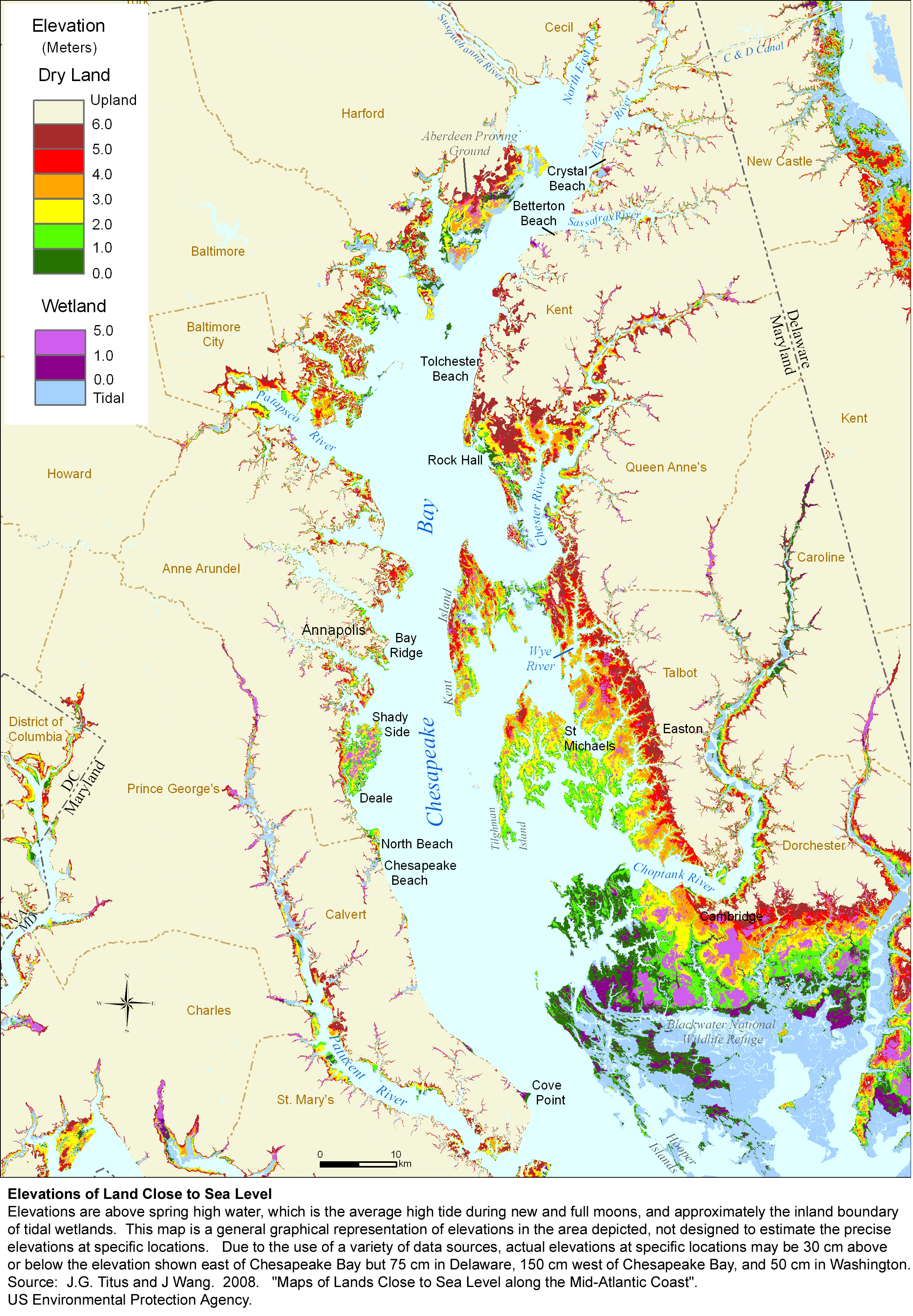
For most of the 20th century, Chesapeake Beach, Maryland, was known for its boardwalk, amusement park and wide, sandy beaches, popular with daytrippers from Washington, D.C.

“The bathing beach has a frontage of three miles,” boasted a tourist brochure from about 1900, “and is equal, if not superior, to any beach on the Atlantic Coast.”Today, on a cloudless spring afternoon, the resort town’s sweeping view of Chesapeake Bay is no less stunning. But there’s no longer any beach in Chesapeake Beach.
Where there once was sand, water now laps against a seven-foot-high wall of boulders protecting a strip of pricey homes marked with “No Trespassing” signs.Surveying the armored shoreline, Jim Titus explains how the natural sinking of the shoreline and slow but steady sea-level rise, mostly due to climate change, have driven the bay’s water more than a foot higher over the past century. Reinforcing the eroding shore with a sea wall held the water back, but it also choked off the natural supply of sand that had replenished the beach. What sand remained gradually sank beneath the rising water.

More >>>


Saturday, February 13, 2010

Sea Caves Reveal Rapid Rise in Ancient Ocean Levels


Sea levels can rise and fall fast, even during an ice age, according to new research

Mallorca, February 12, 2010 - Spain's largest island, is not just a desirable place for a Mediterranean vacation; it's also a treasure trove of the geologic record. That's because of coastal caves that precisely record in stone formations sea level thanks to the island's long-term geologic stability; it has been relatively unaffected by tectonics or glacial uplift or subsidence.

More disturbingly, the record suggests that sea level can rise or fall as fast as two meters a century—nearly 12 times as fast as sea level rise in the past 100 years and indicating the potential for a meter of sea-level rise within one human lifetime. "This has major implications for future concerns with sea-level change," says geoscientist Jeffrey Dorale of the University of Iowa, lead author of the new research published in the February 12 issue of Science. "Our study indicates rapid rates of ice melting and ice formation. The mechanisms underlying these dramatic changes need further consideration as we look to a future of impending climate changes." More >>>

Thursday, December 10, 2009

Mortal Combat: Tuvalu versus China

Low-lying island nations demand dramatic action on climate change. The big boys shrug.

Low-lying island nations demand dramatic action on climate change. The big boys shrug. If I were to guess which group of people currently living on the planet cared least about the ClimateGate hacked e-mail controversy, I'd bet on the citizens of the Alliance of Small Island States.
Members of the Alliance --- a group of about 45 islands and other low-lying nations -- take rising sea levels a bit more seriously than your average think tank funded by Exxon. Their very existence is threatened, and they are making a stink about it at the climate change talks in Copenhagen.
A study published this week in the Proceedings of the National Academy of Sciences contends that global sea levels may rise almost two meters by the end of this century, faster than predicted by the International Panel on Climate Change.
More >>>

Saturday, December 5, 2009

Small Islands, Rising Seas


Small Islands, Rising Seas Bad News for Low Lying Islands

“You know that with a sea-level rise of over 1.5 metres, hundreds of millions of people would be dead. They would simply be wiped out,” President Mohamed Nasheed of the Republic of Maldives told the UN Chronicle just two days after he addressed other world leaders at the 2009 UN General Assembly Summit on Climate Change.

The threat posed by rising sea levels has been the centrepiece of climate change negotiations, the main issue emphasized by Small Island Developing States, also known as the SIDS. More >>>

Tuesday, December 1, 2009

Antarctic melt may push sea levels to 1.4 metres: study


PARIS — Quickening ice loss in West Antarctica will likely contribute heavily to a projected sea level rise of up to 1.4 metres (4.5 feet) by 2100, according to a major scientific report released Tuesday.

Scientists long held that most of Antarctica's continent-sized ice sheet was highly resistant to global warming, and that the more vulnerable West Antarctic ice block would remain intact for thousands of years to come.

The Intergovernmental Panel on Climate Change (IPCC) -- whose 2007 report is the scientific benchmark for the UN December 7-18 Copenhagen climate summit -- did not even factor melting ice sheets into its forecasts for rising seas.

But studies since then show huge loss of ice mass, mainly as a result of warmer ocean temperatures, according to the review by more than 100 experts on the Scientific Committee on Antarctic Research. More >>>

Saturday, November 28, 2009

Seychelles and small islands remind the world that Copenhagen is about survival


VICTORIA, Mahé, November 12, 2009/African Press Organization (APO)/ — The Republic of Seychelles, as a member of the Alliance of Small Island States (AOSIS) -a Climate Change negotiating bloc of 43 island nations, has urged leaders of the world’s industrial nations to double efforts toward concluding an ambitious and legally binding pact at the Dec. 7-18 climate summit in Copenhagen.

This was the call made by the Seychelles delegation during the last UN Climate Change negotiating session which took place in Barcelona, Spain from 2-6 November, 2009.
Seychelles was represented by Ambassador Ronny Jumeau and Mr. Wills Agricole, Director General, Climate and Environmental Services of the Ministry of Environment, Natural Resources and Transport.

More than 4,500 participants, including delegates from 181 countries, took part in the Talks. This call to action by Seychelles’ negotiators follows the statement by President James Michel to the special event on climate change organized prior to the United nations General Assembly in September, where he clearly pitched the fight against Climate Change as a battle for survival by small island states:

“For small islands, climate change is about our existence. It is about maintaining our human right to live and work in the land of our birth, the land of our parents. We must act now to ensure that it is also the land of our children” the President had declared.

More >>>

Climate Change and Sea Level Rise - Seychelles Based Blog Run by Roplh Payet, Special Advisor to the President of the Seychelles.