Showing posts with label al gore. Show all posts

Wednesday, July 26, 2017

An Inconvenient Sequel: Truth To Power

An Inconvenient Sequel: Truth To Power - Get Involved! in a Reality Check

This weekend, former US Vice President Al Gore returns to the big screen with An Inconvenient Sequel: Truth to Power, a new film that celebrates the movement you've helped to create and generates new momentum in the most important fight of our time.

This film comes a little more than a decade after An Inconvenient Truth, the film that launched a global movement and inspired thousands of activists like you to join Vice President Gore in his mission to spread the word about the climate crisis and its solutions.

An Inconvenient Sequel: Truth to Power highlights the actions of Climate Reality Leaders like in the years since the first film, and sends a message that we can't stop now.

Now is the time for all of us to fight like our world depends on it.

This film provides a unique moment for us to gather our friends and networks and enlist them in this fight, helping to ensure that the climate crisis becomes a prominent issue for all communities in the months and years to come.

Besides taking others to see the film and sharing opportunities for local action, we can also share Vice

President Gore's new handbook for climate action. The book is a guide to making a difference and features the impactful stories of a number of Climate Reality Leaders, and is available from Amazon and other booksellers.

As this film and the accompanying handbook reach audiences across the US and around the globe, we have a powerful opportunity to build momentum and urgency around climate action at all levels of society.

Whether you take this chance to rally your community to the cause, or simply log an extra Act of Leadership in coming weeks, we know Climate Reality Leaders won't let this powerful moment pass by.

The film premieres in New York and Los Angeles this Friday, July 28, and in cities across the US on
August 4.

Not in the US? International release dates are still being revealed and updated all the time, so search your favorite movie website to find out if An Inconvenient Sequel: Truth to Power is showing soon in your area.

Tuesday, January 31, 2017

An Inconvenient Sequel: Truth to Power

We have some exciting news to share. Recently, The Climate Reality Project Founder and Chairman Al Gore attended the Sundance Film Festival in Park City, Utah, for the debut of An Inconvenient Sequel: Truth to Power. The film earned a “rapturous response” at its opening-night premiere screening on January 19.

At the festival, Vice President Gore joined an esteemed panel of climate innovators to discuss the role of storytelling in the climate movement. Vice President Gore described how engagement and inspiration through storytelling can encourage climate action alongside Jeff Skoll, founder and chairman of The Skoll Foundation, scientist and broadcaster Dr. David Suzuki, and Mohamed Nasheed, former president of the Maldives.

Read more about the hotly anticipated sequel to the influential, Oscar-winning documentary An Inconvenient Truth here:

Sundance Film Review: ‘An Inconvenient Sequel: Truth to Power’ (Variety)
Sundance: ‘An Inconvenient Sequel’ Debuts to Rapturous Response (THR)
Sundance: Al Gore’s ‘Inconvenient Sequel’ has added timeliness with Trump (USA Today)
‘An Inconvenient Sequel: Truth to Power’ Review: Al Gore Drops the Mic (Again) On Climate Change (IndieWire)
Al Gore is a climate change James Bond in urgent, exhilarating ‘Inconvenient Sequel’ (Mashable) More

Friday, August 7, 2015

ATTEND A CLIMATE REALITY TRAINING WITH AL GORE

The Climate Reality Leadership Corps training in Miami, Florida, which will be held September 28-30, will bring together a select group of individuals committed to addressing the impacts of climate change and implementing the solutions that will define us to future generations. This training is an opportunity to join a global network of leaders committed to solving the climate crisis.

Over the course of three days, you’ll have the opportunity to hear from experts who will share information about the science behind the climate crisis as well as their experiences educating and engaging diverse networks and communities. You will also have the chance to connect with a group of extraordinary leaders from a variety of sectors and countries around the world.

"Life changing," "re-affirming," and "empowering" are just some of the ways past participants have described their experience. Come as a leader, leave as a Climate Reality Leader. More


Wednesday, August 5, 2015

Climate Reality Training in Miami with Al Gore

I’m reaching out today on behalf of The Climate Reality Project, an organization started by former Vice President Al Gore focused on creating a global movement calling for action on climate. We have an upcoming training opportunity in Miami, Florida that I believe you and others who follow The Cayman Institute / The Climate War Room will be interested in.

As we are all aware, the time has come for action on climate. On September 28-30 in Miami, The Climate Reality Project and Mr. Gore will be hosting a training for new Climate Reality Leaders to help grow the movement. There has never been a better time to engage your friends and colleagues on this issue. The Miami training will not only provide attendees with cutting edge tools to most effectively communicate climate change to your community but will also enter them into a community of over 8,000 devoted individuals from 126 countries who are committed to using their voices to address the climate crisis.

Our training in Miami will highlight the unique challenges that climate change poses to the state of Florida and what some local governments are already doing to tackle them; Florida’s huge untapped solar energy generating capacity; and the role of the ever strengthening Latino voice and vote in driving climate action. At the training, Mr. Gore, and experts and influencers from across the climate sphere will present in panels, take questions, and host breakout sessions.

We encourage you to recommend outstanding leaders in your personal and professional life who would be well suited for giving presentations and helping to build strong support for action on climate change. They can apply for the Climate Leadership Corps Training here. I’ve also attached a document you can share with your network, which has a little more information about who we are and what the Miami training will cover. The deadline to apply is August 26th, 2015.

Please do not hesitate to reach out if you have any questions!

Warm regards,

Joseph Moran | Program Assistant-Climate Reality Leadership Corps

750 Ninth Street, NW, Suite 520 | Washington, DC 20001

NOTICE OF CONFIDENTIALITY & DISCLAIMER
The information contained in this e-mail and any attachments is CONFIDENTIAL and is intended only for the use of the addressee. Any unauthorized use, disclosure, distribution, dissemination, or copying is strictly prohibited and may be unlawful. If you are not the intended recipient, you are prohibited from any further viewing of the e-mail or any attachments or from making any use of the e-mail or attachments. If you believe you have received this e-mail in error, notify us immediately and permanently delete the e-mail, any attachments, and all copies thereof from any drives or storage media and destroy any printouts of the e-mail or attachments and any copies of such printouts. Although this e-mail and any attachments are believed to be free of any virus or other defect that might negatively affect any computer system into which it is received and opened, it is the responsibility of the recipient to ensure that it is virus-free and no responsibility is accepted by the sender for any loss or damage arising in any way in the event that such a virus or defect exists. Thank you for your cooperation.

Thursday, September 25, 2014

On Low-Carbon Economies

RMI and Carbon War Room are working together to help Caribbean islands transition to lowcarbon, clean-energy economies

Former Costa Rican president and Carbon War Room head José María Figueres on islands, carbon, and global energy use

In 1994 at age 39, José María Figueres was elected president of Costa Rica, becoming the youngest president of a Central American country during modern times. A graduate of the United States Military Academy at West Point and Harvard University’s John F. Kennedy School of Government, his administration focused on sustainable development. Since then, he has served as the chair of a United Nations taskforce, CEO of the World Economic Forum and then Concordia 21, and most recently president of Sir Richard Branson’s nonprofit Carbon War Room. Fresh off travel through parts of Asia with RMI chief scientist Amory Lovins, we asked Figueres about the importance of working with islands, creating low-carbon economies, and how to accelerate transforming global energy use.

José María Figueres

Rocky Mountain Institute: Like RMI CEO Jules Kortenhorst, your background spans business and government. Looking at today’s energy and climate challenges, why are market-based solutions — even if bolstered by supportive governmental policies — so important for driving change?

José María Figueres: About 40 percent of global carbon emissions can be profitably avoided today within existing international agreements and national regulations by applying already-proven technologies. RMI and CWR are leaders in helping businesses realize this terrific market opportunity. As we get more capital to flow into financing the transition toward clean energy and lower carbon emissions, we can provide profitable example for others to follow and broaden understanding about these issues at the same time.

RMI: Looking at RMI and Carbon War Room’s collaborative work together in the Caribbean, including the Creating Climate Wealth summit earlier this year, why is focusing on islands so important, given their small contribution to climate change yet great vulnerability in the face of it?

JMF: Working with islands to shift their energy base from fossil fuels to renewables is important for at least three reasons. First, it helps improve the quality of life for island residents, who are burdened with some of the highest electricity prices in the world. Second, such a transition creates jobs, investment possibilities, and entrepreneurial opportunities that render these islands — normally dependent on tourism for the overwhelming bulk of their economies — more competitive. And third, our work with islands can yield shining examples of a successful transition to lower-carbon, clean-energy economies using existing technologies. This will hopefully inspire others to follow in their footsteps, and not only on literal islands. After all, islands need not be surrounded by water. They can be an off-grid mine, a rural community, an isolated military installation, and much more.

RMI: Costa Rica, already known as an ecotourism hot spot and global leader in environmental stewardship, has set a goal to become carbon neutral by 2021. Your energy mix is already almost entirely renewable (mostly hydro plus some geothermal and wind), with an impressively small amount of fossil fuels. As the country embraces diversification with other renewables, such as solar in the Guanacaste region, what lessons can the rest of the world learn from your successes and challenges?

JMF: The first lesson is that renewables are profitable. Powered by renewables Costa Rica has successfully diversified its economy, with a very pronounced and competitive export-oriented bias. Secondly, we are living proof it can be done even among developing nations with scarcer economic resources than the developed world. Thirdly, our experience shows that systemic thinking in addressing these challenges is much better than a “silo” focus.

RMI: What do you see as the most significant barriers that stand in the way of transforming global energy use? With renewables making an increasingly compelling economic case — garnering billions of dollars of global investment, while their costs keep declining, making that investment go further — how can we accelerate their adoption and topple incumbent fossil fuels?

JMF: There is nothing harder than changing cultural attitudes. Most of the world grew up on fossil fuels without thinking of their unintended consequences: increasing carbon emissions driving climate change. Now we must change our habits and practices, and do so within a ten- to fifteen-year window to avoid temperature changes from escalating beyond two degrees Celsius. This requires broadening our understanding with respect to the business opportunities it entails, strong leadership to change present business models, and public-private partnerships to make progress in the short time we have to act.

RMI: With China and the U.S. dominating global oil imports, fossil fuel consumption (especially coal), and carbon emissions, how do smaller countries such as Costa Rica and the Caribbean’s island-nations perceive their place in that landscape?

JMF: Smaller nations face both a great challenge and a great opportunity. The challenge — and it’s not an easy one to come to terms with — is that even if we do everything we can in the smaller nations and reduce our carbon footprint to zero, the world still needs China, the U.S., Brazil, India, and other large players to do more and move faster. The opportunity, though, is for smaller nations to set an example in the transition to low-carbon economies, which hopefully inspires others to follow. Then, the issue becomes one of scaling solutions, rather than proving them in the first place. Smaller nations can become early-adopters proving the case that paves the way for other major world energy powers to follow.

Follow José María on Twitter.

This article is from the Summer 2014 issue of Rocky Mountain Institute’s Solution Journal. To read more from back issues of Solutions Journal, please visit the RMI website.


Tuesday, September 2, 2014

We need your help

Young people around the world are asking what our leaders are going to do about climate change -- and they're submitting their questions on video for a chance to have them presented at the United Nations Climate Summit in New York City.

We've been receiving videos from around the world. We've heard questions about solar power in Italy, flooding in the Philippines, and climate change negotiations from a young man in Dubai. The young people asking them are intelligent. They're passionate. And they're going to represent their generation on the world's stage.

But now we need to increase the numbers, to make their combined voices as loud and persuasive as possible. So please help us by persuading young friends and family members to upload a video. If every Climate Reality Leader can help get one more video, we'll be hearing the voices of thousands. The deadline for submission is September 8, so please make sure every 13-21 year-old you know visits our site and submits their video. The clock is ticking:

http://www.askwhywhynot.org

Judging from the knowledge and commitment shown by the inspiring young people who have already uploaded videos, I'm more convinced than ever that we can overcome climate change. We just need to make sure the world's leaders are listening.

750 NINTH STREET, NW, SUITE 520 WASHINGTON, DC, 20001, USA

©2014 THE CLIMATE REALITY PROJECT. ALL RIGHTS RESERVED.


Monday, August 25, 2014

Al Gore’s “Turning Point”

Eight years after Al Gore wrote a book and made a movie to impress upon us the "planetary emergency of global warming" (his subtitle for An Inconvenient Truth), he wrote an article with a more optimistic feel- ing in the 18 June 2014 issue of Rolling Stone. He begins "The Turning Point: New Hope for Climate" as follows:

Al Gore - Climate Reality Leadership Corp

In the struggle to solve the climate crisis, a powerful, largely unnoticed shift is taking place. The forward journey for human civilization will be difficult and dangerous, but it is now clear that we will ultimately prevail. The only question is how quickly we can accelerate and com- plete the transition to a low-carbon civilization.

The "surprising – even shocking – good news" is "our ability to convert sunshine into usable energy . . . much cheaper far more rapidly than anyone had predicted," Gore writes: the cost of photovoltaic electricity is competitive with that from other sources in at least 79 countries, and the 43% decrease in cost of wind- generated electricity since 2009 has made it cheaper than coal-generated electricity. By 2020 more than 80% of world population will live where photovoltaic electricity is competi- tive with other sources.

As evidence of this "largely unnoticed shift," he notes that Germany now generates 37% of its electricity from wind and solar, a percentage expected to reach 50% by 2020, and that nine of ten European coal and gas plants are losing money. Worldwide, capacity for 17 gi- gawatts of solar electricity was installed in 2010, for 39 in 2003, with expectations of 55 in 2014. China claims it will have a capacity of 70 solar gigawatts by 2017. (A gigawatt is the power generating capacity of a standard electric power plant.)

Gore states that in the U.S. 166 coal-fired plants have closed or announced closings in the last 4.5 years, and 183 proposed coal-fired plants have been canceled since 2005. He acknowledges that some of this shift from coal is to natural gas obtained by hydrofracturing ("fracking") but focuses on the emergence of "on-site and grid battery storage and microgrids," noting that the Edison Electric Institute (the U.S. utility trade group) has labeled this trend as the "largest near-term threat" to the present elec- tric utility system. He likens this threat to that posed by cell phones to the landline telephone system. He cites Citigroup’s recognition of the decreased cost of solar and wind electricity and battery storage (long seen as a barrier to intermittent energy from renewable). In addition, he notes a reduction of 49% in energy intensity (energy in- put per dollar output in gross domestic product) since 1980.

Gore observes that the Koch brothers have led the fight against rooftop solar electricity and for keeping the present fossil-fueled electric plants, one of their arguments being that net metering allows producers of solar electricity to benefit from the grid without paying for it. Al- though Gore neglects to mention that in net metering the utility pays the generator only the wholesale price for the surplus generation, he does note that solar electricity gen- eration has the advantage of peaking with electricity de- mand, thereby saving utilities from having to install new peak generation capacity (a point also made by keynoter Perez at the kickoff to develop the solar lessons for School Power Naturally, reported in our Winter 2003 issue).

Gore likens global warming to a fever for planet Earth and notes that the presently-gathering El Niño is expected to result in a pronounced global temperature increase. (Coverage in our Winter 2010 issue of a talk to the American Physical Society and the American Association of Physics Teachers on 15 February 2010 by Judith Lean of the Naval Research Laboratory attributes this to the phase of the 22-year solar cycle.) He correlates the de- struction from Supertyphoon Haiyan and Superstorm Sandy with greater surface water temperature (5.4oF for the former, 9oF for the latter). He notes that higher water temperatures also mean higher sea level and disruption of water supplies that depend on snowmelt. And he adds that even more severe catastrophes are in the offing, like the irreversible collapse of a portion of the West Antarc- tic ice sheet. In addition to heightened sea level, warmer climate also means an atmosphere capable of holding more water vapor and delivering more severe storms, as have been seen in Pensacola (FL), and Nashville (TN). At the same time, global warming will exacerbate the dryness of the drier parts of the Earth through greater evaporation of what little water there is in the ground. Gore also observes that climate change brings concern to the military for both the safety of its bases and the new types of world conflict it will have to deal with.

Gore concedes that these many "knock-on consequences of the climate crisis" are enough to cause anyone to despair. But, as he writes in his opening paragraph, "we will have to take care to guard against despair," lest we become deterred from the action we must pursue. Though there be light at the end of the tunnel, he points out that we are in the tunnel. Among the things he says we need are "a price on carbon in our markets" and "green banks" to finance "green" projects.

"Damage has been done, and the period of consequences will continue for some time to come, but there is still time to avoid the catastrophes that most threaten our future."

Though U.S. greenhouse gas emissions had decreased from 2008 to 2012, due to recovery from the recession, they increased 2.4% in 2013. Gore calls for the U.S. to match the European Union’s commitment to reduce carbon dioxide emissions 40% by 2030.

Gore’s concluding reasons for optimism are that "Rapid technological advancements in renewable energy are stranding carbon investments; grassroots movements are building opposition to the holding of such assets; and new legal restrictions on collateral flows of pollution . . . are further reducing the value of coal, tar sands, and oil and gas assets." "Damage has been done," he adds, "and the period of consequences will continue for some time to come, but there is still time to avoid the catastrophes that most threaten our future."


Thursday, August 14, 2014

Time to ask why

Young people have the most to gain from solving the climate crisis -- and the sooner the better.

They didn't cause the issue, but they'll have to live with it for decades. And for far too long, they and their interests have been ignored by leaders who refuse to protect the planet.

On September 23, this is going to change when exceptional young people get a chance to put their questions to the world's decision-makers -- to speak for their generation at the U.N. Climate Summit in New York City.

Today, we begin searching for the people who will ask their leaders the tough questions about global warming. We're collecting videos of young people ages 13-21 posing tough Why? or Why not? questions about the climate crisis. We'll choose the best to attend the Summit and demand serious answers from the world's leaders.

If you're between the ages of 13 and 21, submit a video. If not, encourage someone you know to submit a video of their own.


Why do we continue burning fossil fuels that cause climate change? Why not switch to clean, renewable energy?

The answers are out there, but we won't get them unless we stand together and demand them -- and refuse to be ignored.

Thanks for your continued support,

Al Gore
Founder and Chairman

SUBMIT A VIDEO


Thursday, January 16, 2014

Planet Earth - The Next Thirty Years

What These Climate Scientists Said About Earth's Future Will Terrify You

I spoke with apocalyptic climate scientists about what our next generation faces, and their answers were bleak.

| Tue Dec. 17, 2013 12:11 PM GMT

Consider this timeline:

  • Late 2007: The Intergovernmental Panel on Climate Change (IPCC) announces that the planet will see a one degree Celsius temperature increase due to climate change by 2100.
  • Late 2008: The Hadley Centre for Meteorological Research predicts a 2C increase by 2100.
  • Mid-2009: The U.N. Environment Programme predicts a 3.5C increase by 2100. Such an increase would remove habitat for human beings on this planet, as nearly all the plankton in the oceans would be destroyed, and associated temperature swings would kill off many land plants. Humans have never lived on a planet at 3.5C above baseline.
  • October 2009: The Hadley Centre for Meteorological Research releases an updated prediction, suggesting a 4C temperature increase by 2060.
  • November 2009: The Global Carbon Project, which monitors the global carbon cycle, and the Copenhagen Diagnosis, a climate science report, predict 6C and 7C temperature increases, respectively, by 2100.
  • December 2010: The U.N. Environment Programme predicts up to a 5C increase by 2050.
  • 2012: The conservative International Energy Agency's World Energy Outlook report for that year states that we are on track to reach a 2C increase by 2017.
  • November 2013: The International Energy Agency predicts a 3.5C increase by 2035.

A briefing provided to the failed U.N. Conference of the Parties in Copenhagen in 2009 provided this summary: "The long-term sea level that corresponds to current CO2 concentration is about 23 meters above today's levels, and the temperatures will be 6 degrees C or more higher. These estimates are based on real long-term climate records, not on models."

On December 3rd, a study by 18 eminent scientists, including the former head of NASA's Goddard Institute for Space Studies, James Hansen, showed that the long-held, internationally agreed upon target to limit rises in global average temperatures to 2 degrees Celsius was in error and far above the 1C threshold that would need to be maintained in order to avoid the effects of catastrophic climate change.

And keep in mind that the various major assessments of future global temperatures seldom assume the worst about possible self-reinforcing climate feedback loops like the methane one.

"Things Are Looking Really Dire"

Climate-change-related deaths are already estimated at five million annually, and the process seems to be accelerating more rapidly than most climate models have suggested. Even without taking into account the release of frozen methane in the Arctic, some scientists are already painting a truly bleak picture of the human future. Take Canadian Wildlife Service biologist Neil Dawe, who in August told a reporter that he wouldn't be surprised if the generation after him witnessed the extinction of humanity. All around the estuary near his office on Vancouver Island, he has been witnessing the unraveling of "the web of life," and "it's happening very quickly."

"Economic growth is the biggest destroyer of the ecology," Dawe says. "Those people who think you can have a growing economy and a healthy environment are wrong. If we don't reduce our numbers, nature will do it for us." And he isn't hopeful humans will be able to save themselves. "Everything is worse and we're still doing the same things. Because ecosystems are so resilient, they don't exact immediate punishment on the stupid."

The University of Arizona's Guy McPherson has similar fears. "We will have very few humans on the planet because of lack of habitat," he says. Of recent studies showing the toll temperature increases will take on that habitat, he adds, "They are only looking at CO2 in the atmosphere."

Here's the question: Could some version of extinction or near-extinction overcome humanity, thanks to climate change—and possibly incredibly fast? Similar things have happened in the past. Fifty-five million years ago, a five degree Celsius rise in average global temperatures seems to have occurred in just 13 years, according to a study published in the October 2013 issue of the Proceedings of the National Academy of Sciences. A report in the August 2013 issue of Science revealed that in the near-term Earth's climate will change 10 times faster than at any other moment in the last 65 million years.

"The Arctic is warming faster than anywhere else on the planet," climate scientist James Hansen has said. "There are potential irreversible effects of melting the Arctic sea ice. If it begins to allow the Arctic Ocean to warm up, and warm the ocean floor, then we'll begin to release methane hydrates. And if we let that happen, that is a potential tipping point that we don't want to happen. If we burn all the fossil fuels then we certainly will cause the methane hydrates, eventually, to come out and cause several degrees more warming, and it's not clear that civilization could survive that extreme climate change."

Yet, long before humanity has burned all fossil fuel reserves on the planet, massive amounts of methane will be released. While the human body is potentially capable of handling a six to nine degree Celsius rise in the planetary temperature, the crops and habitat we use for food production are not. As McPherson put it, "If we see a 3.5 to 4C baseline increase, I see no way to have habitat. We are at .85C above baseline and we've already triggered all these self-reinforcing feedback loops."

He adds: "All the evidence points to a locked-in 3.5 to 5 degree C global temperature rise above the 1850 ‘norm' by mid-century, possibly much sooner. This guarantees a positive feedback, already underway, leading to 4.5 to 6 or more degrees above ‘norm' and that is a level lethal to life. This is partly due to the fact that humans have to eat and plants can't adapt fast enough to make that possible for the seven to nine billion of us—so we'll die."

If you think McPherson's comment about lack of adaptability goes over the edge, consider that the rate of evolution trails the rate of climate change by a factor of 10,000, according to apaper in the August 2013 issue of Ecology Letters. Furthermore, David Wasdel, director of the Apollo-Gaia Project and an expert on multiple feedback dynamics, says, "We are experiencing change 200 to 300 times faster than any of the previous major extinction events."

Wasdel cites with particular alarm scientific reports showing that the oceans have already lost 40 percent of their phytoplankton, the base of the global oceanic food chain, because of climate-change-induced acidification and atmospheric temperature variations. (According to the Center for Ocean Solutions: "The oceans have absorbed almost one-half of human-released CO2 emissions since the Industrial Revolution. Although this has moderated the effect of greenhouse gas emissions, it is chemically altering marine ecosystems 100 times more rapidly than it has changed in at least the last 650,000 years.")

"This is already a mass extinction event," Wasdel adds. "The question is, how far is it going to go? How serious does it become? If we are not able to stop the rate of increase of temperature itself, and get that back under control, then a high temperature event, perhaps another 5-6 degrees [C], would obliterate at least 60 percent to 80 percent of the populations and species of life on Earth."

What Comes Next?

In November 2012, even Jim Yong Kim, president of the World Bank Group (an international financial institution that provides loans to developing countries), warned that "a 4C warmer world can, and must be, avoided. Lack of action on climate change threatens to make the world our children inherit a completely different world than we are living in today."

A World Bank-commissioned report warned that we are indeed on track to a "4C world" marked by extreme heat waves and life-threatening sea-level rise.

The three living diplomats who have led U.N. climate change talks claim there is little chance the next climate treaty, if it is ever approved, will prevent the world from overheating. "There is nothing that can be agreed in 2015 that would be consistent with the 2 degrees," says Yvo de Boer, who was executive secretary of the United Nations Framework Convention on Climate Change in 2009, when attempts to reach a deal at a summit in Copenhagen crumbled. "The only way that a 2015 agreement can achieve a 2-degree goal is to shut down the whole global economy."

Atmospheric and marine scientist Ira Leifer is particularly concerned about the changing rainfall patterns a recently leaked IPCC draft report suggested for our future: "When I look at what the models predicted for a 4C world, I see very little rain over vast swaths of populations. If Spain becomes like Algeria, where do all the Spaniards get the water to survive? We have parts of the world which have high populations which have high rainfall and crops that exist there, and when that rainfall and those crops go away and the country starts looking more like some of North Africa, what keeps the people alive?"

The IPCC report suggests that we can expect a generalized shifting of global rain patterns further north, robbing areas that now get plentiful rain of future water supplies. History shows us that when food supplies collapse, wars begin, while famine and disease spread. All of these things, scientists now fear, could happen on an unprecedented scale, especially given the interconnected nature of the global economy.

"Some scientists are indicating we should make plans to adapt to a 4C world," Leifer comments. "While prudent, one wonders what portion of the living population now could adapt to such a world, and my view is that it's just a few thousand people [seeking refuge] in the Arctic or Antarctica."

Not surprisingly, scientists with such views are often not the most popular guys in the global room. McPherson, for instance, has often been labeled "Guy McStinction"—to which he responds, "I'm just reporting the results from other scientists. Nearly all of these results are published in established, esteemed literature. I don't think anybody is taking issue with NASA, or Nature, or Science, or the Proceedings of the National Academy of Sciences. [Those] and the others I report are reasonably well known and come from legitimate sources, like NOAA [the National Oceanic and Atmospheric Administration], for example. I'm not making this information up, I'm just connecting a couple of dots, and it's something many people have difficulty with."

McPherson does not hold out much hope for the future, nor for a governmental willingness to make anything close to the radical changes that would be necessary to quickly ease the flow of greenhouse gases into the atmosphere; nor does he expect the mainstream media to put much effort into reporting on all of this because, as he says, "There's not much money in the end of civilization, and even less to be made in human extinction." The destruction of the planet, on the other hand, is a good bet, he believes, "because there is money in this, and as long as that's the case, it is going to continue."

Leifer, however, is convinced that there is a moral obligation never to give up and that the path to global destruction could be altered. "In the short term, if you can make it in the economic interests of people to do the right thing, it'll happen very fast." He offers an analogy when it comes to whether humanity will be willing to act to mitigate the effects of climate change: "People do all sorts of things to lower their risk of cancer, not because you are guaranteed not to get it, but because you do what you can and take out the health protections and insurance you need in order to try to lower your risk of getting it."

The signs of a worsening climate crisis are all around us, whether we allow ourselves to see them or not. Certainly, the scientific community gets it. As do countless communities across the globe where the effects of climate change are already being experienced in striking ways and local preparations for climatic disasters, including increasingly powerful floods, droughts, wildfires, heat waves, and storms are underway. Evacuations from low-lying South Pacific islands have already begun. People in such areas, out of necessity, are starting to try to teach their children how to adapt to, and live in, what we are causing our world to become.

My niece and nephews are doing something similar. They are growing vegetables in a backyard garden and their eight chickens provide more than enough eggs for the family. Their parents are intent on teaching them how to be ever more self-sustaining. But none of these heartfelt actions can mitigate what is already underway when it comes to the global climate.

I am 45 years old, and I often wonder how my generation will survive the impending climate crisis. What will happen to our world if the summer Arctic waters are indeed ice-free only a few years from now? What will my life look like if I live to experience a 3.5 Celsius global temperature increase?

Above all, I wonder how coming generations will survive.

Dahr Jamail has written extensively about climate change as well as the BP oil disaster in the Gulf of Mexico. He is a recipient of numerous awards, including the Martha Gellhorn Award for Journalism and the James Aronson Award for Social Justice Journalism. He is the author of two books:Beyond the Green Zone: Dispatches from an Unembedded Journalist in Occupied IraqandThe Will to Resist: Soldiers Who Refuse to Fight in Iraq and Afghanistan. He currently works for al-Jazeera English in Doha, Qatar. To stay on top of important articles like these, sign up to receive the latest updates from TomDispatch.com here.

Thursday, October 31, 2013

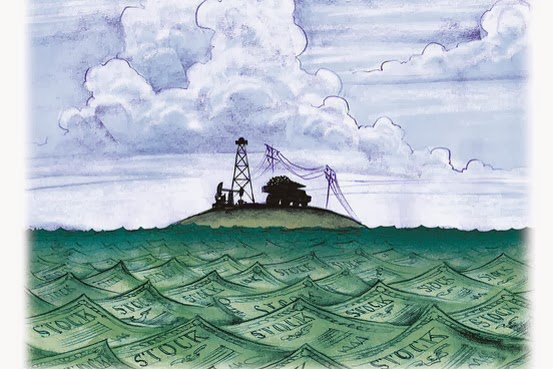
The Coming Carbon Asset Bubble

After the credit crisis and Great Recession, it seemed ridiculous to have thought that investing in subprime mortgages was a good idea. As with most market "bubbles," the risk of giving 7.5 million mortgages to people who couldn't possibly pay them off was somehow invisible to many investors at the time.

One reason such bubbles form is the tendency by many investors to confuse "risk" with "uncertainty." As the economist Frank Knight established, there is a subtle but crucial distinction between the two: Uncertainty is what good investors usually fear the most, because it cannot be measured or priced as risk can be. But when investors mislabel risk as uncertainty, they become vulnerable to the assumption that since it cannot be measured, they might as well ignore it.

That is exactly what is happening with the subprime carbon asset bubble: It is still growing because most market participants are mistakenly treating carbon risk as an uncertainty, and are thus failing to incorporate it in investment analyses. By overlooking a known material-risk factor, investors are exposing their portfolios to an externality that should be integrated into the capital allocation process.

Here is the relevance of carbon to investing: There is consensus within the scientific community that increasing the global temperature by more than 2°C will likely cause devastating and irreversible damage to the planet. Reliable measurements make it clear that we will easily cross this threshold in the near term at our current rate of CO2 emissions. So in an effort to avoid it, the International Energy Agency has calculated a global "Carbon Budget" that accommodates the burning of merely one-third of existing fossil fuel reserves by 2050. Put differently, at least two-thirds of fossil fuel reserves will not be monetized if we are to stay below 2°C of warming—creating "stranded carbon assets."

A stranded asset is one that loses economic value well ahead of its anticipated useful life. Stranded carbon assets include fossil fuels, as well as those assets which, given their dependence on fossil fuels, are also CO2-emissions intensive. Not all carbon-intensive assets are created equal, and it is reasonable to assume that in carbon-constrained scenarios the projects with the highest break-even costs and emissions profile (e.g., tar sands and coal) will be stranded first.

Many investors cite what we believe is a misinformed view that carbon assets will not be vulnerable to stranding until a meaningful carbon price is enforced by a global accord. While a global price on carbon certainly would be important, we believe that investors are mistaken to assume that is the only path to stranding carbon assets. We believe that any such strategy is unwise and increasingly reckless—because of three broad risks:

First is regulation that could strand assets in several ways: direct regulation on carbon led by authorities at the local, national, regional, or global level; indirect regulation through increased pollution controls, constraints on water usage, or policies targeting health concerns; and mandates on renewable energy adoption and efficiency standards. Even the threat of impending regulation creates uncertainty for long-lived carbon-intensive assets.

Second, stranding may occur as a result of market forces. Renewable technologies are already economically competitive with fossil fuels in a number of countries without subsidies. This cost competitiveness, combined with the ability to secure stable long-term prices for power, and an increase in distributed electricity models, could continue to shift capital allocation way from fossil fuels.

Third, sociopolitical pressures (e.g., fossil-fuel divestment campaigns, environmental advocacy, grass-roots protests and changing public opinion) could create an environment in which carbon-intensive businesses could lose their "license to operate," thereby stranding assets.

Delaying action to mitigate climate change will not delay climate change itself. As such, investors can strand fossil-fuel energy assets today, or absorb the cost of inaction by causing a much larger stranding across industries and asset classes in the future. The case to incorporate carbon risk into both equity and debt valuations now is one of short- and long-term prudent risk management. There are four principal ways investors can do this:

First, identify carbon asset risks across portfolios. At a minimum, investors should determine the extent to which carbon risk is embedded in current and future investments. This can be achieved by, for example, considering the key drivers of a company's current and future asset base in the context of carbon risks and developing tools that quantify risks for valuations. Note that passive, index tracking funds should also identify their exposure to carbon risks since they too are vulnerable to stranding as fossil fuel-dependent assets make up roughly 10%-30% of most major exchanges.

Second, engage corporate boards and executives on plans to mitigate and disclose carbon risks. Investors should ask questions like: Do companies have a shadow price on carbon (if not, why not?) and how does it impact their cash position? What is the amount of carbon they plan to burn and how does it relate to their long-term strategic plan? Investors should pressure executive teams to divert cash flow away from capital expenditures on developing fossil fuels and toward more productive uses in the context of a transition to a low carbon economy.

Third, diversify investments into opportunities positioned to succeed in a low-carbon economy. Investors should tilt portfolios away from assets with embedded carbon risks and toward assets with low or no carbon emissions. Investors have the opportunity to capitalize on emerging solutions such as: energy generation (e.g., solar, wind, geothermal); buildings (e.g., insulating materials, lighting, metering); and transport (e.g., engines, electric vehicles, fleet logistics). This hedging strategy will buffer the impact an extreme carbon risk event might have on a portfolio while potentially capturing the upside of the transition away from fossil fuel assets.

Fourth, divest fossil fuel assets. This is certainly the surest way to reduce carbon risk, though we fully recognize that divesting can be complicated and may be difficult for many asset owners. Such a transition could be phased in over several years, and there are gradations; early and easy progress can be made by at least divesting from the most emissions-intensive forms of energy—especially since they are likely to face stranding well ahead of less carbon-intensive fossil fuels.

In the words of President John F. Kennedy, "There are risks and costs to a program of action. But they are far less than the long-range risks and costs of comfortable inaction." The transition to a low carbon future will revolutionize the global economy and present significant opportunities for superior investment returns. However, investors must also acknowledge that carbon risk is real and growing. Inaction is no longer prudent. More


Tuesday, October 22, 2013

Record hot year causes fire emergency in Australia

A state of emergency has been declared in Australia's most populous state and officials are saying that the 63 fires burning in New South Wales (NSW) present the worst fire danger seen in 45 years.

Seventeen of the fires are uncontained, and two, in Springwood and Lithgow, are classed as emergency situations. Three boys, age 11, 14, and 15, are being questioned by police on suspicion of lighting fires.

With temperatures remaining above 30°C and with wind gusts of up to 100 kilometres an hour, conditions favour the fires, and this weather is expected to continue. Firefighters fear a 300 kilometre fire front might join with a separate 60 kilometre fire (see map of current fires).

Ahead of the worsening weather, the NSW Rural Fire Service was conducting last-ditch back-burning operations – lighting small controlled fires in the path of large blazes so that no flammable material remains in the area, and the fire front cannot advance. These efforts were planned to strengthen containment lines at State Mine near Lithgow. Rural Fire Service commissioner, Shane Fitzsimmons, said the operations were risky but considered.

"If it comes off, and works, it's a wonderful firefighting effort," he told a press briefing. "But there is every likelihood investing in a strategy like that, that it will breach, that it will fail – and then you've got a fire that will cross over everything you've just tried to implement."

Primed for ignition

The worst property losses were caused by separate fires closer to Sydney in Springwood and Winmalee. More than 200 houses have been destroyed and at least one person has died so far.

The state of emergency gives authorities the power to force residents to evacuate and the right to demolish buildings that pose a danger, but so far these measures have not been used.

Climate models predict the worst fire weather will be increasingly common in NSW, but the ferocity of the current fires was not caused by particularly bad fire weather, says climate scientist Andy Pitman from the University of New South Wales in Sydney. Instead, it was the result of a very warm winter – the second warmest on record in NSW and part of Australia's warmest 12 months on record– which was probably caused by climate change, according to Pitman.

"Vegetation that would commonly basically shut down in winter continued to transpire," says Pitman. By continuing to give off water, the vegetation dried out the soil so that in spring, the plants had little access to water and became dry. That primed the landscape for fire: "Really hot days combined with strong winds plus ignition equals a major problem," says Pitman. More


Monday, October 7, 2013

24 Hours of Reality: The Cost of Carbon

Updates from The Climate Reality Project - 24 Hours of Reality: The Cost of Carbon

This year’s theme, The Cost of Carbon, explores the reality that we are all paying the price for carbon pollution today: tax dollars diverted for cleaning up damage from super storms; families displaced by flooding and wildfires; lives and livelihoods lost as terrain and weather patterns alter underfoot; food and water scarcity that leads to geopolitical instability. The list goes on and on and the costs go well beyond money. And yet few are reporting on the connection between carbon pollution and its devastating consequences – until now.

During the show, we will travel the world exploring six continents— Africa, Asia, North America, South America, Australia, and Europe — identifying the specific costs we are already paying for carbon pollution. Six hosts, one from each continent, will guide the segments. Along with former Vice President Al Gore and the President and CEO of Climate Reality Maggie L. Fox, our hosts and guests will be a variety of international celebrities, scientists, economists, business leaders, and other experts who will help us explore the diverse impacts that climate change is having around the world and the associated costs.

Continue to tune in for more updates about 24 Hours of Reality and be sure to spread the word about the event and invite your networks to RSVP.


Sunday, September 29, 2013

Thursday, September 12, 2013

A Climate Alarm, Too Muted for Some

This month, the world will get a new report from a United Nations panel about the science of climate change. Scientists will soon meet in Stockholm to put the finishing touches on the document, and behind the scenes, two big fights are brewing.

In one case, we have a lot of mainstream science that says if human society keeps burning fossil fuels with abandon, considerable land ice could melt and the ocean could rise as much as three feet by the year 2100. We have some outlier science that says the problem could be quite a bit worse than that, with a maximum rise exceeding five feet.

The drafters of the report went with the lower numbers, choosing to treat the outlier science as not very credible.

In the second case, we have mainstream science that says if the amount of carbon dioxide in the atmosphere doubles, which is well on its way to happening, the long-term rise in the temperature of the earth will be at least 3.6 degrees Fahrenheit, but more likely above 5 degrees. We have outlier science that says the rise could come in well below 3 degrees.

In this case, the drafters of the report lowered the bottom end in a range of temperatures for how much the earth could warm, treating the outlier science as credible.

Climate change skeptics often disparage these periodic reports from the United Nations, claiming that the panel writing them routinely stretches the boundaries of scientific evidence to make the problem look as dire as possible. So it is interesting to see that in these two important cases, the panel seems to be bending over backward to be scientifically conservative.

Is it right to throw out bleeding-edge science in the one case while keeping it in the other? That is hard to judge for anybody who is not a working climate scientist. After all, we pay them for their expertise, just as we pay doctors to advise us if we are diagnosed with cancer. And we are talking about two distinct issues here, each with its own specialized body of research.

The group making these decisions is the Intergovernmental Panel on Climate Change, a worldwide committee of several hundred scientists knowledgeable in the complex field of climatology. It won the Nobel Peace Prize in 2007, along with Al Gore, for helping to alert the public to the risks that are being run with the unchecked combustion of fossil fuels.

The group’s decisions will not be final until the official report is released on Sept. 27. We know about them only because a secret draft was leaked ahead of the final editing session coming up in Stockholm. Scientists from a few countries have raised objections to the preliminary decisions on sea level and temperature, and they could well change in the final report.

Perhaps they should; there are climate scientists not serving on the committee this year who think so. Their fear is that the intergovernmental panel might be pulling punches.

It turns out that the Nobel Prize, welcome as it might have been back in 2007, served the same function it has for many other scientists who have won it over the years: it painted a fat target on the committee’s back. The group has been subjected to attack in recent years by climate skeptics. The intimidation tactics have included abusive language on blogs, comparisons to the Unabomber, e-mail hacking and even occasional death threats.

Who could blame the panel if it wound up erring on the side of scientific conservatism? Yet most citizens surely want something else from the group: an unvarnished analysis of the risks they face.

To be clear, even if the Intergovernmental Panel on Climate Change ends up sticking with the lowball numbers in these two instances, they are worrisome enough. As best scientists can tell, the question with sea level is not whether it is going to get to three feet and then five feet of increase, but merely whether it will happen in this century or the next.

Likewise, with temperature, the panel is saying only that the lowball numbers are possible, not that they are likely. In fact, the metric used in the scientific literature, the temperature effect of doubled carbon dioxide, is merely a convenient way of comparing studies. Many people make the mistake of thinking that is how much of a global temperature increase will actually occur. More